Swat Valley, Pakistan: Where It Is, Places to Visit and How to Get There
By Imtiyaz Ahmed Shigri, founder of Chogori Adventure, Skardu · Updated November 2026
The Swat Valley is a long, green river valley in Khyber Pakhtunkhwa, in north-west Pakistan. From Mingora, its main town at about 930 m, the road climbs about 95 km up the valley to Kalam at about 1,990 m, where the Swat River begins. Swat is known for its clear river, its pine and deodar forests, its high lakes such as Mahodand, the snow slopes of Malam Jabba and a rich Buddhist heritage from the Gandhara world. Mingora is about 236 km by road from Islamabad and about 165 km from Peshawar, both via the Swat Motorway. The best time for the Buddhist sites is spring or autumn; for Kalam and the lakes it is June to September.

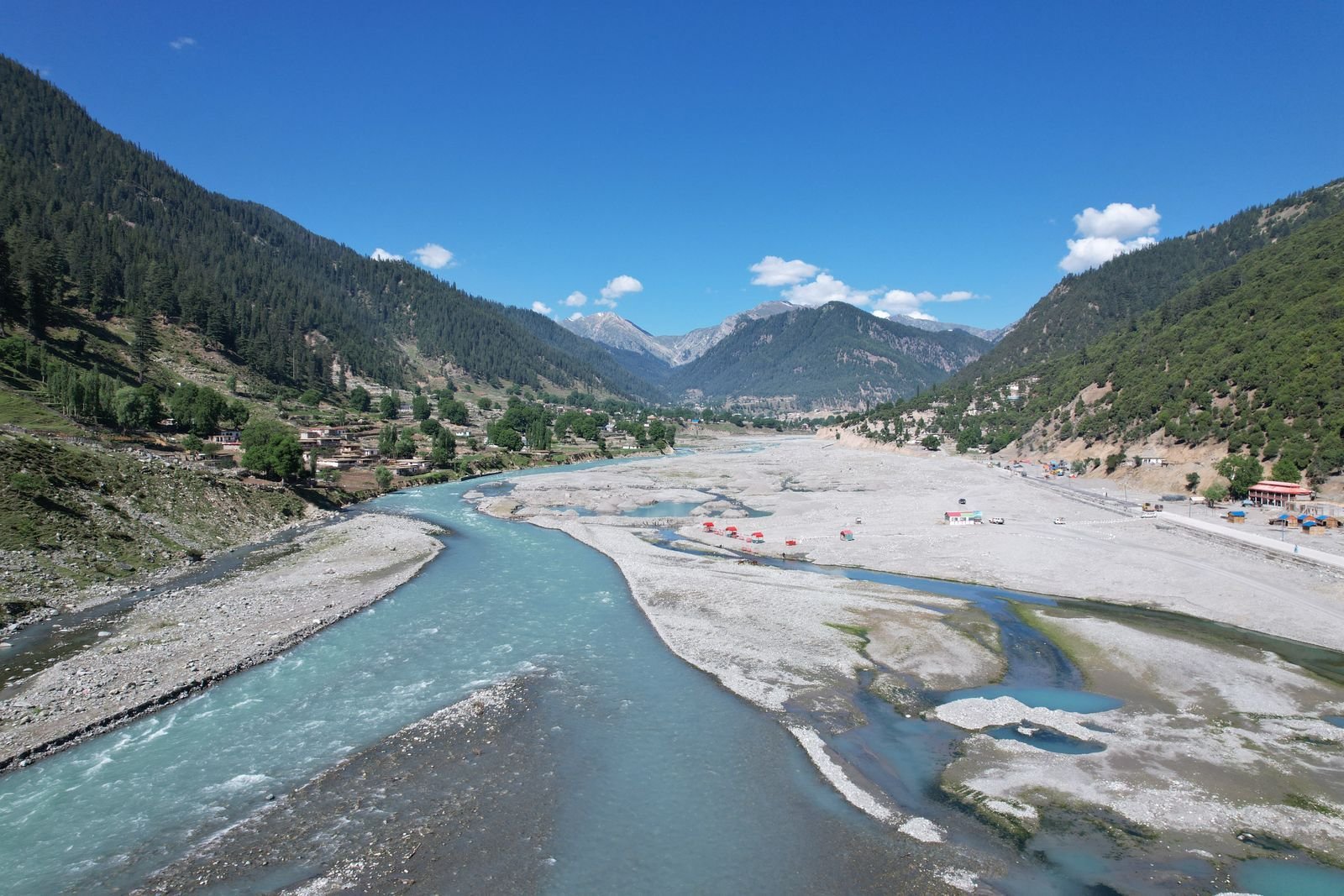
The Swat River braiding across its wide gravel bed between pine-covered mountains near Kalam.
We are a local company, founded in Skardu in 2015, and Swat is part of our cultural and Buddhist tours. This guide answers what our guests ask most: where the Swat Valley is, which places to visit, what the Buddhist sites are, when to go, how to get there and how many days you need. Road distances come from road-routing data and are rounded, and heights come from satellite elevation data and are rounded too.
Swat Valley at a glance
The Swat Valley is a river valley in Malakand Division, Khyber Pakhtunkhwa, rising from about 930 m at Mingora to about 1,990 m at Kalam. Here are the key facts in one table.
| Item | Details |
|---|---|
| Where | Malakand Division, Khyber Pakhtunkhwa, north-west Pakistan |
| Districts | Since January 2026, two districts: Swat, around Mingora and Saidu Sharif, and Bar Swat, the upper valley from Khwazakhela to Kalam |
| River | The Swat River, formed at Kalam where the Ushu and Gabral rivers meet; it joins the Kabul River near Charsadda |
| Main towns, south to north | Barikot, Mingora and Saidu Sharif, Khwazakhela, Madyan, Bahrain, Kalam |
| Heights | Mingora about 930 m; Madyan about 1,370 m; Bahrain about 1,440 m; Kalam about 1,990 m; Mahodand Lake about 2,860 m |
| From Islamabad | About 236 km by road to Mingora, via the M-1 and the Swat Motorway |
| From Peshawar | About 165 km by road to Mingora, via the M-1 and the Swat Motorway |
| Up the valley | Mingora to Kalam about 95 km; Kalam to Mahodand Lake 30 to 40 km by jeep track |
| Known for | Buddhist stupas and rock carvings, the Swat Museum, the White Palace, river and forest scenery, trout, emeralds, skiing at Malam Jabba |
| Best time | March to April and October to November for the cultural sites; June to September for Kalam and the lakes; about December to February for snow |
| Days needed | 2 to 3 days for Mingora and the Buddhist sites; 4 to 5 days with Kalam and Mahodand Lake |
Where is the Swat Valley?
The Swat Valley lies in Khyber Pakhtunkhwa's Malakand Division, in the hills of north-west Pakistan, north of Peshawar and north-west of Islamabad. It follows the Swat River from its source at Kalam south past Bahrain, Madyan and Mingora to Chakdara, where the valley opens out.
Since January 2026 Swat has been two districts. The district of Swat covers the lower valley around Mingora and Saidu Sharif, with Kabal, Charbagh and Barikot. The new district of Bar Swat covers the upper valley from Khwazakhela to Kalam, with its headquarters at Matta. You will still see older maps and signs that show a single Swat district, and many people simply say the lower valley and the upper valley, which is how we describe them in this guide.
The Swat River begins at Kalam, at about 1,990 m, where the Ushu and Gabral rivers meet. From there it runs through narrow gorges to about Madyan, then flows more gently through the wide lower valley past Mingora, at about 930 m, to Chakdara. Below Chakdara it joins the Panjkora River, and it finally flows into the Kabul River near Charsadda, in the Peshawar valley.
To the west, beyond the hills, lies Dir. The Kumrat Valley, which some trips combine with Swat, is in Upper Dir, on the Panjkora River, not in Swat. To the north and east rise high mountain ridges.
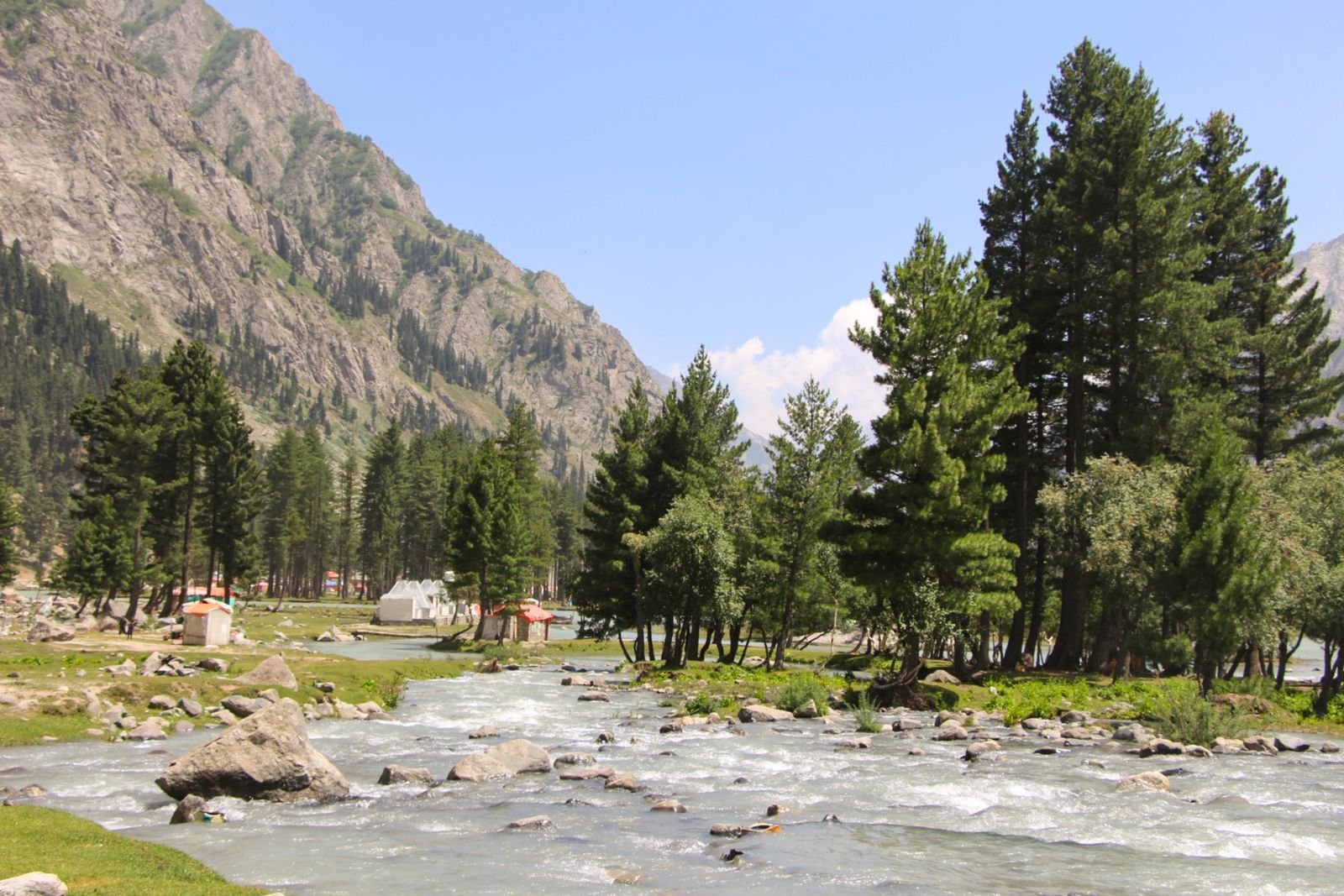
A clear mountain river running over boulders past tall pines below a rocky peak in upper Swat.
Swat Valley map in words
If you trace the valley on a map from south to north, these are the main places in order, with rounded road distances: Chakdara on the river, at about 700 m, where the Swat Motorway ends; Barikot, about 22 km, at about 800 m; Mingora, about 18 km, at about 930 m, with Saidu Sharif just beside it; Khwazakhela, about 25 km, at about 1,150 m; Madyan, about 26 km, at about 1,370 m; Bahrain, about 9 km, at about 1,440 m; and Kalam, about 35 km, at about 1,990 m.
Above Kalam the valley splits. One road runs west up the Gabral (Utror) valley to Utror, about 16 km, at about 2,270 m, and on to Gabral, at about 2,310 m. The other runs north up the Ushu valley through the forest to Matiltan, at about 2,300 m, and on by jeep track to Mahodand Lake, at about 2,860 m, 30 to 40 km from Kalam. Malam Jabba lies on a ridge above Mingora, 35 to 45 km by road from the town.
| Stage | Road distance | What you see |
|---|---|---|
| Islamabad → Chakdara | About 198 km | The M-1 motorway, then the Swat Motorway through the hills to the mouth of the valley |
| Chakdara → Barikot → Mingora | About 40 km | The wide lower valley and the Buddhist sites near Barikot |
| Mingora → Khwazakhela → Madyan | About 51 km | The valley narrows; terraced fields and villages on the slopes |
| Madyan → Bahrain | About 9 km | The river climbing between steep valley sides |
| Bahrain → Kalam | About 35 km | A mountain road up the gorge to the head of the Swat River |
| Kalam → Mahodand Lake | 30 to 40 km | Jeep track through the Ushu forest and Matiltan to the lake |
| Kalam → Utror → Gabral | About 21 km | Side valley with river meadows and forest |
The legs include short detours into town centres, so Islamabad to Kalam adds up to a little over 330 km. It is a long day on mountain roads, and most of our guests break the journey in Mingora.
Places to visit in Swat
The best places to visit in Swat are the Swat Museum and Butkara in Mingora, the stupas and rock carvings near Barikot, Udegram, the White Palace at Marghazar, Malam Jabba, Madyan, Bahrain, Kalam, the Ushu forest and Mahodand Lake. Here they are in order, from the lower valley to the upper valley, with heights rounded from satellite data.
Mingora and Saidu Sharif: the Swat Museum
Mingora, at about 930 m, is the main town and market centre of Swat. Saidu Sharif lies just beside it, at about 960 m. Together they are the base for visiting the Buddhist sites of the lower valley.
The highlight is the Swat Museum in Saidu Sharif. It was created with the help of the Italian Archaeological Mission and opened on 10 November 1963, and a new building, funded through Italian support, opened on 11 December 2014. The museum holds Gandhara sculpture from Butkara, Panr, Saidu Sharif, Udegram and other sites in the valley. We suggest visiting it before the sites themselves, so the stupas make more sense when you stand in front of them.
Butkara I, Shingardar, the Jahanabad Buddha and Amluk-Dara
Butkara I lies in Mingora itself. It is a Buddhist sacred area excavated by Domenico Faccenna of the Italian mission between 1956 and 1962. Its origins go back to the Mauryan period, from the 3rd or 2nd century BC. It is the site where the mission's long work in Swat began.
Shingardar is a stupa beside the road near Ghaligai, between Barikot and Saidu Sharif. The heritage record dates the stupa and its monastery to between the 1st and 5th centuries AD. Local tradition, recorded by the pilgrim Xuanzang, links it to a King Uttarasena and relics of the Buddha; this is a legend rather than a fact, but it gives the site its story.
The Jahanabad Buddha is a great seated Buddha carved into the rock in the 7th century AD. It is one of the largest Buddhist rock sculptures in South Asia. The Italian Archaeological Mission restored it in five campaigns between 2012 and 2016, and in November 2016 the face was completed using 3-D technology.
Amluk-Dara is a stupa near Nawagai, in the Barikot area. Aurel Stein first recorded it in 1926, and the Italian mission studied it in the 1960s and 1970s. It was founded around the 3rd century AD and stayed in use until the 10th or 11th century, and it faces Mount Ilam. A larger complex around it was uncovered in 2012, and the site is protected under the Khyber Pakhtunkhwa Antiquities Act of 2016.
Udegram: Raja Gira's castle and the Ghaznavid mosque
Udegram lies in the lower valley, near Mingora. On the hill above the village stand the ruins of Raja Gira's castle, linked to the Hindu Shahi period and excavated by the Italian mission in the late 1950s. Scholars identify Udegram with Ora, one of the towns Alexander the Great took in 327 BC.
On the same hill stands a Ghaznavid mosque, built in 440 AH, or 1048 to 1049 AD, according to an Arabic inscription found in 1984. The Italian mission excavated it from 1985 and restored it from 2011. It is one of the oldest mosques in the region.
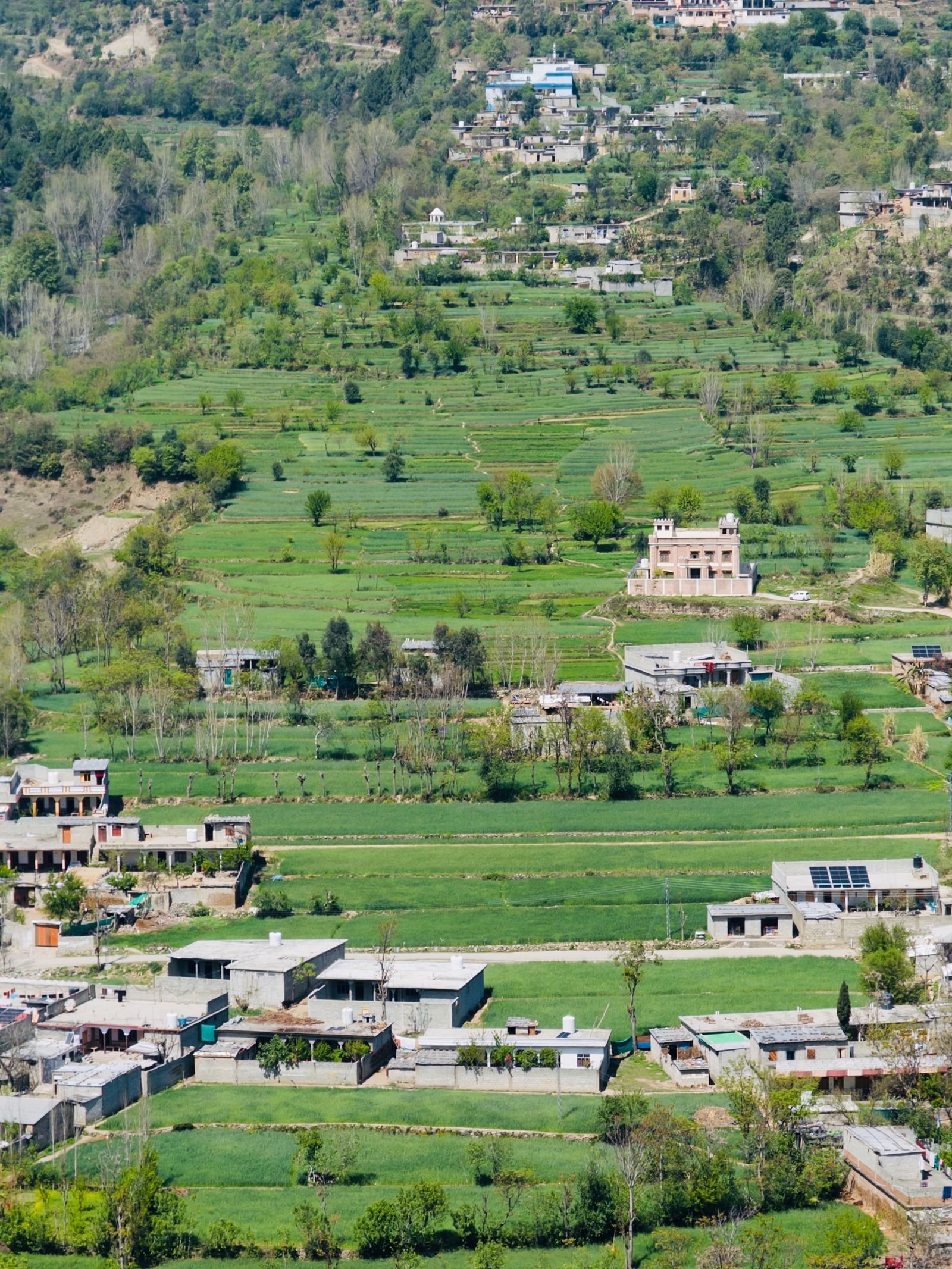
Green terraced fields and village houses on a hillside in the Swat Valley.
Marghazar and the White Palace
Marghazar is a side valley a short drive south of Saidu Sharif, below Ram Takht. Its best-known building is the White Palace, the summer house built by Miangul Abdul Wadud, the first Wali of Swat, around 1940. It is said to be built of white marble.
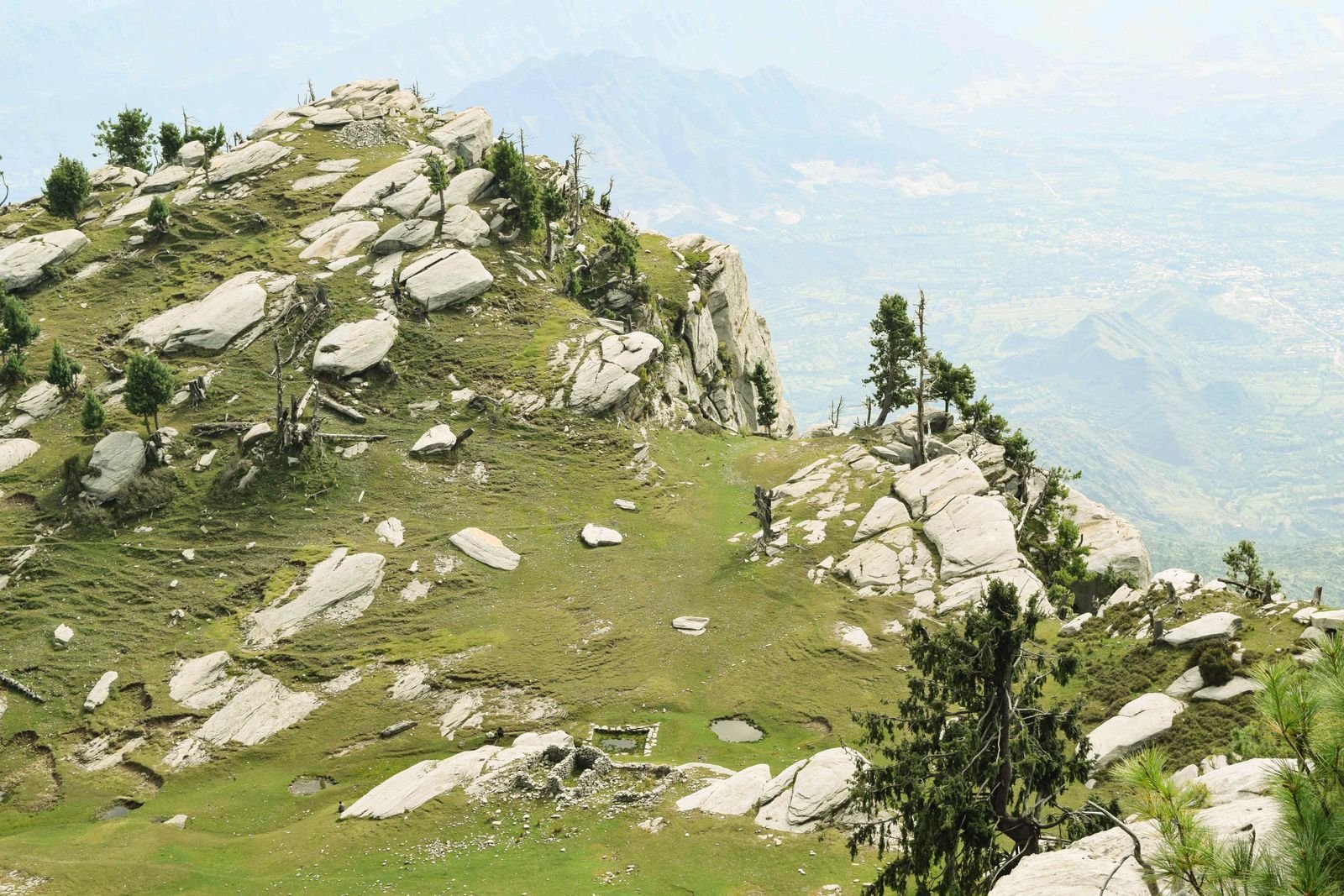
A grassy ridge with white boulders and pines on Ram Takht above Marghazar, with the valley hazy below.
Malam Jabba
Malam Jabba lies high above the valley, 35 to 45 km by road from Mingora. It has Pakistan's best-known ski slope, served by a single chairlift at roughly 2,500 to 2,700 m. Skiing depends on snow, which usually falls from about December to February. Our winter treks guide has more ideas for the snow season.
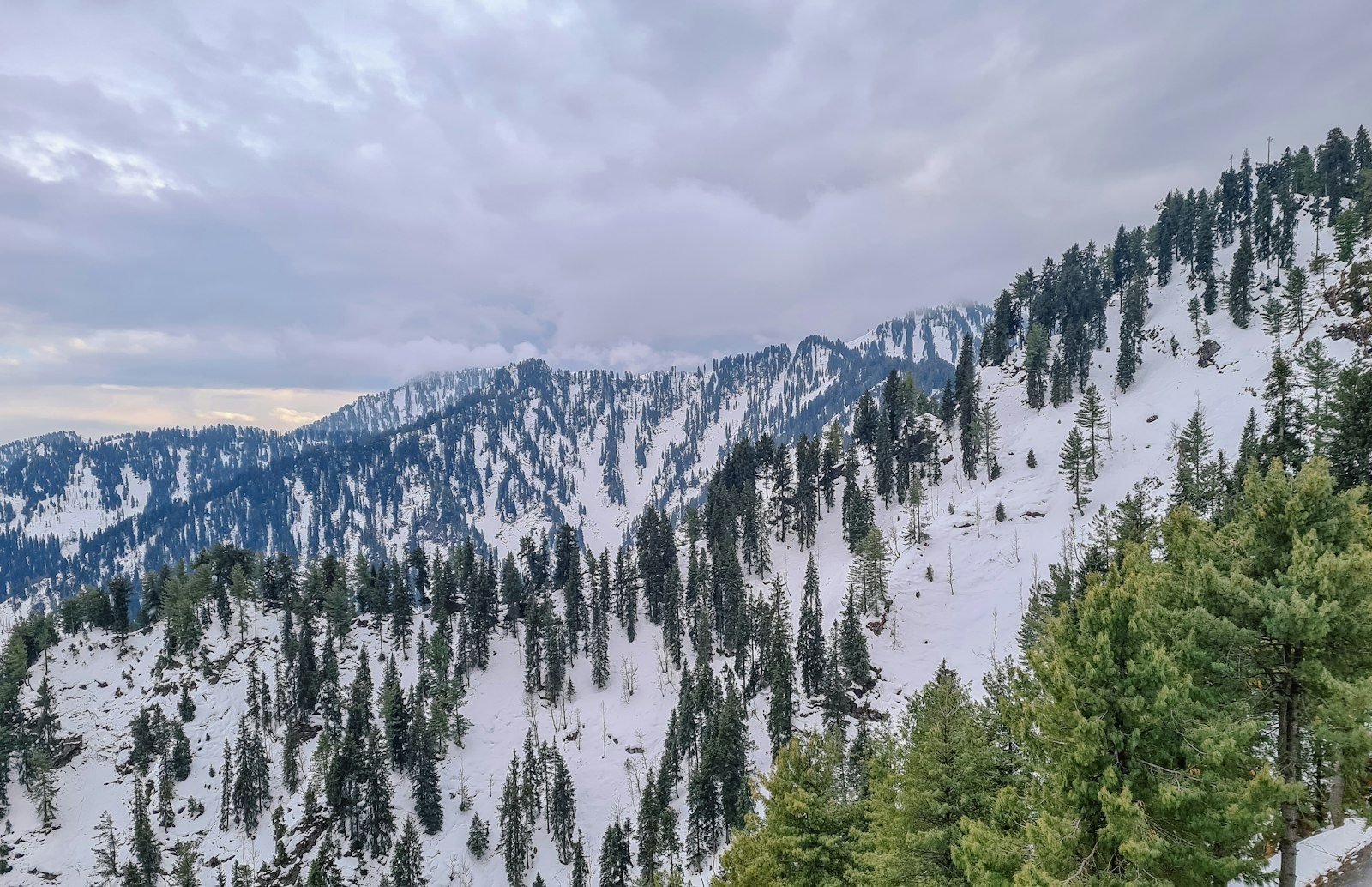
Snow-covered slopes and pine forest at Malam Jabba under a cloudy winter sky.
Madyan
Madyan, at about 1,370 m and about 51 km north of Mingora, is where the valley turns from wide and gentle to narrow and steep. The river runs fast beside the town, and the air is noticeably cooler than in Mingora. Madyan is known for its trout, and it makes a quiet first night in the upper valley, with small hotels and guest houses.
Bahrain
Bahrain, at about 1,440 m and only about 9 km beyond Madyan, is another place to try Swat River trout, a local speciality. It is a lively stop on the way to Kalam, and the start of the mountain road up the gorge.
Kalam and the Ushu forest
Kalam, at about 1,990 m and about 95 km by road from Mingora, is the main town of the upper valley and the base for its lakes and forests. Here the Ushu and Gabral rivers meet to form the Swat River, and the town spreads along the turquoise water between high, forested mountains.
North of Kalam, the road up the Ushu valley runs through the Ushu forest, a dense forest of deodar and pine on the way to Matiltan. It is one of the most beautiful parts of the upper valley.
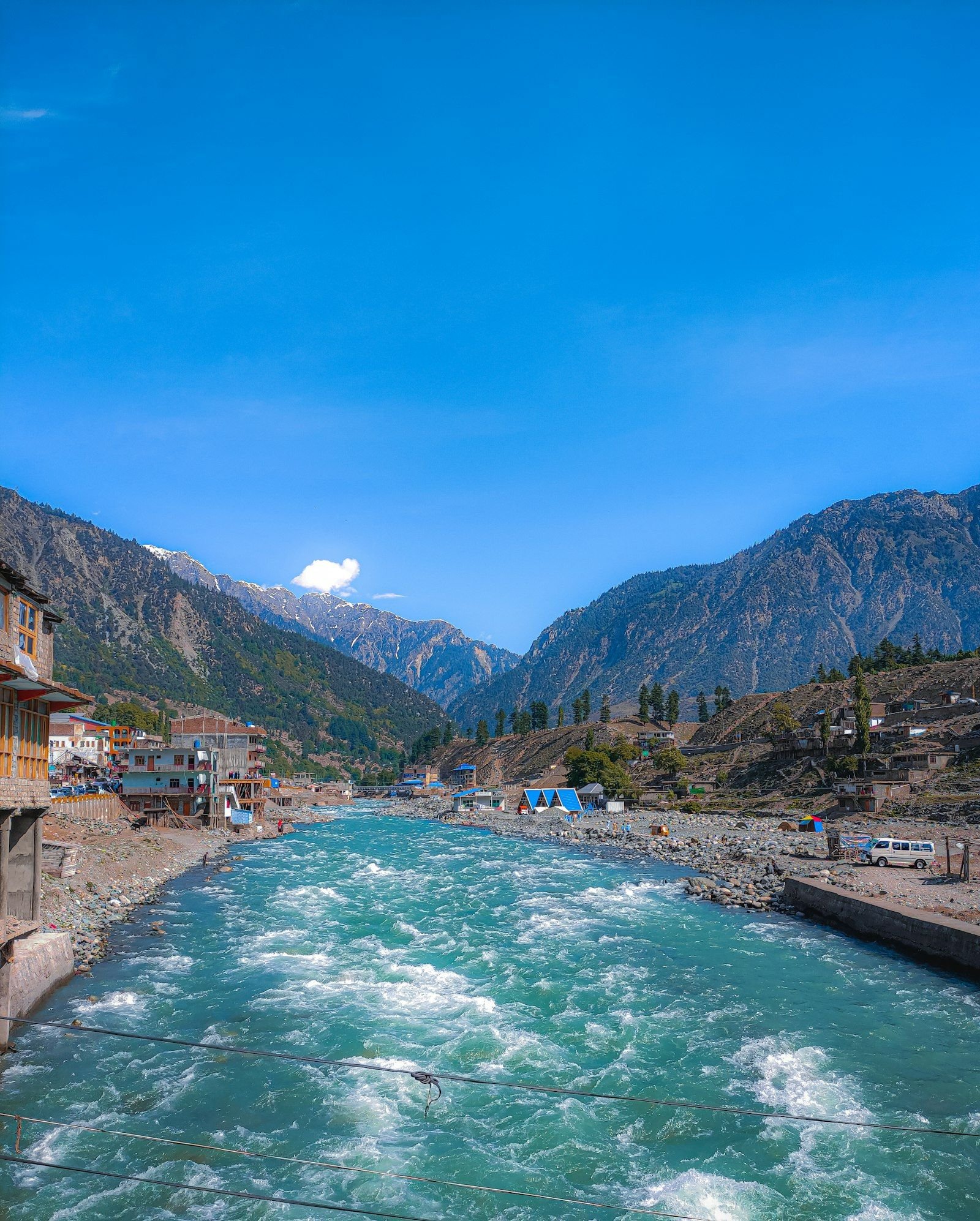
The turquoise Swat River rushing through Kalam between buildings and high mountains.
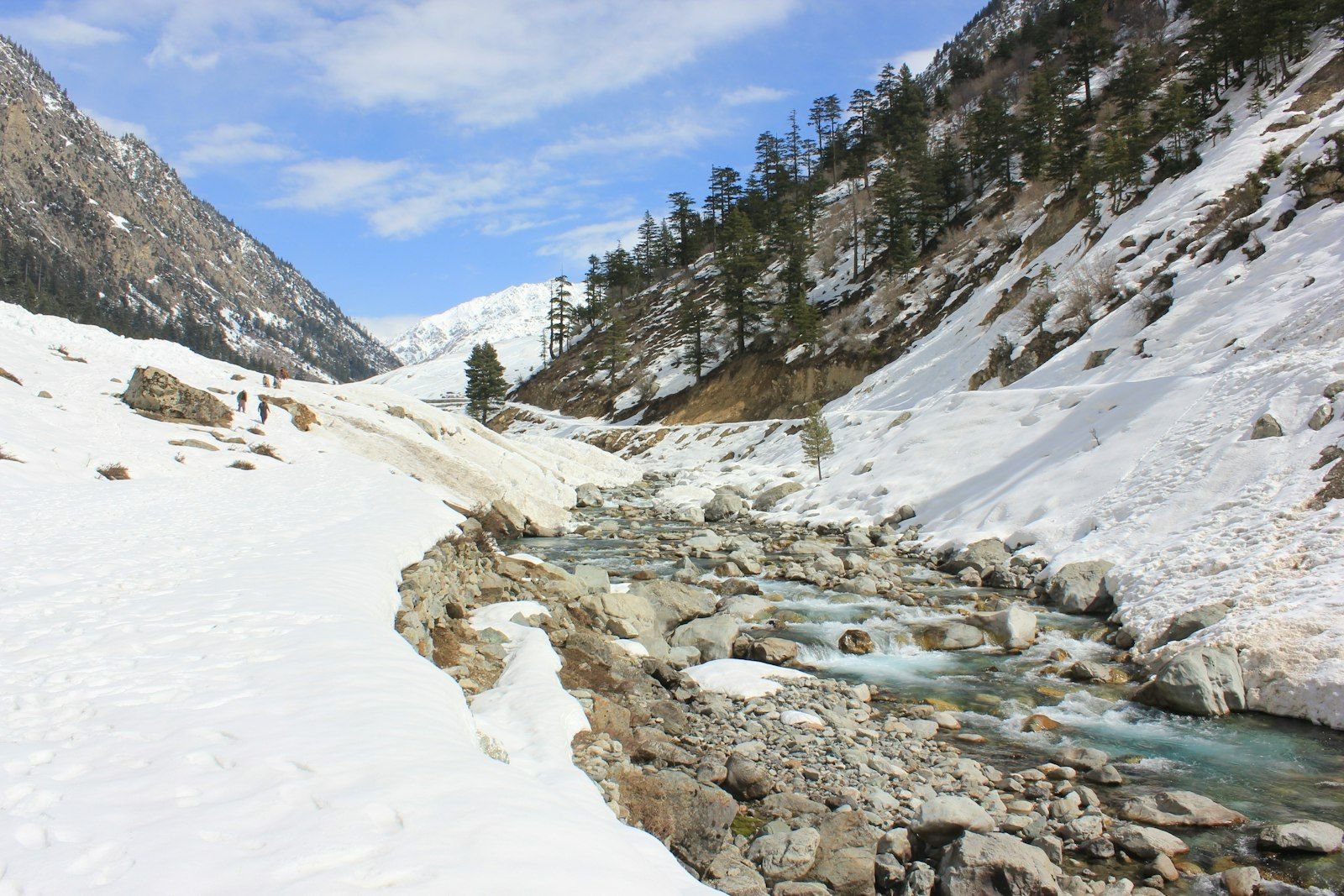
A stream between deep snowbanks in a pine-lined valley at Matiltan, above Kalam.
Mahodand Lake
Mahodand Lake, at about 2,860 m, lies 30 to 40 km above Kalam at the head of the Ushu and Matiltan valley. The last part is a jeep track, so you travel in a local four-wheel-drive. The lake sits in a wide meadow below granite peaks and is known for its trout. Snow closes the track in winter, and the usual season is June to September.
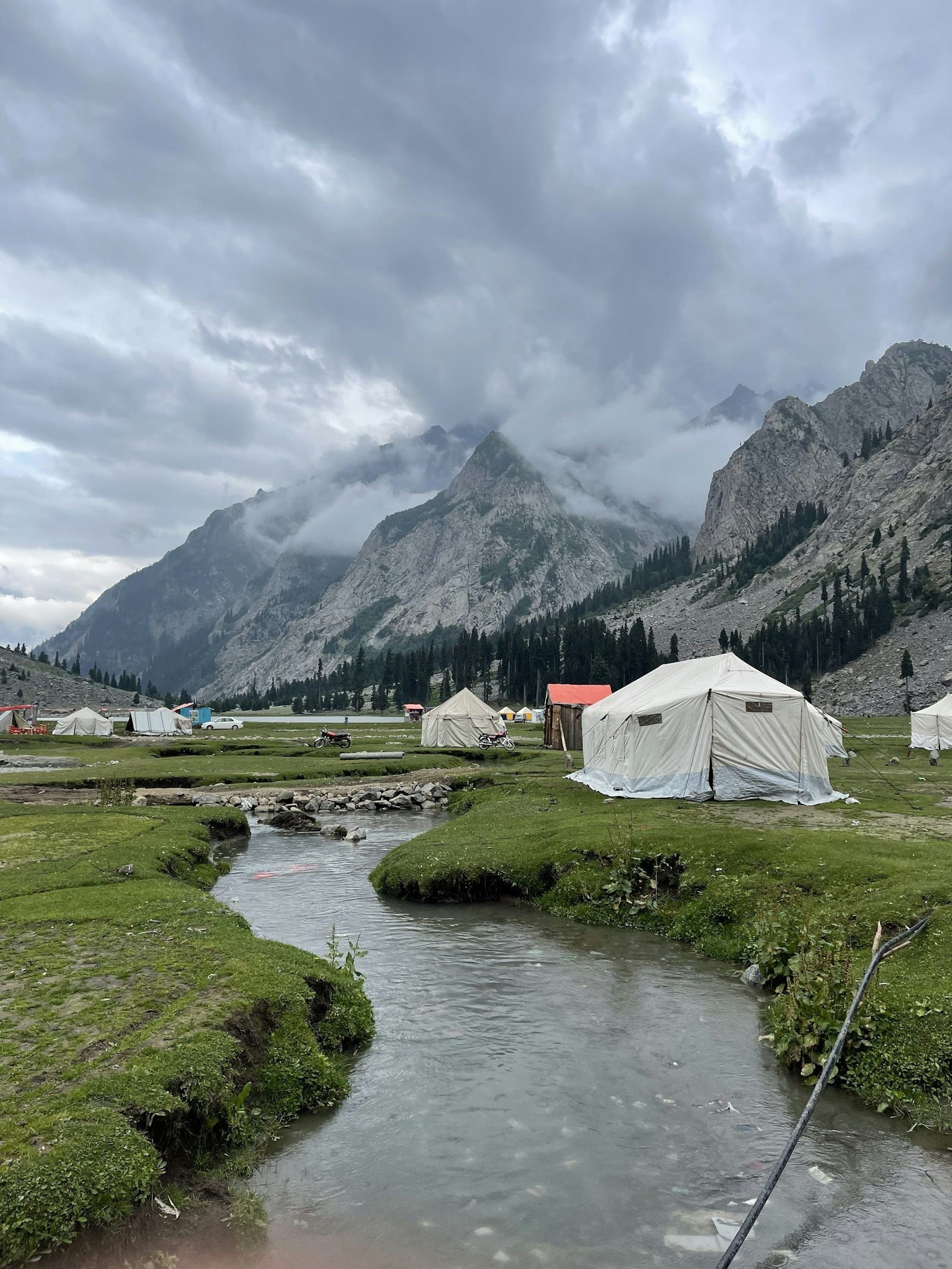
Tents beside a meadow stream at Mahodand, with cloud-wrapped granite peaks behind.
Utror, Gabral and Gabin Jabba
West of Kalam, a side road follows the Gabral (Utror) valley to Utror, about 16 km away at about 2,270 m, and then Gabral, at about 2,310 m. The river winds through a wide, forested valley. Near Matta, lower down the main valley, Gabin Jabba is a high meadow often described as the gateway to the Daral and Saidgai lakes.
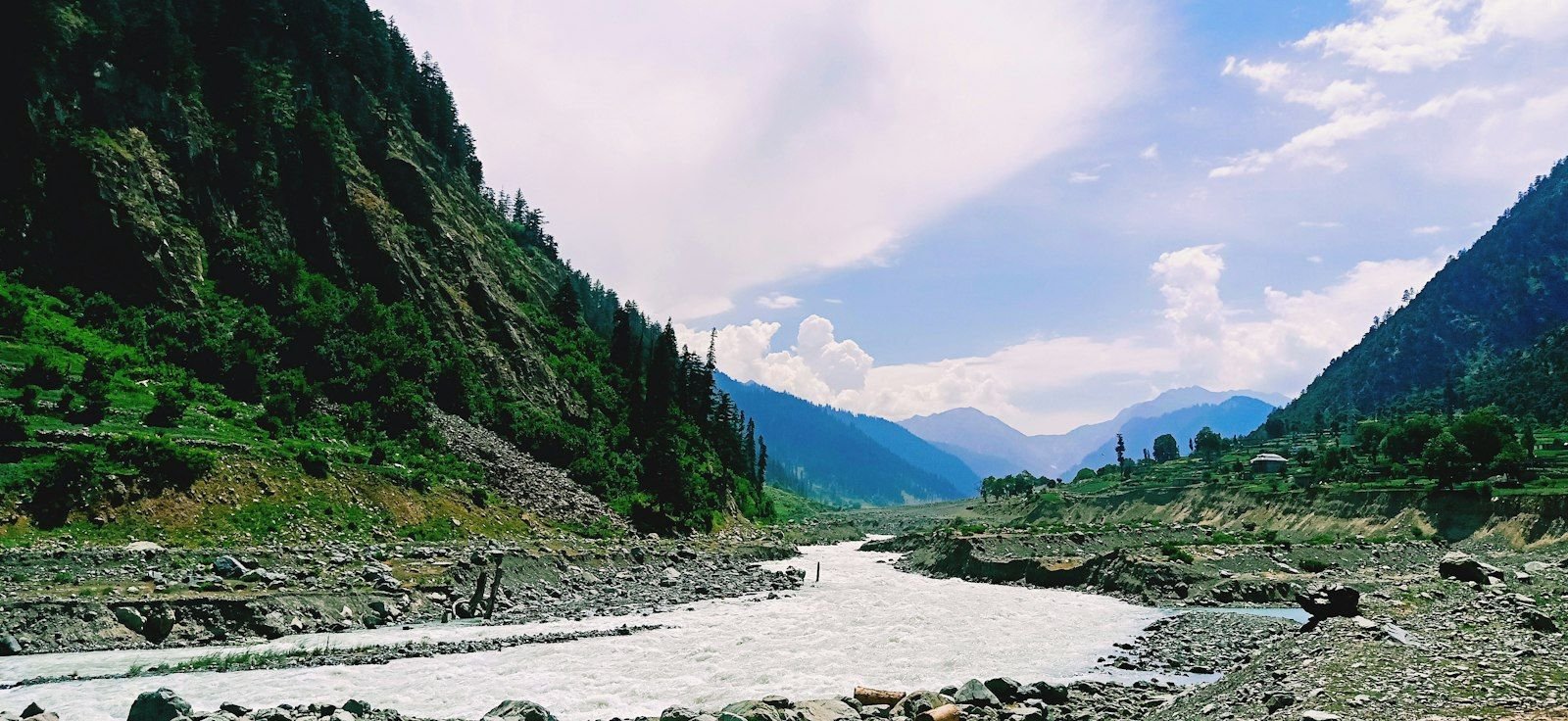
A wide river winding through a forested valley on the road from Kalam to Utror.
The Buddhist heritage of Swat
Swat is the Uddiyana of early Buddhist texts, and its stupas, monasteries and rock carvings belong to the wider Gandhara world. Chinese pilgrims such as Faxian and Xuanzang came here between the 5th and 7th centuries AD.
Faxian, in the early 5th century, found Buddhism flourishing in the valley. Xuanzang, around 630 AD, described many monasteries, though by then most of them were largely deserted. Their accounts help scholars link ruins in the valley with the places the pilgrims described.
Modern research in Swat owes much to the Italian Archaeological Mission in Pakistan. Giuseppe Tucci made the first short survey in November 1955, and permanent work, beginning with the excavation of Butkara I, started in 1956. Domenico Faccenna led the mission for many years, and Luca M. Olivieri directs it today. The mission has excavated, studied and restored many of the sites in this guide, and many of its finds are on display in the Swat Museum.
For a visitor, the Buddhist sites fall into three groups. In Mingora there are Butkara I and the museum. Near Barikot, at the south end of the valley, there are Shingardar, Amluk-Dara and the hill of Barikot itself. And at Jahanabad there is the great seated Buddha carved into the rock. With a good guide, you can see the main ones in two days.
These are sacred places for Buddhists from many countries, and we treat them with respect. Walk around a stupa clockwise, as pilgrims do, do not climb on the ruins or carvings, and ask before you photograph anyone at prayer. Our Buddhist Pilgrimage Tour Pakistan links the stupas of Swat with Taxila, Takht-i-Bahi and the Peshawar Museum.
| Site | Where | Age (as dated by scholars) |
|---|---|---|
| Butkara I | Mingora | From the 3rd or 2nd century BC (Mauryan period) |
| Shingardar stupa | Near Ghaligai, between Barikot and Saidu Sharif | 1st to 5th century AD |
| Amluk-Dara stupa | Near Nawagai, Barikot area | Founded around the 3rd century AD; in use to the 10th or 11th century |
| Jahanabad seated Buddha | Jahanabad | 7th century AD; restored 2012 to 2016 |
| Swat Museum | Saidu Sharif | Opened 1963; new building 2014 |
Swat history in brief
Swat has a long history: it was a Buddhist centre, the scene of Alexander the Great's campaign of 327 BC, a Hindu Shahi and Ghaznavid land, and from 1926 to 1969 a princely state under its Walis. Here is the story in a few steps.
Alexander the Great. In 327 BC Alexander marched through this region. Scholars, from Aurel Stein in 1929 and Giuseppe Tucci in 1955 to the Italian mission today, identify Barikot with Bazira and Udegram with Ora, two towns his army took. Excavations at Barikot since 1977 show that the town existed before Alexander arrived.
Buddhist Uddiyana. For centuries afterwards Swat was a centre of Buddhism, as the stupas, monasteries and rock carvings of the valley show. The pilgrims Faxian and Xuanzang left accounts of it in the 5th and 7th centuries AD.
Hindu Shahi and Ghaznavid Swat. Raja Gira's castle above Udegram is linked to the Hindu Shahi period. On the same hill, a mosque dated 1048 to 1049 comes from the Ghaznavid period and is one of the oldest mosques in the region.
The Yusufzai and the Swat state. Later, Swat became the land of the Yusufzai Pashtuns. In the early 20th century a Yusufzai state took shape here, and in 1926 the British recognised Miangul Abdul Wadud as Wali, or ruler, of Swat. The state acceded to Pakistan in November 1947. The second and last Wali, Miangul Jahanzeb, ruled from 1949 until 28 July 1969, when the state was merged into Pakistan. The first Wali built the White Palace at Marghazar around 1940. The standard history of this period is Sultan-i-Rome's study of the Swat state.
Best time to visit Swat
The best time to visit Swat depends on where you go: March to April and October to November for the Buddhist sites around Mingora, June to September for Kalam and Mahodand Lake, and about December to February for snow at Malam Jabba. Here is how the year works out.
Spring, March to April. The lower valley around Mingora and Barikot is green and pleasant, and this is one of the two most comfortable times for the stupas and the museum. Kalam is still cold, and the high valleys above it still hold snow.
Early summer, May to June. The lower valley grows hot, with June afternoons roughly in the mid-30s °C, so plan the Buddhist sites for early morning. Up the valley, Kalam is cool and fresh, and the jeep track to Mahodand usually opens from late spring, once the snow has gone.
High summer, July to August. This is the main season for Kalam, the Ushu forest, Utror and Mahodand Lake.
September. A fine month for the upper valley, while the lake track is usually still open.
Autumn, October to November. The lower valley is comfortable again, which makes this the second good season for the cultural sites. Up high, the first snow can close the Mahodand track, and nights in Kalam turn cold.
Winter, December to February. Mingora is mild in winter, so the Buddhist sites can be visited, and our cultural tours of Swat have winter dates. Kalam is snowbound for much of the season, and snow can block the road from Bahrain for a day or more until it is cleared. Malam Jabba usually has snow for skiing from about December to February.
Swat Valley weather
Swat Valley weather changes a lot with height: the lower valley around Mingora is mild in winter and hot in early summer, while Kalam, about 1,000 m higher, is cool in summer and snowbound for much of winter. Plan your clothes for the highest place you will visit, not for Mingora.
There are no official long-term climate averages for the valley that we can point you to, so we describe the seasons in words rather than in a table. The pattern is simple. In the lower valley, winter days are mild and nights are cold. Spring is fresh, early summer is hot, and the monsoon months can bring heavy showers. In the upper valley, around Kalam, summers are cool, with fresh nights, and winters bring deep snow.
Rain falls in two main spells: in spring, and again in the monsoon months of July and August. Mountain roads are slower after heavy rain, so leave some spare time in any plan for the upper valley.
- Lower valley (Mingora, Saidu Sharif, Barikot): mild winters, hot early summer, comfortable spring and autumn.
- Middle valley (Madyan, Bahrain): cooler than Mingora all year, pleasant in summer.
- Upper valley (Kalam, Utror, Matiltan): cool summers, cold nights, heavy winter snow.
- High places (Mahodand Lake, Malam Jabba): cold even in summer evenings; snow in winter.
What to pack: light clothes and a sun hat for the lower valley in summer, a warm fleece and a rain jacket for Kalam at any time of year, and full winter clothing if you visit Malam Jabba or Kalam between December and February.
How to get to Swat
Most travellers reach Swat by road: Mingora is about 236 km from Islamabad and about 165 km from Peshawar, both via the M-1 motorway and the Swat Motorway. From Mingora the road runs on up the valley to Kalam, about 95 km further.
The Swat Motorway, also called the M-16, is an 81 km, four-lane road from the Karnal Sher Khan interchange on the M-1 to Chakdara, where the Swat Valley begins. It opened to traffic in June 2019. From Chakdara the road continues about 40 km through Barikot to Mingora.
From Islamabad, the route follows the M-1 towards Peshawar, then turns north onto the Swat Motorway. From Peshawar, the route follows the M-1 east for a short way before joining the same motorway. Either way, the slower driving begins in the valley itself.
Above Mingora the road runs through Khwazakhela, Madyan and Bahrain to Kalam. Between Bahrain and Kalam it is a mountain road up a gorge, and in winter snow can block it for a day or more. Beyond Kalam, the way to Mahodand Lake is a jeep track, open only in the warmer months. It is a long day on mountain roads from Islamabad to Kalam, so we usually stop for a night in Mingora on the way.
Saidu Sharif has a small airport, about 5 km north of Mingora, but it has no regular scheduled flights at present. Plan your trip by road.
The road to Chitral and the Kalash valleys also leaves the Swat Motorway at Chakdara and heads north through Dir, so Swat combines well with a trip there. Our Kalash guide explains that route.
How many days do you need in Swat?
Plan 2 to 3 days for Mingora and the Buddhist sites, and 4 to 5 days if you also want to see Kalam, the Ushu forest and Mahodand Lake. Here are two sample plans from Islamabad, and a winter add-on.
2 to 3 days: Mingora and the Buddhist sites. Day 1: drive from Islamabad or Peshawar to Mingora, stopping at Shingardar and Amluk-Dara near Barikot and at Udegram on the way. Day 2: the Swat Museum, Butkara I and the Jahanabad Buddha, with an afternoon at Marghazar and the White Palace. Day 3: return, or carry on up the valley. This plan works all year, and best in spring, autumn and winter.
4 to 5 days: the whole valley. Day 1: to Mingora, with the Barikot sites. Day 2: the museum and Butkara, then on up the valley through Madyan and Bahrain to Kalam. Day 3: by jeep through the Ushu forest and Matiltan to Mahodand Lake and back. Day 4: Utror and Gabral, or a slow morning in Kalam, then down to Mingora. Day 5: return to Islamabad. This plan works best from June to September.
Winter add-on: Malam Jabba. From about December to February, add a day at Malam Jabba for the snow, using Mingora as your base.
Swat also fits into a longer journey. Our Pakistan Cultural Tour includes Swat together with Lahore, Multan, Peshawar and Taxila, and our 7-Day Pakistan Cultural Trip covers Lahore, Peshawar, Swat and Taxila in a week.
Where to stay in Swat
Stay in Mingora or Saidu Sharif for the Buddhist sites, and in Madyan, Bahrain or Kalam for the upper valley. Each has a different feel.
- Mingora and Saidu Sharif: hotels of every level, close to the museum, Butkara and the bazaar. The best base for the cultural sites and for Malam Jabba.
- Madyan: smaller hotels and guest houses by the river, quieter than Mingora and cooler in summer.
- Bahrain: smaller hotels and guest houses, handy for the road up to Kalam.
- Kalam: the base for Mahodand Lake, the Ushu forest and Utror, with hotels and guest houses along the river.
- Malam Jabba: there is a hotel near the ski slope, or you can stay in Mingora and go up for the day.
On our tours we choose and book the hotels for you, so you can simply enjoy the valley.
What is Swat famous for?
Swat is famous for its green river valley and forests, its Buddhist heritage, the White Palace, skiing at Malam Jabba, Swat River trout and Swat emeralds. Here is a little more on the local specialities.
Trout. Trout from the Swat River and its farms is a local speciality, served fresh at Madyan, Bahrain and Kalam. Trout farms line parts of the upper valley. If you want to fish the river yourself, a fishing licence is needed.
Emeralds. Emeralds have been mined on a hill above Mingora since 1958, and Swat stones are among the best known from Pakistan. If you buy gems, buy from a dealer you trust and ask for a receipt.
Forests and rivers. The deodar and pine forests of the upper valley, the turquoise river at Kalam and the lakes above it draw visitors from across Pakistan every summer.
Buddhist art. The Gandhara sculpture in the Swat Museum, and the stupas and rock carvings in the valley, draw many foreign visitors to Swat.
Travel tips for Swat
Register your trip online if you are a foreign visitor, dress modestly, carry cash, and leave spare time in winter for the road above Bahrain. Here are our main tips.
- Visa: most visitors apply online through the Pakistan Online Visa System. Our Pakistan visa guide explains the steps.
- Registration: foreign visitors on a tourist visa can register their trip online with the Khyber Pakhtunkhwa Culture and Tourism Authority through its portal or the KP Tourism app. You can start on the Khyber Pakhtunkhwa tourism portal. We handle this for our guests.
- Dress and etiquette: Swat is a conservative, mostly Pashtun region. Men should wear long trousers; women should cover their arms and legs, and may want a scarf for villages and mosques. Remove your shoes before entering a mosque.
- Photos: ask before you photograph people, especially women. At the Buddhist sites, do not climb on the stupas or carvings.
- Cash: carry enough Pakistani rupees before you head up the valley. Mingora, as the main town, is the place to sort out money.
- Winter roads: snow can block the road between Bahrain and Kalam for a day or more, and the track to Mahodand Lake stays shut until late spring. Build a spare day into any winter plan for the upper valley.
- Food: try the river trout, and be ready for generous Pashtun hospitality.
Our Pakistan travel guide covers money, transport and customs for the whole country.
Visit Swat with us
We run Swat as part of our cultural and Buddhist tours, with local licensed guides and groups of at most 12. These are the trips that include Swat, with their starting prices.
| Trip | Length | From | Highlights |
|---|---|---|---|
| Pakistan Cultural Tour: Lahore, Multan, Peshawar, Swat and Taxila | 10 days | USD 1,400 | Lahore, Multan, Peshawar, Swat and Taxila; winter dates |
| 7-Day Pakistan Cultural Trip: Lahore, Peshawar, Swat and Taxila | 7 days | USD 1,000 | Lahore, Peshawar, Swat and Taxila; group date in January |
| Buddhist Pilgrimage Tour Pakistan | 7 days | USD 1,500 | Taxila, Bhamala, the Peshawar Museum, Shahbaz Garhi, Takht-i-Bahi and the stupas of Swat; January and March |
| Peshawar City Tour | 2 days | USD 300 per person | Private tour of Peshawar, easy to combine with Swat |
If you are heading for Chitral, our Kalash Valley Tour also travels the Swat Motorway to Chakdara. And if you start in Lahore, our Lahore City Tour is a good first stop before the drive north.
Chogori Adventure was founded in Skardu in 2015, and since then we have looked after more than 3,000 customers on more than 500 trips. Would you like a private trip, more time in Kalam or a winter visit to the Buddhist sites? Contact us and tell us when you would like to travel. We have offices in Skardu and Islamabad, and we will plan the journey with you.
Frequently asked questions
Where is the Swat Valley?
The Swat Valley is in Malakand Division, Khyber Pakhtunkhwa, in north-west Pakistan. It follows the Swat River from Kalam, at about 1,990 m, south past Bahrain, Madyan and Mingora to Chakdara. Since January 2026 it has been two districts: Swat, around Mingora and Saidu Sharif, and Bar Swat, the upper valley from Khwazakhela to Kalam.
How far is Swat from Islamabad?
Mingora, the main town of Swat, is about 236 km from Islamabad by road, via the M-1 motorway and the Swat Motorway to Chakdara. From Peshawar it is about 165 km on the same motorways. Kalam is a further 95 km up the valley, so it is a long day on mountain roads from Islamabad to Kalam.
What is the best time to visit Swat?
It depends on where you go. March to April and October to November are the most comfortable months for the Buddhist sites and the museum around Mingora. June to September is best for Kalam, the Ushu forest and Mahodand Lake. For snow at Malam Jabba, come from about December to February, when skiing depends on snowfall.
Which is better, Kalam or Mingora?
They suit different trips. Mingora, at about 930 m, is the base for the Swat Museum, Butkara and the other Buddhist sites, and works all year. Kalam, at about 1,990 m and 95 km further up the valley, is the base for forests, rivers and Mahodand Lake, and is best from June to September. Many travellers see both.
How do you get to Mahodand Lake?
Mahodand Lake, at about 2,860 m, lies 30 to 40 km above Kalam at the head of the Ushu valley. You drive through the Ushu forest and Matiltan, and the last part is a jeep track, so you travel in a local four-wheel-drive. The track is usually open from June to September and is closed by snow in winter.
When is the ski season at Malam Jabba?
Malam Jabba usually has snow for skiing from about December to February, but there is no fixed official season, and skiing depends on how much snow falls each year. The resort has a single chairlift at roughly 2,500 to 2,700 m, 35 to 45 km by road from Mingora. Check the snow before you plan a ski day.
What are the main Buddhist sites in Swat?
The main ones are Butkara I in Mingora, from the 3rd or 2nd century BC; the Shingardar stupa near Barikot; the Amluk-Dara stupa below Mount Ilam; and the great 7th-century seated Buddha carved into the rock at Jahanabad. The Swat Museum in Saidu Sharif holds Gandhara sculpture from these and other sites in the valley.
How many days do you need in Swat?
Plan 2 to 3 days to see Mingora, the Swat Museum and the Buddhist sites, with an afternoon at Marghazar. Allow 4 to 5 days if you also want Kalam, the Ushu forest and Mahodand Lake. In winter, add a day at Malam Jabba for the snow. Our cultural tours fit Swat into a week or ten days.
Is there an airport in Swat?
Yes, Saidu Sharif has a small airport, about 5 km north of Mingora, but it has no regular scheduled flights at present. Most travellers reach Swat by road from Islamabad or Peshawar via the Swat Motorway, which ends at Chakdara at the mouth of the valley. Plan your journey by road rather than by air.
Do foreigners need to register to visit Swat?
Foreign visitors on a tourist visa can register their trip online with the Khyber Pakhtunkhwa Culture and Tourism Authority, through its portal or the KP Tourism app. When you travel with us, we handle the registration for you, together with the hotels, transport and guides for the whole trip.
What is Swat famous for?
Swat is famous for its green river valley, pine and deodar forests and high lakes such as Mahodand. It is also known for its Buddhist heritage, as the Uddiyana of early texts, for the White Palace at Marghazar, skiing at Malam Jabba, trout from the Swat River and emeralds mined above Mingora since 1958.
What is the weather like in the Swat Valley?
It changes with height. The lower valley around Mingora, at about 930 m, is mild in winter and hot in early summer. Kalam, at about 1,990 m, is cool in summer and snowbound for much of winter, and snow can block the road from Bahrain for a day or more. Bring a warm layer for the upper valley in any season.
About the author
Imtiyaz Ahmed Shigri founded Chogori Adventure in Skardu in 2015. Our guides are local, government-licensed and English-speaking, and most of them are trained in first aid. We are licensed by the Department of Tourist Services (licence no. 2494) and the Gilgit-Baltistan tourism department (licence DTS-GB-055), and we are a member of the Pakistan Association of Tour Operators, with offices in Skardu and Islamabad.
Rated 4.9 out of 5 from 47 reviews on Google (November 2026). Read our reviews on Google