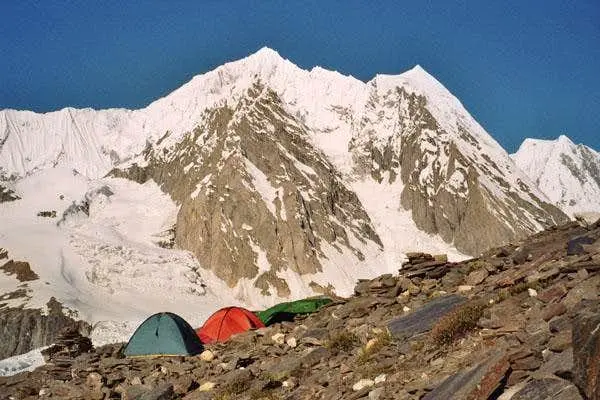
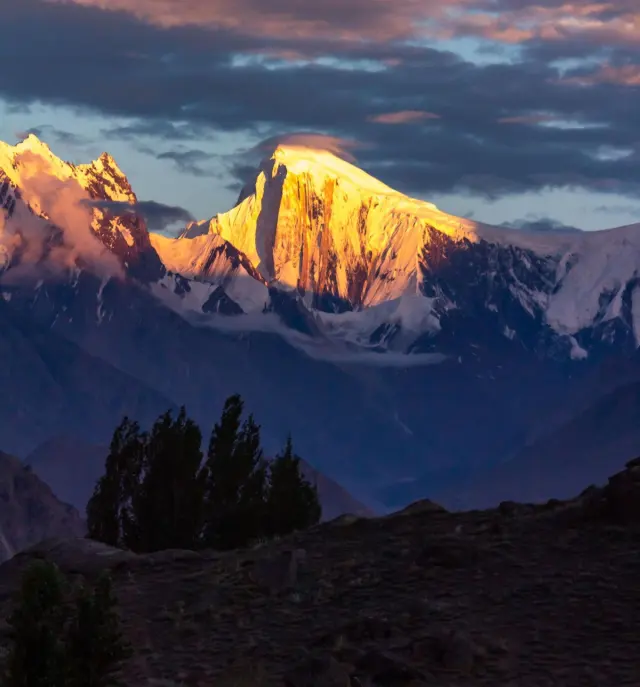
The Karakoram K2 Trek is our fast, private loop through the Karakoram of Pakistan: 19 days from Islamabad back to Islamabad. You walk up the Baltoro Glacier to Concordia (4,691 m) and K2 Base Camp (about 5,150 m), then cross the Gondogoro La (5,585 m) on fixed ropes to the Hushe valley. It is two days shorter than our 21-day K2 Gondogoro La Trek on the same route, because there is no rest day on the way up. It runs privately, on your own dates; private groups pay from $2,300 per person, with the trekking permit, government fees and park fees included.
Before you book: this is a fast itinerary
There is no rest day on the way up: you walk from Askoli to K2 Base Camp in 7 days, and the first walking day is about 31.5 km.
You need at least one earlier trek above 4,000 m and strong fitness for long days on rough glacier.
Altitude: the pace is faster than the usual advice for acclimatisation, so altitude sickness is a real risk, even for fit people. If you have not been to high altitude before, choose the 21-day K2 Gondogoro La Trek, which has a rest day.
Turning back: our lead guide decides if anyone must stop or go down, and that decision is final. Going down is the main treatment for serious altitude sickness.
The trek in numbers
Length: 19 days from Islamabad back to Islamabad, with 12 days on the trail (days 5 to 16).
Highest point: the Gondogoro La, 5,585 m (18,323 ft). K2 Base Camp is at about 5,150 m (16,896 ft); you sleep at Broad Peak Base Camp (4,850 m) and Ali Camp (4,950 m).
Distance: about 97 km from Askoli to K2 Base Camp, then about 57 km over the pass to Hushe: about 155 km on foot in all.
Walking: usually 4 to 8 hours a day; the first day to Mongron takes 9 to 12 hours, and the pass day 9 to 12 hours.
Camping: there are no villages or teahouses between Askoli and Hushe. You sleep in twin-sharing tents, and our cooks prepare all meals on the trek.
Grade: challenging, with one technical day: the pass is crossed on fixed ropes, with a harness and crampons.
Karakoram K2 Trek route map
Karakoram K2 Trek route map: camps, heights and days, from Islamabad to K2 Base Camp and over the Gondogoro La to Hushe (not to scale). On a phone, swipe sideways to see the whole map.
This trek runs privately, for your own group and dates. The price per person depends on the size of the group, from $2,300 per person for 9 or more people. It includes domestic flights, hotels (1 night in Islamabad and 2 nights in Skardu on arrival; 1 night in Skardu and 2 nights in Islamabad on return), meals on the trek, guides, cooks, porters for your bag up to 16 kg, the trekking permit, government fees and taxes, and the Central Karakoram National Park fee. International flights, the Pakistan visa fee, insurance, tips and climbing gear for the pass are not included. See the full K2 trek cost breakdown.
Private Group PricesPrice per person. Your group price is applied automatically when you book.
Solo price
2 to 4 people
5 to 8 people
9 to 20 people
$4,500
$3,000
$2,400
$2,300
How to book this trip
1
Choose a date
This trip runs as a private tour: choose the start date that suits you in the booking form.
2
Send your details
Fill in the booking form with your name, email and group size.
3
Pay the 10% advance deposit
The deposit holds your place on the trip.
4
We confirm your booking
Once the deposit arrives, we confirm and start booking your hotels and arrangements.
5
Pay the balance
By bank transfer two weeks before you arrive, or bring cash to Islamabad.
Highlights
The whole K2 and Gondogoro La loop in 19 days, on your own dates
Crossing the Gondogoro La (5,585 m) on fixed ropes, with a dawn view of K2, Broad Peak, Gasherbrum I and Gasherbrum II
K2 Base Camp, the Gilkey Memorial and a night at Broad Peak Base Camp
A night at Concordia, “the Throne Room of the Mountain Gods”
The 360-degree view of the mountains at Concordia
Close views of the Gasherbrums, Marble Peak, Chogolisa, Baltoro Kangri, Sia Kangri and Mitre Peak from Concordia
Close views of Muztagh Tower, Masherbrum and Urdukas Peak from the upper Baltoro Glacier
Close views of the Cathedrals, Uli Biaho, Paju Peak and the Trango Towers from the lower Baltoro Glacier
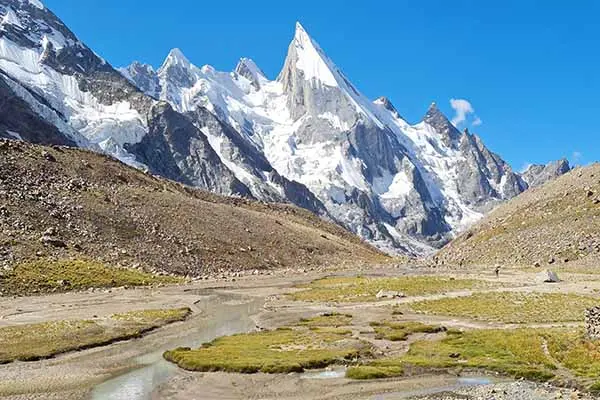
The Vigne and Gondogoro glaciers, and Laila Peak above Khuspang camp
Chogolisa and Masherbrum seen from both sides
The Hushe valley and village life in Hushe
A full expedition-style trek, with camping all the way
Views of the Biafo, Liligo, Dunge, Muztagh, Yermanendu, Mandu and other glaciers
Glacial lakes, waterfalls and streams
The life and culture of the Balti porters
The Shigar, Braldu and Khaplu valleys, the Shyok River and Skardu
The Tibetan-influenced culture and heritage of the Balti people
A scenic flight over the Himalaya and the Karakoram
The Karakoram Highway, if the flight is cancelled
Delicious Pakistani food
Sightseeing in Islamabad or Rawalpindi
Chogori Adventure is a local trekking company from Pakistan: a team with deep knowledge of the places, the people and the rules.
Welcome to Pakistan. Our staff meet you at Islamabad International Airport, holding a Chogori Adventure sign, and take you to our partner hotel near the Margalla Hills. Please send us your flight details 3–4 days before you arrive. After you have rested, we settle the trip balance and hold a short briefing; if you arrive late, we do both in Skardu.
Accommodation: Hotel room on twin sharing basis.
Meals: Breakfast included.
Day 2: Fly to Skardu
Skardu · 540–2,230 m (1,772–7,316 ft)
We fly to Skardu in the morning. Skardu is the starting point for treks and expeditions in the Karakoram, and on a clear day the flight gives spectacular views of the Himalaya and the Karakoram, with Nanga Parbat towering above the other peaks. Our staff meet you at Skardu Airport and take you to our partner hotel. In the afternoon you can rest or visit the bazaar and the outskirts of Skardu.
Accommodation: Hotel room on twin sharing basis.
Meals: Breakfast, lunch and dinner included.
Day 3: Rest Day in Skardu
Skardu · 2,230 m (7,316 ft)
Skardu lies beside the Indus River, surrounded by mountains. After breakfast we take an acclimatization walk up to Kharpocho Fort, a short hike from the bazaar, with wide views over the Indus, Skardu and the valley. In the afternoon you can check your trekking gear and buy anything you still need in the bazaar; your guide will help you. Meanwhile our Skardu office arranges the trekking permit. This is usually done in a day, but it can take longer.
Accommodation: Hotel room on twin sharing basis.
Meals: Breakfast, lunch and dinner included.
Day 4: Drive to Askoli
Askoli · 3,000 m (9,843 ft)
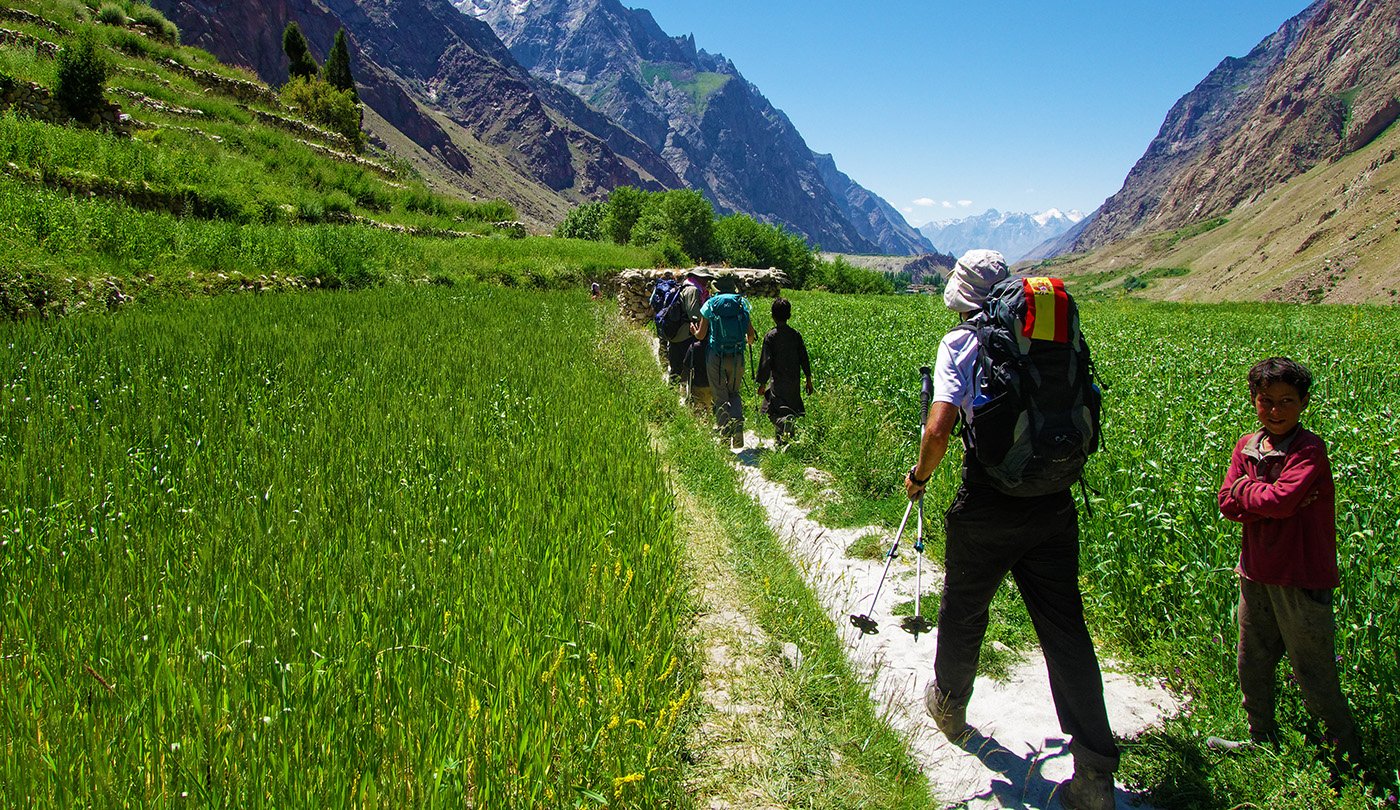
We drive to Askoli with our crew and supplies, a 5–7-hour jeep ride. Half an hour from Skardu we enter the Shigar valley, the valley that leads to K2, the second-highest mountain on Earth. The road runs through the green fields of Shigar beside the Shigar River, then narrows into the mountains and follows the Braldu River to Askoli, the last village before the Baltoro Glacier. Our porters join us at Askoli or at Paju. When we arrive, the tents are up and tea and snacks are waiting; dinner is in the mess tent.
Accommodation: Tents on twin sharing basis.
Meals: Breakfast, lunch and dinner included.
Day 5: Trek to Mongron
Mongron · 3,300 m (10,827 ft)
The trek begins on foot from Askoli. A walk of 3–4 hours (about 12 km) takes us to Korofon, at the junction of the Biafo Glacier and the Braldu River. We pass Jhula camp and continue along the river to Mongron, with Bakhordas peak, the first big peak on the way to K2, in view. This is the longest walking day of the way up.
Walking: 9–12 hours, about 31.5 km. Times are for a fit trekker at a normal pace; yours may be shorter or longer.
Accommodation: Tents on twin sharing basis.
Meals: Breakfast, lunch and dinner included.
Day 6: Trek to Paju
Paju · 3,400 m (11,155 ft)
A short day along the Braldu River to Paju, the last camp before the Baltoro Glacier, with the first views of the Paju peaks and the Cathedral towers. There is no rest day here on this fast itinerary, so take it easy in the afternoon.
Walking: 3–4 hours, about 9 km.
Accommodation: Tents on twin sharing basis.
Meals: Breakfast, lunch and dinner included.
Day 7: Trek to Khoburse
Khoburse · 3,800 m (12,467 ft)
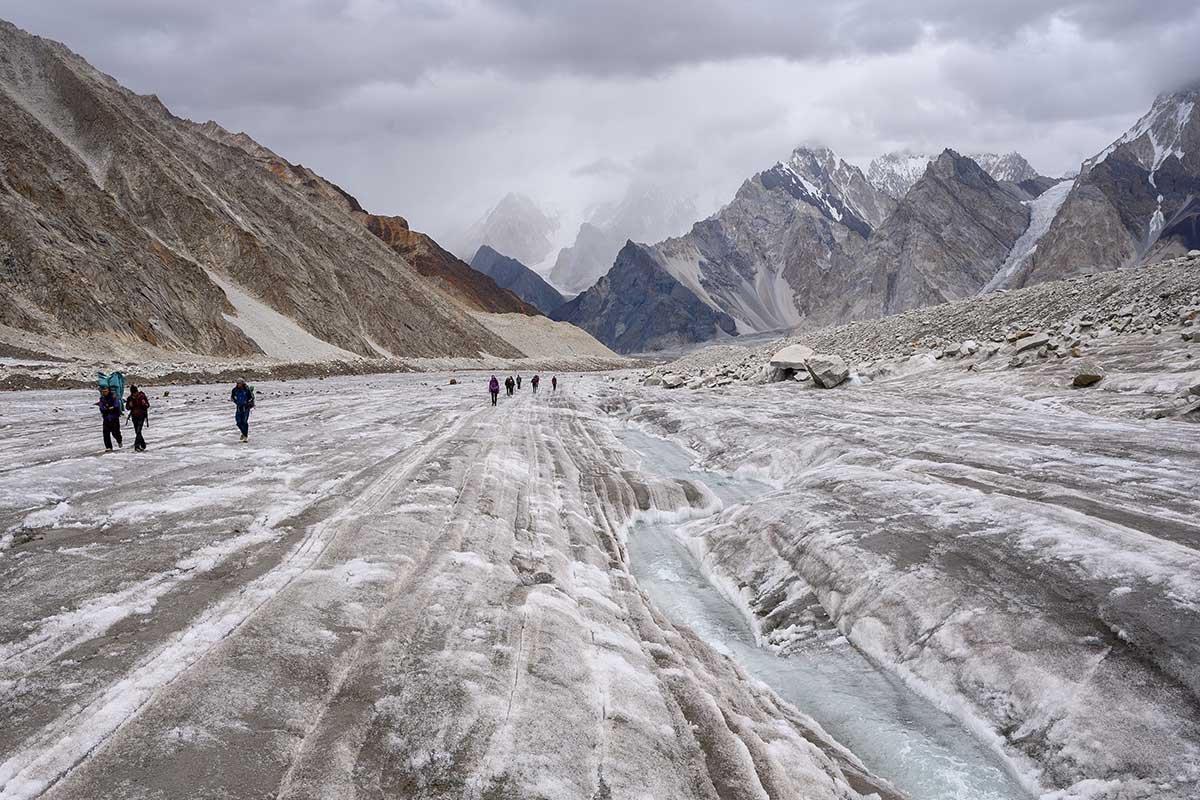
Today we step onto the Baltoro Glacier. It is about 63 km long, and we follow it all the way to Concordia, where it meets the Godwin-Austen Glacier. Half an hour from Paju we reach the snout of the glacier, with views of the Trango Towers, Uli Biaho and Paju Peak. From here the trail goes up and down over the glacier: take care, and let horses and donkeys pass when they cross your path. After 3–4 hours we stop for lunch at Liligo, facing the Trango towers, then continue along the right edge of the glacier to Khoburse camp.
Walking: 5–6 hours, about 14.7 km.
Accommodation: Tents on twin sharing basis.
Meals: Breakfast, lunch and dinner included.
Day 8: Trek to Urdukas
Urdukas · 4,000 m (13,123 ft)
After an early breakfast we cross the rough glacier to Urdukas. It is the shortest day of the trek, and Urdukas is the last camp on solid ground before the glacier camps. The camp sits high above the Baltoro Glacier with the best views of the granite spires of Trango, Uli Biaho and the Cathedrals, and in good weather you can see Gasherbrum IV. After Concordia, it is the most scenic camp on the trek.
Walking: 4–5 hours, about 6.2 km.
Accommodation: Tents on twin sharing basis.
Meals: Breakfast, lunch and dinner included.
Day 9: Trek to Goro 2
Goro 2 · 4,300 m (14,108 ft)
We walk up the middle of the Baltoro Glacier over rough moraine, with Masherbrum on the right and Muztagh Tower on the left, and get our first distant views of the Gasherbrums and Broad Peak. After 3–4 hours we stop for lunch and a rest at Goro 1, then walk another 3–4 hours to Goro 2 and camp facing Masherbrum. Goro 2 is windy and cold. It is our first camp on the glacier itself, at the junction of the Baltoro and Younghusband glaciers, and the view back down the Baltoro is stunning.
Walking: 7–8 hours, about 12.2 km.
Accommodation: Tents on twin sharing basis.
Meals: Breakfast, lunch and dinner included.
Day 10: Trek to Concordia
Concordia · 4,691 m (15,390 ft)
A very special day: we walk through magnificent mountain scenery to Concordia, with K2 in view if the weather is clear. Concordia, known as the “Throne Room of the Mountain Gods”, is one of the finest campsites on Earth. It lies where the Baltoro, Godwin-Austen, Gasherbrum and Vigne glaciers meet, surrounded by Marble Peak, K2, Broad Peak, Gasherbrum III, Mitre Peak, Baltoro Kangri, Sia Kangri and Chogolisa. Few people ever see this wilderness. The camp is cold, and it often snows here, even in summer.
Walking: 5–6 hours, about 11.8 km.
Accommodation: Tents on twin sharing basis.
Meals: Breakfast, lunch and dinner included.
Day 11: Trek to Broad Peak Base Camp and K2 Base Camp (Gilkey Memorial)
K2 Base Camp · 5,150 m (16,896 ft)
Today we walk to Broad Peak Base Camp and K2 Base Camp. We set off early from Concordia, crossing the glacial streams at the junction of the glaciers next to camp. The glacier between Concordia and K2 Base Camp is rough because the ice is melting; the rest is a smoother track to Broad Peak Base Camp. It takes about three hours to reach Broad Peak Base Camp, where we have lunch, then about two more hours up the mostly white Godwin-Austen Glacier to K2 Base Camp, at about 5,150 m (16,896 ft).
From K2 Base Camp, the Gilkey Memorial is a 10–15-minute walk up the mountain, with memorials to climbers who lost their lives in the Karakoram. In July and August you may meet climbers at Broad Peak and K2 Base Camp. After paying our respects, we walk back to Broad Peak Base Camp and camp there for the night.
Walking: 4–6 hours from Concordia to K2 Base Camp (about 11.8 km), then about 5 km back to Broad Peak Base Camp.
Accommodation: Tents on twin sharing basis.
Meals: Breakfast, lunch and dinner included.
Day 12: Trek Back to Concordia
Concordia · 4,691 m (15,390 ft)
After breakfast at Broad Peak Base Camp, we walk back down the glacier to Concordia by the same route. The afternoon is free to rest and enjoy the 360-degree view of the mountains around Concordia.
Walking: about 3 hours, about 7 km.
Accommodation: Tents on twin sharing basis.
Meals: Breakfast, lunch and dinner included.
Day 13: Trek to Ali Camp
Ali Camp · 4,950 m (16,240 ft)
From Concordia we walk along the upper Baltoro Glacier, pass Mitre Peak and reach the Vigne Glacier. The Vigne is a white glacier and easy to walk on, but it has small crevasses, so stay close to the guide and the crew, and use crampons if there is fresh snow. Ali Camp (4,950 m), below the Gondogoro La, is the highest night of the trek. We eat early and go to bed early, because the crossing starts in the night.
Walking: 5–6 hours, about 12 km.
Accommodation: Tents on twin sharing basis.
Meals: Breakfast, lunch and dinner included.
Day 14: Cross the Gondogoro La and Trek to Khuspang
Gondogoro La · 5,585 m (18,323 ft)
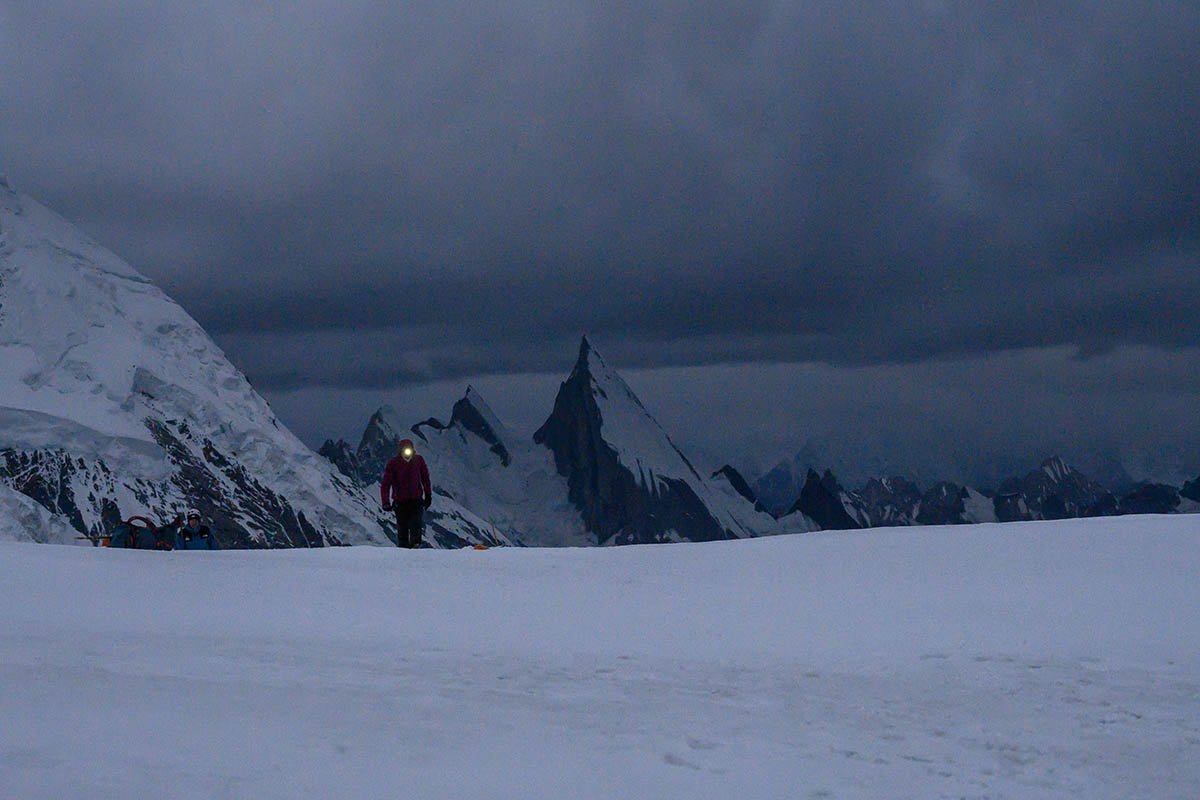
This is the key day of the trek. We get up around midnight, have breakfast and set off with our guide, our crew and the local rescue team who look after the fixed ropes on the pass. We cross before sunrise for safety: the snow is firm in the cold, and there is less risk of falling rock on the descent before the sun warms the slope.
We walk up the western Vigne Glacier to the foot of the pass, put on harnesses and crampons, and climb slowly on the fixed ropes. It usually takes about 3 hours to reach the top. At dawn, from the top of the Gondogoro La (5,585 m, 18,323 ft), you can see four 8,000 m peaks, K2, Broad Peak, Gasherbrum I and Gasherbrum II, with the whole Baltoro behind you; on the other side are Laila Peak and the Gondogoro valley.
The descent is steep, and fixed ropes are used here too. Early in the summer it is snowy, so keep your crampons on; later in the season it is mostly rock, and crampons usually come off. Watch every step: our guide leads from the front and the crew stays with you. Below the steep part the trail becomes easy down to Khuspang (4,680 m), where we camp facing Laila Peak.
Walking: 9–12 hours, about 8 km. The longest day of the trek.
Accommodation: Tents on twin sharing basis.
Meals: Breakfast, lunch and dinner included.
Day 15: Trek to Saicho
Saicho · 3,350 m (10,991 ft)
We walk down the Gondogoro Glacier for about an hour to Dalchangpa, with Masherbrum in view, and stop there for lunch. After lunch the trail goes through the Gondogoro pastures to Saicho camp. Saicho is lower and milder, so you can wash and take a shower here.
Walking: 6–8 hours, about 18 km, mostly downhill.
Accommodation: Tents on twin sharing basis.
Meals: Breakfast, lunch and dinner included.
Day 16: Trek to Hushe and Drive to Skardu
Skardu · 2,230 m (7,316 ft)
An easy walk down the valley brings us to the fields of Hushe, the last village of Ghanche District. Our jeeps are waiting, and we drive back to Skardu, about 5 hours past Khaplu and along the Shyok and Indus rivers. The trek is over.
Walking: 3–4 hours, about 7 km, then about 5 hours by jeep.
Accommodation: Hotel room on twin sharing basis.
Meals: Breakfast, lunch and dinner included.
Day 17: Fly Back to Islamabad
Islamabad · 540 m (1,772 ft)
Today we fly back to Islamabad, the capital of Pakistan. If the flight is cancelled because of the weather, we drive on the Karakoram Highway instead.
Accommodation: Hotel room on twin sharing basis.
Meals: Breakfast included.
Day 18: Contingency Day in Islamabad
Islamabad · 540 m (1,772 ft)
A spare day in case of delays or a cancelled flight. If it is not needed, it is a free day in Islamabad.
Accommodation: Hotel room on twin sharing basis.
Meals: Breakfast included.
Day 19: Departure Home
Islamabad · 540 m (1,772 ft)
The last day of the Karakoram K2 Trek: our staff take you to Islamabad International Airport to say goodbye.
19 days from Islamabad back to Islamabad, with 12 days on the trail (days 5 to 16): up the Baltoro Glacier to K2 Base Camp, then over the Gondogoro La to Hushe.
How is it different from the 21-day K2 Gondogoro La Trek?
The route is the same, but this trek is two days shorter: there is no rest day at Paju and the first walking day goes all the way from Askoli to Mongron. It runs privately on your own dates, while the K2 Gondogoro La Trek has fixed group departures and a slower pace.
Who is this fast itinerary for?
Fit trekkers who have already trekked above 4,000 m and want a shorter trip. Because it climbs faster than the usual advice for acclimatisation, altitude sickness is a real risk; if you have not been to high altitude before, choose the 21-day K2 Gondogoro La Trek.
How high is the Gondogoro La?
The Gondogoro La is 5,585 m (18,323 ft) high, the highest point of this trek. K2 Base Camp, which we visit on day 11, is at about 5,150 m (16,896 ft), and Ali Camp, where we sleep the night before the pass, is at 4,950 m (16,240 ft).
How long is the walk in kilometres?
About 155 km on foot: about 97 km from Askoli to K2 Base Camp, then about 57 km over the Gondogoro La to Hushe. The day plan above gives the hours and kilometres for each day.
How hard is the Gondogoro La, and do I need climbing skills?
The pass day is the hardest part of the trek: 9 to 12 hours, starting around midnight, with a steep climb and an even steeper descent on fixed ropes, wearing a harness and crampons. Early in the season the descent is snowy; from August it is mostly loose rock. You don't need mountaineering experience, but you should be comfortable on steep ground and have already trekked to at least 4,000 m. Practising walking in crampons before the trip helps. More: Gondogoro La difficulty.
What gear do I need for the Gondogoro La?
Crampons, a climbing harness, a helmet, a jumar (rope ascender), carabiners, a descender or figure-8, shoe covers (gaiters) and mittens, on top of your normal trekking gear; good, sturdy hiking boots are also very useful. They are not included in the price: bring your own, or ask us to arrange them in Skardu. The fixed ropes on the pass are put in place each season by a local rescue team, who also help trekkers on the crossing.
What happens if the pass cannot be crossed?
The crossing depends on snow and weather, and our guide decides on the day. If conditions are too risky, we do not cross: the group walks back down the Baltoro Glacier to Askoli instead, as on the K2 Base Camp Trek.
Is this a private trip only?
Yes. There are no fixed group dates: we run it for your own group, on the dates you choose. The price per person depends on the group size.
How much does it cost?
From $2,300 per person for a group of 9 or more, up to $4,500 for one person, with the trekking permit, government fees and park fee included. The table above shows the price for each group size, and Pakistani citizens pay USD 300 less. See the full K2 trek cost breakdown.
What is the best time for this trek?
This private trek runs from June to early October. The fixed ropes on the pass are usually in place from mid to late June. July, August and early September usually have the most settled weather; early in the season there is more snow on the pass.
What is the weather like on the trek?
In the trekking season (June to September) days are usually dry and clear. Lower down, daytime temperatures are around 10–20°C; at the high camps such as Concordia and Ali Camp, nights fall to around 0 to −10°C. Storms and strong wind can still happen, and light snow is possible high up, even in summer.
Do I need a permit or a visa?
You need the Mountaineering & Trekking visa (trekking category; see our Pakistan visa guide), which you apply for online; we send you our letter of invitation, free for our guests (the visa portal calls it a sponsor letter), and help with the process. K2 Base Camp and the Gondogoro La lie in the Central Karakoram National Park, a restricted area: the trekking permit, government fees and park fee are arranged by us and included in the price.
Do I need travel insurance?
Yes. Travel insurance is required and is not included in the price. Your policy must cover helicopter rescue and emergency evacuation, and trekking up to at least 6,000 m. Mountain rescue in Pakistan uses army helicopters, and payment may be needed in advance, so check this with your insurer.
How much is the single supplement for a room or tent?
If you would like a room or tent to yourself:
Single hotel room: USD 200 extra, covering all 5 hotel nights in Islamabad and Skardu.
Single tent on the trek: USD 200 extra.
A woman travelling alone gets a separate room and tent at no extra cost if there is no other woman in the group.
How do I book, and what are the payment terms?
Choose a date and send your details. A 10% advance deposit confirms your booking; deposits are not refundable. Once it is received we book your hotels and arrangements, help with your visa and arrange the permit. The balance can be paid by bank transfer two weeks before you arrive, or in cash when you arrive in Islamabad.
Who will guide us on the trek?
Our guides are government-licensed, speak English and have years of experience on the Baltoro and the Gondogoro La. An assistant guide, the kitchen team and porters travel with you all the way. For private groups we try to find a guide who speaks your language.
How do you deal with altitude sickness?
Your guide checks on you every day, and the lead guide decides if anyone must stop or go down. Drink plenty of water and tell your guide at once about any headache, dizziness or nausea: the treatment for serious altitude sickness is to go down. More on risks and rescue: Before you trek in Pakistan
Where do we sleep, and what do we eat?
Hotel rooms on twin sharing in Islamabad and Skardu, and twin-sharing tents on the trek. Our cooks prepare all meals on the trek, a mix of Pakistani and Western dishes, and drinking water is boiled for safety.
Are there toilets and showers on the trek?
There are toilets up to Urdukas, and toilet tents at most camps on the glacier. You can wash and shower up to Urdukas, and again at Saicho on the way down to Hushe; higher up it is too cold for showers.
Can I charge my phone? Is there Wi-Fi or phone signal?
We carry an electric generator for groups of more than 5 trekkers, and solar panels for smaller groups, for charging your devices and lighting the camp.
There is no internet or phone signal between Askoli and Hushe. At Concordia there is a mobile signal tower, but it is not reliable: it runs on solar power, so it usually works only on sunny days, and only when the operating company keeps it repaired. When it works, our guide can share the connection with the group, but nothing is guaranteed. The group always carries a satellite phone for emergencies.
How much luggage can I bring?
Porters carry up to 16 kg of your bag; each extra kilo costs USD 12.
What should I pack?
Bring warm layers and a down jacket for nights down to about −10°C, a waterproof jacket, broken-in trekking boots, a warm sleeping bag, a sun hat, sunglasses and sunscreen, and the climbing gear for the pass: crampons, a harness, a helmet, a jumar, carabiners, a descender or figure-8, shoe covers and mittens. We strongly recommend bringing your own clothing, sleeping bag and boots. If you need to, you can rent gear in Skardu; a sleeping bag costs about USD 40–80. Porters carry up to 16 kg of your luggage. See our K2 trek cost guide for gear rental.
How much should I tip, and how much cash should I bring?
Tipping is your choice, but the Karakoram has a strong tipping culture and tips are an important part of the crew's income. Each trekker usually gives about USD 100–250 in total for the whole crew, in cash. Bring extra cash for drinks, laundry and shopping in Skardu.
What happens if the Skardu flight is cancelled?
Flights to and from Skardu depend on the weather and are sometimes cancelled. If that happens we drive on the Karakoram Highway instead, and the itinerary keeps a spare day in Islamabad for this.
What happens if I return early from the trek?
If you, or your whole group, decide to return early from the trek, for any reason, the extra costs this causes are not included in the price and are not covered by us: for example extra hotel nights, extra jeeps or other transport, changed flights, or a guide or porter to take you back. This applies to groups and to individual travellers. Our services are provided as listed in the trip plan for this trek.
Local, government-licensed and English-speaking; most of them are trained in first aid.
Crew
Our cooks and porters come from the villages of Baltistan.
Licences
Department of Tourist Services licence no. 2494; Gilgit-Baltistan tourism licence no. DTS-GB-055. Member of the Pakistan Association of Tour Operators.