Pakistan Visa Guide: Tourist e-Visa, Trekking Visa and Permits
By Imtiyaz Ahmed Shigri, founder of Chogori Adventure, Skardu · Updated November 2026
Most visitors to Pakistan apply online for the tourist e-visa on the official Pakistan Online Visa System; treks and climbs in restricted zones, such as K2 Base Camp and the Gondogoro La, need the Mountaineering & Trekking visa instead. That visa needs a sponsor letter from a tour operator licensed by the Department of Tourist Services. We send our letter of invitation (the portal calls it a sponsor letter) free once your trip is booked. Apply early: the portal says the Mountaineering & Trekking visa normally takes about 4 weeks, and the tourist e-visa 7 to 10 working days.
This guide explains which visa fits which trip, how to apply step by step on visa.nadra.gov.pk, what the fees and processing times are, and which places in northern Pakistan need a trekking or climbing permit. We are a licensed tour operator based in Skardu, and we arrange permits, the licensed guide and the official briefing for our guests.
Last checked: 15 November 2026 against the official Pakistan visa portal.

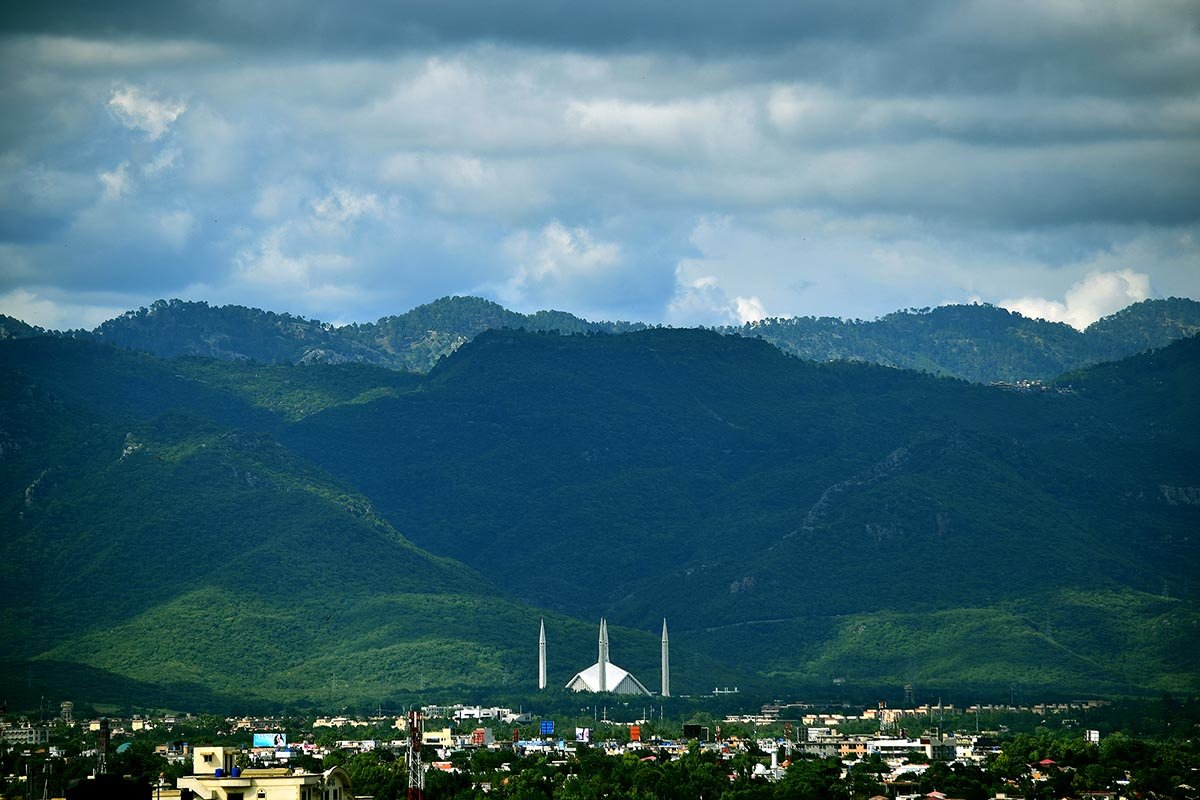
The Faisal Mosque in Islamabad. Most trips to the north begin in the capital.
Pakistan visa at a glance
Here is the short version. The details for each line follow further down.
| Question | Short answer |
|---|---|
| Where do I apply? | Online only, on the Pakistan Online Visa System (visa.nadra.gov.pk), run by NADRA for the Ministry of Interior. |
| Who can apply online? | Citizens of the 192 countries listed on the portal. |
| Visa for a sightseeing tour | Tourist visa (Tourist/Visit category), "Individual – less than 3 months". |
| Visa for K2 Base Camp and other restricted treks | Mountaineering & Trekking visa, Trekking sub-category. |
| Visa for climbing a peak above 6,500 m | Mountaineering & Trekking visa, Mountaineering sub-category. |
| Entries and length | Single entry, for a stay of up to 3 months (both visas). |
| Processing time | Tourist visa: 7–10 working days, the portal states. Mountaineering & Trekking visa: normally 4 weeks. |
| Fee | Depends on your nationality. Check the official fee calculator. |
| Our letter of invitation | Free for our guests. Required for the Mountaineering & Trekking visa. |
| Visa use-by date | All visas are valid for entry for 6 months from the date of issue. |
Which Pakistan visa do I need?
Match the visa to the most demanding part of your trip. If your holiday is a road journey through Hunza and Skardu, the tourist visa is the right one. If any day of your trip crosses a restricted trekking zone or climbs a listed peak, apply for the Mountaineering & Trekking visa from the start.
| Your trip | Visa to apply for | Our letter needed? |
|---|---|---|
| City tours: Islamabad, Lahore, Peshawar | Tourist e-visa | No (hotel booking is the listed document) |
| Road tours in Hunza, Skardu, Shigar, Khaplu, the Karakoram Highway | Tourist e-visa | No |
| Fairy Meadows and Nanga Parbat viewpoints | Tourist e-visa (we confirm for longer treks) | No, unless your trek needs it |
| Kalash valleys and Chitral sightseeing | Tourist e-visa | No |
| K2 Base Camp, Concordia, Gondogoro La, Hushe valley treks | Mountaineering & Trekking visa (Trekking) | Yes, we send it free |
| Snow Lake, Biafo and Hispar La | Mountaineering & Trekking visa (Trekking) | Yes, we send it free |
| Trekking peaks of 6,500 m or lower | Mountaineering & Trekking visa (Trekking) | Yes, we send it free |
| Expeditions to peaks above 6,500 m, such as K2 or Spantik | Mountaineering & Trekking visa (Mountaineering) | Yes, we send it free |
Two other categories exist that most of our readers do not need. The Business visa is a separate category on the portal, and the business invitation is issued through the government's e-business invitation letter system. The Family Visit visa is for people visiting relatives in Pakistan. If you plan to see family and then join a trek in a restricted zone, talk to us first, because the trek decides the visa.
Who needs no visa
The portal states that citizens of the six Gulf Cooperation Council states (Bahrain, Kuwait, Oman, Qatar, Saudi Arabia and the United Arab Emirates) do not need a visa to enter Pakistan. The official visa abolition list also shows visa-free entry for ordinary passport holders from the Maldives (three months) and Nepal (one month). Other entries on that list cover diplomatic and official passports only. Everyone else, including US, UK, Canadian, Australian and EU citizens, needs a visa before travelling.
Visa on arrival, ETA and older schemes
The portal does not list a visa on arrival category for tourists today. Its FAQ explains that an Electronic Travel Authorization (ETA) is generated only for applications made under visa on arrival categories, and that the ETA is not a visa: it only lets the holder travel and ask for a visa at the arrival counter. Some older schemes, such as group visas through designated operators, still appear in old policy pages, but they are not on the portal now. Our advice is simple: apply for your visa online before you fly.
Indian nationals
India is not on the e-visa country list. Indian nationals apply through the High Commission of Pakistan in New Delhi; the requirements are on the Ministry of Foreign Affairs website.
The tourist e-visa
The tourist e-visa is the visa for sightseeing, cultural tours and road trips through the north. It sits in the Tourist/Visit category on the official tourist visa page. For a holiday, choose the sub-category "Individual – less than 3 months". The calculator also lists stays of up to 6 months and over 6 months, but those are not needed for a normal trip.
Who can apply
The portal's home page says the system is open to citizens of 192 countries, and the country list shows which ones. The FAQ says applicants should apply from the country where they live. If you live outside your home country, keep a scan of your residence permit ready; some visa categories on the portal ask third-country applicants for proof of legal residence.
What you get
- A single-entry visa for a stay of up to 3 months.
- A document called a Visa Grant Notice, which is your visa. Print it and keep a copy on your phone.
- A use-by period: all visas are valid for entry for 6 months from the date of issue, so do not apply too early.
Documents for the tourist e-visa
For a new entry visa the portal lists three items: a photograph, your passport and your hotel booking details. In practice, prepare these files before you start:
- A scan of your passport photo page. Check that your passport has at least 6 months left after your planned exit; the portal does not state a minimum, but other official pages use 6 months and it avoids problems at check-in.
- A recent passport-style photo as a file of up to 350 KB, made to the portal's photograph guide.
- Your hotel bookings, or the hotel list in our booking confirmation if you travel with us.
- Your travel dates and the places you plan to visit.
- A Visa or Mastercard to pay the fee online.
Our guests on tours often ask whether they need our letter for a tourist visa. The portal does not list a letter of invitation as a required document for a new tourist visa today; the hotel booking is what it asks for. Once your trip is booked, we can still send our letter free if it helps you, and a sponsor letter is also one of the documents for an extension.
How to apply, step by step
- Go to visa.nadra.gov.pk. The portal states that online applications can only be submitted there. The portal says it has no collaboration with any other website, so ignore look-alike sites.
- Create an account with your email address. Write the password down; you will use the same account to follow your application.
- Choose the category Tourist/Visit, then the sub-category "Individual – less than 3 months", and Application Type "Entry".
- Fill in the online form.
- Upload your photo (up to 350 KB), your passport scan and your hotel booking details.
- Pay the fee by Visa or Mastercard. The amount depends on your nationality.
- Submit and note your application number.
- Watch your email and account. If the visa office sends the file back for review, answer within 7 days; the portal says the application is cancelled if it is not resubmitted in that time, and the processing clock starts again after you resubmit.
- When the visa is granted, download and print the Visa Grant Notice. You can also check an issued visa or ETA on the portal's verification page.
The portal adds that applicants may be called for an interview at a Pakistan mission abroad if required. Apply early in case you are asked to attend one.
Processing time
The portal states 7–10 working days for a new tourist visa, two weeks for an extension, and 4 weeks for applicants with Afghanistan or Somalia passports. These are working days, so weekends do not count. The portal does not guarantee a time, so we suggest you apply three to four weeks before you fly.
Fees by nationality
The fee depends on your nationality, the number of entries and the length of stay. It is set on the official fee calculator and paid online. Here are three examples for a single-entry visa of less than 3 months, from the fee calculator on 15 November 2026:
| Nationality | Tourist visa fee (single entry) | Mountaineering & Trekking visa fee |
|---|---|---|
| United States | USD 60 | USD 60 |
| United Kingdom | USD 60 | USD 60 |
| Canada | USD 60 | USD 60 |
Fees change, and other nationalities pay different amounts, so check the calculator for your passport on the day you apply. For every nationality we tested, the tourist visa and the Mountaineering & Trekking visa cost the same. The visa fee is separate from trekking permits and royalties, which are paid later, in Pakistan.
The Mountaineering & Trekking visa
You need the Mountaineering & Trekking visa for K2 Base Camp, the Gondogoro La and other treks and climbs on the official lists. It is one visa category with two sub-categories: Trekking and Mountaineering. The official Mountaineering & Trekking visa page says all foreigners can apply, from the same 192 countries as the e-visa.

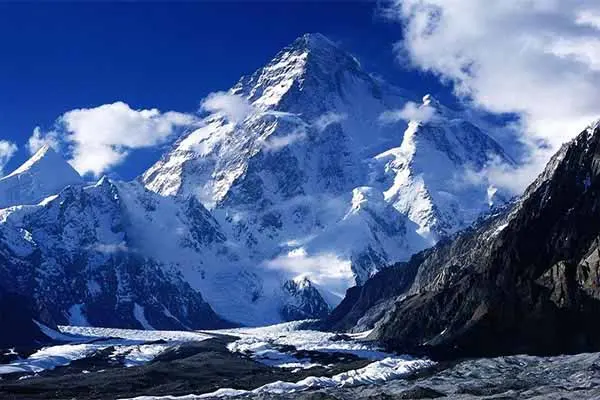
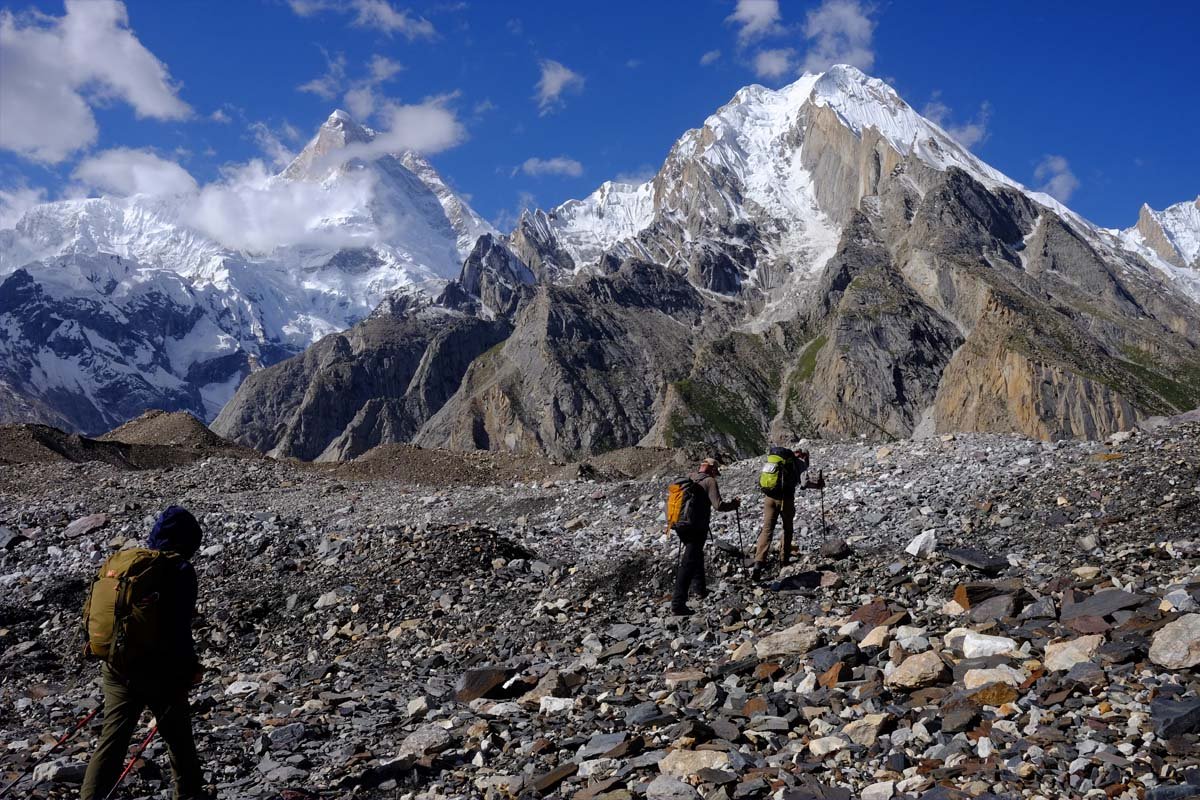
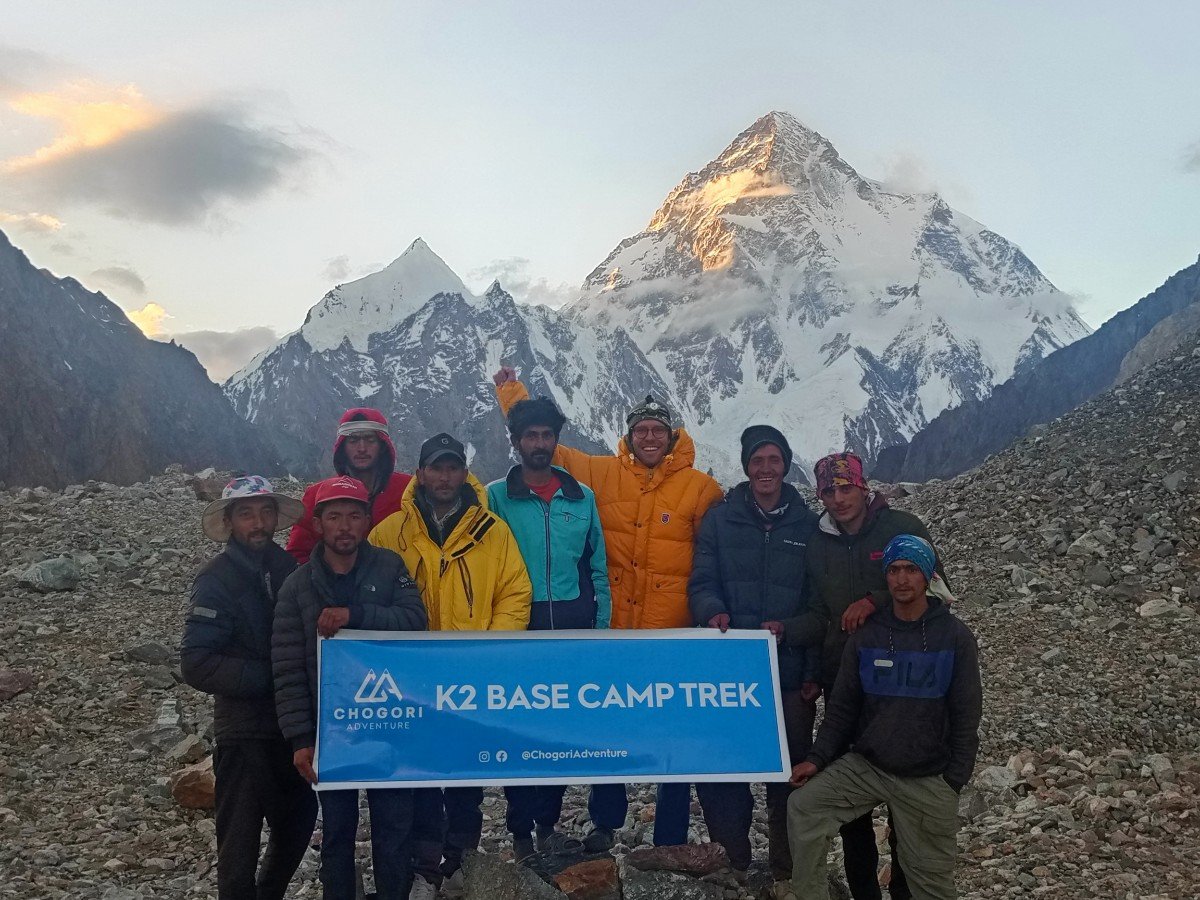
Concordia and K2. The Baltoro is a restricted zone, so trekkers here need the Mountaineering & Trekking visa.
Trekking or Mountaineering: which sub-category
The line is 6,500 m. If your peak is above 6,500 m, choose Mountaineering. For treks, and for peaks of 6,500 m or lower, choose Trekking. The portal's purpose field asks you to name the mountains from its list that you plan to climb, and the list of treks and list of peaks show the routes and summits it covers. A K2 Base Camp trekker applies under Trekking; a K2 climber applies under Mountaineering.
Documents for the Mountaineering & Trekking visa
- Your passport scan.
- A photograph (same rules as the tourist visa).
- The Trekking Application Form or the Mountaineering Application Form, depending on the sub-category.
- A sponsor letter or agreement with a tour operator authorised by the Department of Tourist Services (DTS). The portal is clear that it must be with a DTS-authorised operator.
- A list of the other members of your group, if you have it. Each member of a group submits a separate application.
Our free letter of invitation
The sponsor letter is where we come in. We send your letter of invitation free once your trip is booked (the portal calls it a sponsor letter). We are licensed by the Department of Tourist Services (licence no. 2494) and by the Gilgit-Baltistan tourism department (licence DTS-GB-055), and Chogori Adventure appears on the official list of tour operators on the visa portal. You can check that list for any operator before you book.
Ask for the letter as soon as you book, so you can apply in good time.
Processing time, entries and length
The portal says the Mountaineering & Trekking visa normally takes 4 weeks (working days), and it advises you to plan your trip once you have the Visa Grant Notice. The visa is a first-time, single-entry visa for a stay of up to 3 months. That is plenty for a three-week trek or a two-month 8,000 m expedition, but plan your dates so you do not need to leave and re-enter.
What the visa fee does not cover
The online fee is for the visa application only. If the visa is granted, the royalty for a peak and the trekking permit fees are paid after you arrive, in Pakistan. When you travel with us, we pay these fees for you in Pakistan and file the permit paperwork; your trip page shows what is included in the price.
Trekking zones in Gilgit-Baltistan: open and restricted
Gilgit-Baltistan divides trekking routes into restricted zones and open zones. The zone sets the rules. Restricted zones need a permit, a licensed guide and porters, and a liaison officer for each group. Open-zone treks are still registered and still pay fees.
Restricted zones
The Gilgit-Baltistan tourism department says visitors must get a permit before trekking or climbing in a restricted area, and must hire a licensed guide and porters there. The official trek list marks the main Baltoro and Hushe routes as restricted: K2 Base Camp and Concordia, the Gondogoro La, the Masherbrum Pass and the Hushe valley treks to Masherbrum, Gondogoro and K6/K7 base camps. The royalty schedule adds that a liaison officer is assigned to each group in a restricted zone.
Open zones
Open zones include the Snow Lake and Hispar La route, the Lukpo Pass, Shimshal, Chapursan and the Deosai routes. Open does not mean that no permit is ever needed: the department says all trekking and mountaineering in Gilgit-Baltistan must be registered with the tourism department, environment fees still apply on open-zone routes, and we confirm the current permit rule for your route when you book. The official fee data also mentions a third band, the "Low Frequency Zone", but no public definition of it was available when we checked.
Trekking permit fee
According to the Gilgit-Baltistan tourism department's 2025 fee schedule (also linked from the visa portal), the trekking fee for foreigners is USD 150 per person in summer (April to September), USD 75 in autumn (October and November) and USD 75 in winter (December to March). On top of that comes an environment fee: USD 190 per trekker in a restricted zone and USD 100 in an open zone, outside the Central Karakoram National Park. Inside the park a waste-management fee applies instead; the official schedule shows two different figures for it, so we confirm the current amount when you book. The fees are listed on the DTS Gilgit-Baltistan fees page.
Briefing and debriefing
The official schedule says briefing and debriefing of expedition and trekking parties are mandatory and are held only in tourism offices in Gilgit-Baltistan. In practice this means a meeting at the tourism office before you start and again after you finish. We arrange the official briefing and handle the forms.
What we arrange for you
- The trekking permit: the request letter, the member list, porter insurance, fee slips and the copies of your visa and passport.
- A government-licensed guide and the porters required in restricted zones.
- The liaison officer for restricted-zone groups, where the rules require one.
- The official briefing and debriefing at the Gilgit-Baltistan tourism office.
- Registration of your trek with the tourism department, also for open-zone routes.
For the wider picture of trekking rules, rescue and mountain manners, read Before you trek in Pakistan.
Climbing permits and peak royalty
Peaks above 6,500 m need a climbing permit and a royalty, paid per climber in Pakistan. The Department of Tourism in Gilgit-Baltistan is the only authority that issues climbing permits, and an expedition must be linked to a registered tour company.
K2 royalty
For K2 (8,611 m) the royalty for foreigners is USD 3,500 per climber in summer (April to September), USD 2,000 in autumn and USD 1,000 in winter, according to the Gilgit-Baltistan tourism department's 2025 schedule. Two official sources give the same figures. An environment fee is added on top. For the full cost of a K2 climb, see how much it costs to climb K2.
Other peaks above 6,500 m
The royalty for other peaks depends on their height band, from 6,501 m up to 8,500 m. The full table is on the official royalty and permit checklist linked from the visa portal. If a climber wants a second peak, the rules require a separate application and an additional fee. The schedule caps a group at 20 members.
Peaks of 6,500 m or lower
There is no royalty for peaks of 6,500 m or lower, and they fall under the Trekking sub-category of the visa. Rules for these peaks changed in recent years, so we confirm the current rule and fee when you book. For the main peaks in this range, see our guide to trekking peaks in Pakistan.
How the climbing permit works
Once your visa is granted, we file the permit application with the tourism department: the request letter, the member list, insurance for high-altitude porters, the liaison officer and low-altitude porters (up to PKR 3 million each), the fee slips and copies of each member's visa. The schedule says the mountaineering permit is issued three days after a complete application. Our expeditions include all of this.
Which places need which visa and permit
This table covers the places our guests ask about most. It follows the official trek and peak lists and the Gilgit-Baltistan fee schedule. Where no official rule was found, we say so, and we confirm before your trip.
| Place / activity | Region | Visa | Permit | Who arranges it | Notes |
|---|---|---|---|---|---|
| Islamabad, Lahore, Peshawar city tours | Federal, Punjab, Khyber Pakhtunkhwa | Tourist e-visa | No trekking permit | You (visa); we arrange the tour | All three airports are official entry ports. A KP tourist registration form exists; we confirm whether Peshawar needs it |
| Karakoram Highway drive | KP to Gilgit-Baltistan | Tourist e-visa | No | We do | Carry your passport and copies for checkposts. See our Karakoram Highway tour |
| Hunza: Karimabad, Attabad, Passu | Gilgit-Baltistan | Tourist e-visa | No | We do | Hotels must be licensed by the Gilgit-Baltistan tourism department. See our Hunza tour |
| Khunjerab Pass day trip | Gilgit-Baltistan, China border | Tourist e-visa | No trekking permit; Khunjerab National Park entry permit from the Wildlife Department | We do | Sost is an official land entry and exit port. Crossing into China needs a Chinese visa |
| Skardu, Shigar, Khaplu | Gilgit-Baltistan | Tourist e-visa | No | We do | See our Skardu Hunza tour |
| Deosai | Gilgit-Baltistan | Tourist e-visa | National park entry permit from the Wildlife Department; Deosai treks are open zone | We do | Camping only at designated sites |
| Fairy Meadows (Raikot) | Gilgit-Baltistan (Diamer) | Tourist e-visa | No permit on the official lists we checked; we confirm before your trip. Trekking registration applies | We do | See our Fairy Meadows trek |
| Nanga Parbat Base Camp (Raikot) trek | Gilgit-Baltistan (Diamer) | Tourist e-visa or Trekking visa: we confirm when you book | No permit on the official lists we checked; we confirm before your trip | We do | Not on the official trek list |
| K2 Base Camp and Concordia | Gilgit-Baltistan (Baltoro) | Mountaineering & Trekking visa (Trekking) | Yes: restricted-zone trekking permit | We do: permit, licensed guide, porters, liaison officer | Trekking fee plus environment or park fee; briefing and debriefing in Gilgit-Baltistan. See our K2 Base Camp Trek |
| Gondogoro La | Gilgit-Baltistan (Baltoro to Hushe) | Mountaineering & Trekking visa (Trekking) | Yes: restricted zone | We do | See our K2 Gondogoro La trek |
| Masherbrum Pass (Baltoro to Hushe) | Gilgit-Baltistan | Mountaineering & Trekking visa (Trekking) | Yes: restricted zone | We do | On the official trek list |
| Hushe valley treks: Masherbrum, Gondogoro, K6/K7 base camps | Gilgit-Baltistan (Ghanche) | Mountaineering & Trekking visa (Trekking) | Yes: restricted zone | We do | Licensed guide and porters required |
| Trango Towers and Shipton base camp | Gilgit-Baltistan (Baltoro) | Mountaineering & Trekking visa (Trekking) | The two official lists disagree on the zone; we confirm before your trip | We do | Plan for a restricted-zone permit |
| Snow Lake, Biafo and Hispar La | Gilgit-Baltistan | Mountaineering & Trekking visa (Trekking); the portal lists this route under that visa | Open zone; trekking registration and fees still apply | We do | Open-zone environment fee USD 100 per trekker. See our Snow Lake trek |
| Rush Lake | Gilgit-Baltistan (Nagar) | Tourist e-visa or Trekking visa: we confirm when you book | No permit on the official lists we checked; we confirm before your trip | We do | Not on the official trek list |
| Nangma valley | Gilgit-Baltistan (Ghanche) | We confirm the visa type when you book | No permit on the official lists we checked; we confirm before your trip | We do | Not on the official trek list |
| Laila Peak Base Camp | Gilgit-Baltistan (Hushe) | Mountaineering & Trekking visa (Trekking) | Probably restricted, as the Hushe valley route is; we confirm before your trip | We do | See our Laila Peak Base Camp trek |
| Climbing a peak of 6,500 m or lower (Laila, Gondogoro Peak, Khosar Gang, Pastore) | Gilgit-Baltistan | Mountaineering & Trekking visa (Trekking) | No royalty; we confirm the current permit rule and fee when you book | We do | Pastore and Gondogoro Peak lie on restricted Baltoro and Hushe routes; Khosar Gang zone not clear from the official lists |
| Climbing a 7,000 m peak (Spantik, 7,027 m) | Gilgit-Baltistan (Nagar) | Mountaineering & Trekking visa (Mountaineering) | Yes: climbing permit and royalty (7,001–7,500 m band) plus environment fee | We do; liaison officer if in a restricted zone | See our Spantik expedition |
| K2 expedition | Gilgit-Baltistan (Baltoro) | Mountaineering & Trekking visa (Mountaineering) | Yes: climbing permit and K2 royalty | We do, with a liaison officer | Restricted zone. See our K2 climbing expedition |
| Broad Peak, Gasherbrum I, Gasherbrum II | Gilgit-Baltistan (Baltoro) | Mountaineering & Trekking visa (Mountaineering) | Yes: climbing permit and royalty (8,001–8,500 m band) | We do, with a liaison officer | Restricted zone |
| Nanga Parbat expedition | Gilgit-Baltistan (Diamer) | Mountaineering & Trekking visa (Mountaineering) | Yes: climbing permit and royalty (8,001–8,500 m band) | We do | Zone not clear from the official data; we confirm |
| Kalash valleys and Chitral | Khyber Pakhtunkhwa | Tourist e-visa; for Chitral pass treks we confirm the visa type when you book | KP tourist registration form; no official NOC rule found, we confirm | We fill in the registration form for you | See our tour through Chitral and the Kalash valleys |
| Swat | Khyber Pakhtunkhwa | Tourist e-visa | KP tourist registration form; no official NOC rule found, we confirm | We do | |
| Neelum valley | Azad Jammu and Kashmir | Tourist e-visa | No official rule found; we confirm before your trip | We do | |
| Chapursan and Baba Ghundi | Gilgit-Baltistan (Gojal) | Tourist e-visa for the valley; Trekking visa for the Chapursan to Batura trek | Chapursan trek: open zone | We do | |
| Shimshal | Gilgit-Baltistan (Gojal) | Tourist e-visa for the village; Trekking visa for the passes | Shimshal treks: open zone | We do |
Rules and fee schedules can change between seasons, so we confirm the current rules before your trip. If your plan mixes a tour and a restricted trek, apply for the Mountaineering & Trekking visa for the whole trip.
On arrival and while you travel
Airports and land borders
The airports of Islamabad, Lahore and Peshawar are official entry ports, and the Sost land route on the Karakoram Highway is the official port on the China side. The full list is on the entry and exit ports page. The portal also says all foreigners can now fill in the disembarkation card through the PakID mobile app.
Police registration
Most visitors do not need to register with the police. According to the portal's important terms, foreigners are exempt, except nationals of a short list of countries and anyone whose passport is stamped on arrival with an instruction to report to the Foreigners Registration Office. The official policy page says a Foreigner Registration Branch is in the office of every District Police Officer.
Passport checks in Gilgit-Baltistan
On the Karakoram Highway and on the roads to Skardu, Hunza and the trailheads you will pass checkposts where passports may be checked. Carry your passport at all times, plus a few paper copies of the photo page and your visa.
Chitral and the Kalash valleys
The Khyber Pakhtunkhwa Culture and Tourism Authority runs an official tourist registration form for individuals and groups. For our guests, we fill it in, with our company and guide licence details, before you reach Chitral.
Crossing into China at the Khunjerab Pass
A day trip to the Khunjerab Pass from Hunza needs your Pakistan visa and the national park entry permit, which we arrange. If you want to cross the border and continue into China, you need a Chinese visa as well, arranged before you travel.
Extending your visa
If you are already in Pakistan and want to stay longer, apply for an extension on the same portal, choosing Application Type "Extension". For a tourist visa extension the portal asks for your passport, photo, hotel booking, the page with your entry stamp, your last visa page, and a sponsor letter from an SECP-registered company or tour operator (or a Pakistani national on e-stamp paper) with the sponsor's ID card. Our letter of invitation is a sponsor letter from a licensed tour operator. The portal states two weeks (working days) for an extension, so apply well before your visa ends.
When to apply: a simple timeline
Start with the trip, then the visa. Book your trip first, so we can send the letter and the dates on your application match your itinerary.
| When | Trek or expedition | Tour on a tourist e-visa |
|---|---|---|
| 3–6 months before | Book the trip; check your passport has at least 6 months left after your return | Book the trip and hotels |
| 8–10 weeks before | Receive our free letter of invitation | — |
| About 8 weeks before | Apply for the Mountaineering & Trekking visa (about 4 weeks to process) | — |
| 3–4 weeks before | Visa Grant Notice should be in hand | Apply for the tourist e-visa (7–10 working days) |
| 1 week before | Send us a copy of the visa; print two copies | Print the visa; download the PakID app |
| On arrival | Official briefing at the Gilgit-Baltistan tourism office | Start your tour |
Checklist before you fly
- Passport with at least 6 months left after your return.
- Printed Visa Grant Notice, plus a copy on your phone.
- Two paper copies of your passport photo page and visa.
- Our letter of invitation and booking confirmation (for treks and climbs).
- Travel insurance that covers trekking at your planned altitude.
- Some US dollars or euros in cash for personal costs.
Common mistakes that delay a visa
- Applying for the tourist visa for a restricted trek. Apply for the right visa from the start.
- Using a look-alike website. Apply only on visa.nadra.gov.pk.
- A photo that is too large or does not meet the photo guide.
- Missing the 7-day window to answer when the file is sent back for review.
- Applying too early: the visa must be used within 6 months of issue.
- Dates on the application that do not match the trip in our letter.
How we help with your visa and permits
We are a Skardu company, founded in 2015, with offices in Skardu and Islamabad, and a member of the Pakistan Association of Tour Operators. More than 3,000 customers have travelled with us on over 500 trips. For every guest we:
- send your letter of invitation free once your trip is booked (the portal calls it a sponsor letter);
- advise which visa and sub-category to choose for your route;
- arrange the trekking or climbing permit, the royalty and park fees, the licensed guide, porters and liaison officer;
- arrange the official briefing and debriefing at the Gilgit-Baltistan tourism office;
- fill in the KP tourist registration for Chitral and Kalash trips.
Ready to plan? See our K2 Base Camp Trek, browse our expeditions, read the Gilgit-Baltistan travel guide and the Pakistan travel guide, or check Before you trek in Pakistan. Questions about your visa? Contact us and we will reply with the steps for your passport.
Frequently asked questions
Do US, UK and Canadian citizens need a visa for Pakistan?
Yes. Citizens of the United States, the United Kingdom and Canada need a visa before travelling. They apply online on the Pakistan Online Visa System at visa.nadra.gov.pk, usually for the tourist e-visa, or for the Mountaineering & Trekking visa if they plan a restricted trek or a climb.
How long does the Pakistan e-visa take?
The portal states 7–10 working days for a new tourist visa. The Mountaineering & Trekking visa normally takes 4 weeks. If the file is sent back to you for review, the time starts again after you resubmit, so apply three to four weeks ahead for a tour and about eight weeks ahead for a trek or climb.
How much does a Pakistan visa cost?
It depends on your nationality. On the official fee calculator on 15 November 2026, a single-entry visa for less than 3 months cost USD 60 for US, UK and Canadian citizens. The tourist and the trekking visa cost the same. Check the calculator on the day you apply.
Is there a visa on arrival in Pakistan?
The portal does not list a visa on arrival category for tourists today. An ETA is not a visa, and older group schemes are not on the portal. Apply online before you fly.
Do I need a trekking visa for K2 Base Camp?
Yes. K2 Base Camp and Concordia are in a restricted zone, so you need the Mountaineering & Trekking visa, Trekking sub-category, with a sponsor letter from a DTS-licensed operator. A tourist visa is not enough for this trek.
What is a letter of invitation, and does it cost anything?
It is a letter from a licensed tour operator that sponsors your trip. The portal calls it a sponsor letter, and it is required for the Mountaineering & Trekking visa. Our letter of invitation is free for all our guests.
Can I apply for a trekking visa myself?
You fill in and submit the application yourself on the portal, but you cannot apply without a sponsor letter or agreement with a DTS-authorised tour operator. The trekking permit in restricted zones is also filed by a registered company, with a licensed guide.
Can I change a tourist visa to a trekking visa in Pakistan?
We found no official way to switch from a tourist visa to a trekking visa inside Pakistan, so apply for the right visa from the start: if any part of your trip is a restricted trek or a climb, choose the Mountaineering & Trekking visa.
Is a tourist visa enough for Hunza, Skardu and Fairy Meadows?
Yes, for sightseeing and road tours in Hunza, Skardu, Shigar, Khaplu and a visit to Fairy Meadows the tourist e-visa is the right visa. For longer treks beyond Fairy Meadows we confirm the visa type when you book.
Do I need a permit or NOC for Gilgit-Baltistan?
No trekking permit or NOC for normal sightseeing, but national parks such as Deosai and Khunjerab need an entry permit from the Wildlife Department. Restricted-zone treks need a trekking permit, peaks above 6,500 m need a climbing permit, and all treks are registered with the tourism department. We found no official NOC rule for tourists, and we arrange every permit your route needs.
How much is the K2 permit?
For K2 climbers, the royalty is USD 3,500 per person in summer (April to September), USD 2,000 in autumn and USD 1,000 in winter. K2 Base Camp trekkers pay no royalty; the trekking fee is USD 150 per person in summer, plus an environment or park fee. See K2 Base Camp trek cost and the cost to climb K2.
How do I check my Pakistan visa status?
Sign in to the account you created on visa.nadra.gov.pk to follow your application and see any request for review. Once a visa or ETA is issued, you can also check it on the portal's verification page.
About the author
Imtiyaz Ahmed Shigri founded Chogori Adventure in Skardu in 2015. Our guides are local, government-licensed and English-speaking, and most of them are trained in first aid. We are licensed by the Department of Tourist Services (licence no. 2494) and the Gilgit-Baltistan tourism department (licence DTS-GB-055), and we are a member of the Pakistan Association of Tour Operators, with offices in Skardu and Islamabad.
Rated 4.9 out of 5 from 47 reviews on Google (November 2026). Read our reviews on Google