Kalash Valleys and the Kalasha People: Culture, Festivals and How to Visit
By Imtiyaz Ahmed Shigri, founder of Chogori Adventure, Skardu · Updated November 2026
The Kalasha (often called the Kalash people) are a small community in north-west Pakistan with their own ancient religion, their own language and their own calendar of festivals. They live in three side valleys near Chitral: Bumburet, Rumbur and Birir. The 2023 census counted about 7,466 people who speak Kalasha as their mother tongue, and a survey by the Kalash Valleys Development Authority, as reported in the press, counted about 4,100 followers of the Kalasha religion, so this is a community of a few thousand people. Visitors come to learn about a living culture: its four seasonal festivals, its wooden villages that climb the hillsides, the Kalasha Dur Museum and a sky-watching tradition, Suri Jagek, that UNESCO lists as heritage in need of urgent safeguarding.

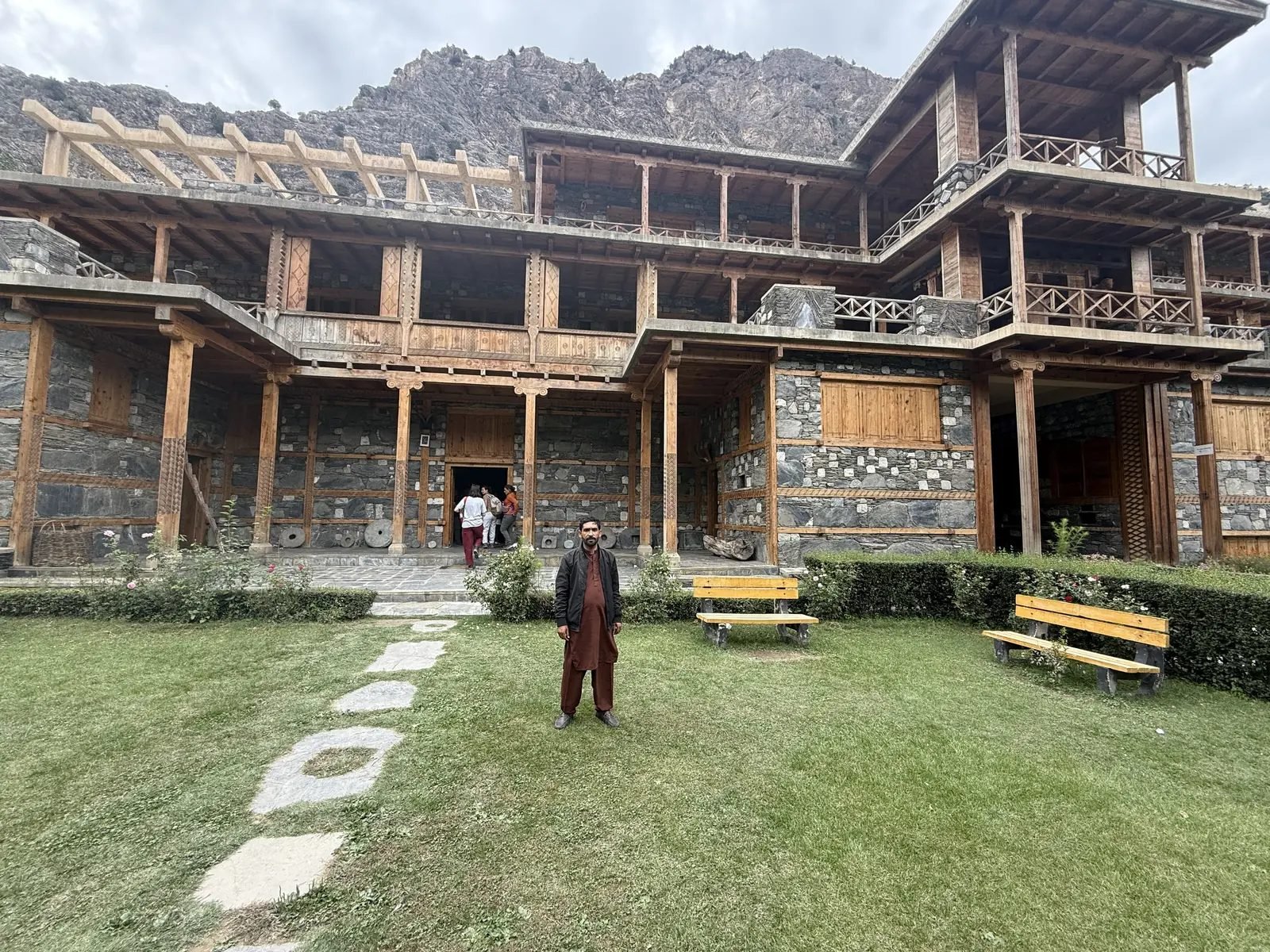
The Kalasha Dur Museum in Brun, Bumburet, built of stone and timber with wooden balconies.
We are a local company from Skardu, and we have guided travellers across northern Pakistan since 2015. This guide is written for travellers who want to visit with care. The Kalasha are a living community and our hosts, not an attraction, and a good visit starts with understanding a little of how they live.
Kalash at a glance
The Kalash valleys are three side valleys of the Chitral valley in Lower Chitral District, Khyber Pakhtunkhwa, home to the Kalasha community. Here are the key facts in one table. Heights are rounded, as they are on all our pages.
| Item | Details |
|---|---|
| Location | Three side valleys on the west of the Chitral (Kunar) valley, in Lower Chitral District, Khyber Pakhtunkhwa, Pakistan |
| Valleys | Bumburet, Rumbur and Birir |
| Height of the villages | About 1,750 to 2,050 m |
| Population | About 7,466 Kalasha speakers (2023 census, including some Muslims); about 4,100 followers of the Kalasha religion (KVDA survey) |
| Language | Kalasha (Kalasha-mun), an Indo-Aryan language whose closest relative is Khowar |
| Religion | The Kalasha religion, with a creator god, Dezau, and a number of other deities |
| Festivals | Chilam Joshi (spring), Uchal (summer), Pul (autumn, Birir only) and Chaumos (winter) |
| Recognition | Suri Jagek on UNESCO's urgent-safeguarding list (2018); the valleys were added to the World Heritage Tentative List in 2026 |
| Nearest town | Chitral, about 1,500 m, about 34 to 35 km by road from Bumburet, Rumbur or Birir |
| From Islamabad by road | About 402 km to Chitral through the Lowari Tunnel: a long day on mountain roads |
Who are the Kalasha people?
The Kalasha are a small Indo-Aryan-speaking community of the Hindu Kush who have kept their own religion, language and festivals in three valleys near Chitral. They call themselves Kalasha, and their language is Kalasha-mun. In English you will see both "Kalash" and "Kalasha"; we use Kalasha for the people and the language, and "Kalash valleys" for the place, as most visitors do.
How many Kalasha are there?
The numbers depend on what you count. The 2023 census recorded 7,466 people in Pakistan with Kalasha as their mother tongue. That figure includes Kalasha-speaking families who have become Muslim. The followers of the Kalasha religion are fewer: a survey by the Kalash Valleys Development Authority (KVDA), a provincial body, as reported in the press, counted about 4,100 followers. Most people who live in the three valleys today are Muslim, and the two communities live side by side, often as neighbours.
Either way, this is a small community. When you visit, you are a guest in villages where each family's fields, goats and festival preparations matter to the whole valley.
Religion
The Kalasha follow their own ancient religion, separate from the faiths of their neighbours. We explain the main ideas below.
Language
Kalasha is an Indo-Aryan language of the Dardic group; its closest relative is Khowar. Ethnologue lists Kalasha as vigorous, while some researchers consider it threatened; before the 2023 census, academic estimates put its speakers at 3,000 to 5,000.
Where are the Kalash valleys?
The three Kalash valleys lie on the west side of the Chitral valley, south of Chitral town, in Lower Chitral District. Bumburet and Rumbur are reached from the village of Ayun, about 21 km by road from Chitral; the two valleys join below their villages. Birir is reached separately, from Gahirat on the Chitral to Drosh road further south.
Think of it as a short branch road from the main valley. From Chitral you drive south along the Chitral River to Ayun (about 1,400 m), then turn west up a narrow side valley. The road climbs beside a stream, through walnut and fruit trees, and splits: one branch runs into Bumburet, the other into Rumbur. Birir has its own road from the main valley, so going from Bumburet to Birir means driving back down through Ayun (about 24 km in all).
| Valley | Main villages | Height | Character | Where guests stay |
|---|---|---|---|---|
| Bumburet | Brun, Anish and other villages | About 1,850 to 2,050 m | Most of the guesthouses; home of the Kalasha Dur Museum and the closing ceremony of Chilam Joshi | Guesthouses and small hotels in Brun and Anish |
| Rumbur | Grom (Grum) | About 1,850 to 1,950 m | Quieter, with a few family guesthouses; the shrine of Sajigor | A few family guesthouses in Grom |
| Birir | Birir, Behal Birir (upper village) | About 1,750 to 2,050 m | The southernmost valley, with very limited lodging; the only valley that holds Pul | Very limited lodging; simple guesthouses |
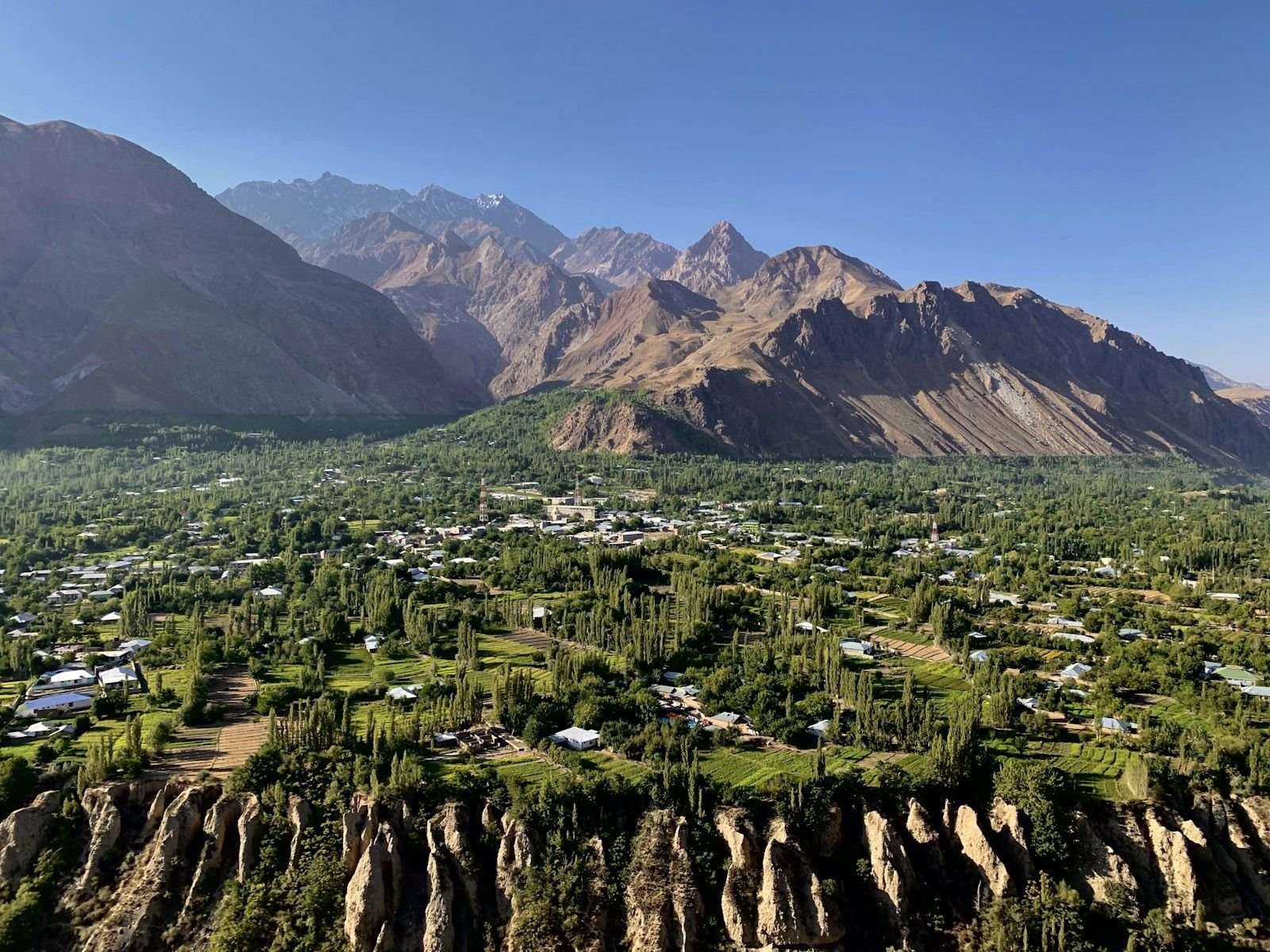
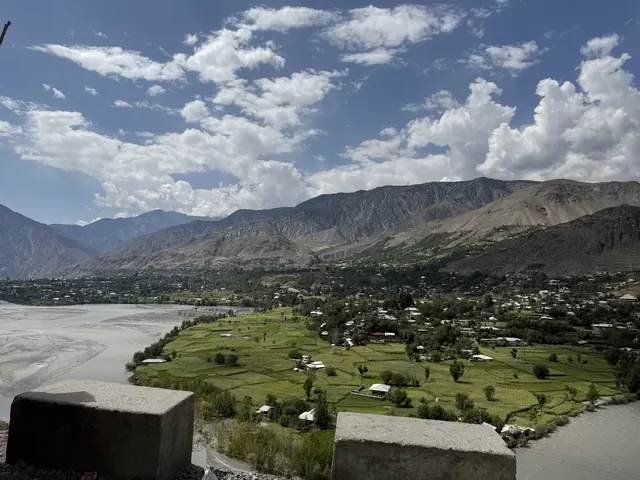
A green valley of villages and poplars below the Hindu Kush in Chitral.
Bumburet
Bumburet is the valley most visitors see first. Anish (about 1,850 to 1,900 m) lies lower down and Brun (about 1,950 m) further in. The Kalasha Dur Museum stands in Brun at about 2,000 m. Bumburet has most of the guesthouses, and the closing ceremony of the spring festival, Chilam Joshi, takes place here. As across the three valleys, many residents are Muslim, so you will see Kalasha and Muslim homes, fields and families side by side.
Rumbur
Rumbur branches off to the north of Bumburet, and Grom (about 1,950 m), about 12 km by road from Brun, is where guests stay. It has fewer guesthouses than Bumburet and a slower rhythm. The shrine of Sajigor is in Rumbur. If you would like quiet days, short walks between villages and time to talk with your hosts, Rumbur is a good choice.
Birir
Birir is the southernmost valley, reached from Gahirat, and its villages run from about 1,750 m up to about 2,050 m at Behal Birir. It has very limited lodging. Birir holds the autumn festival, Pul, which no other valley celebrates, and its elders fix the day that ends the ban on picking grapes and walnuts before the festival. Our Kalash Valley Tour spends a full day in Birir.
Kalasha religion and sacred places
The Kalasha religion honours a creator god, Dezau, and several other deities, and it divides the world into pure (onjesta) and impure (pragata) places, animals and times. It is a living faith, practised at open-air altars, in the family hall called the Jestak han and through the four seasonal festivals. What follows is a short, respectful outline, not a complete account; Kalasha elders and scholars know far more.
The deities
At the head of the Kalasha religion is Dezau (also written Dezaw or Desau), the creator god. Below him stand a number of deities with their own shrines and roles. Sajigor has his shrine in Rumbur; according to a Kalasha legend, it was founded where an arrow landed. Warin is described in academic work as the mightiest of the gods. Praba and Mahandeo are also honoured, and men pray at the Mahandeo shrine for health and fertility in spring, according to accounts recorded in the valleys. Jestak is the goddess of the home, family and marriage. Kalasha tradition is also said to link the winter festival with Balumain, a culture hero.
The shrines are not buildings like churches or temples. The main altars are open-air, often a stone platform marked with carved wooden horse heads. Goats are offered there, with a fire of juniper. You may pass these places on a village walk. Look from a distance, do not touch anything, and do not step onto an altar.
Pure and impure: onjesta and pragata
Much of Kalasha life follows the idea of onjesta (pure) and pragata (impure). Together with other rules of custom, this is called dastoor. Onjesta belongs to the high places: the mountains and high pastures, juniper and holly-oak, the markhor, goats, honey bees, altars and goat stables. Pragata belongs to the lower valley: onions and garlic, cattle, sheep, hens and eggs, the graveyard and the Bashali. Women are in the pragata sphere at certain times, such as during menstruation and childbirth. That is why the upper parts of a valley are treated as pure and why the women's house is built below the village.
It is not a list of good and bad things but a way of keeping two spheres apart. It also explains customs that puzzle visitors: many Kalasha avoid chicken and eggs, goats are the pure animal and the usual offering, and juniper smoke is used in ritual. The high pastures and peaks are said to be the home of gods and of fairies, called suchi.
The Jestak han
The Jestak han is the house of Jestak, the goddess of domestic life, family and marriage. Each lineage has its shrine there. It is a sacred place and a gathering place for the community: when a respected person dies, the body lies there while the community says farewell. Enter only if you are invited, and do not touch shrine objects.
The Bashali
The Bashali is the women's house, used during menstruation and childbirth; children are born there. It is also a social space, where women spend time together, talk and rest from work. Dezalik, a goddess who protects mothers and babies, is said to be represented inside. Men are not allowed in the area, and visitors of any gender should not enter or photograph it. Your guide will point it out so you can keep your distance.
Graveyards
The dead are traditionally laid above ground in ornamented wooden coffins, and wooden effigies called gandau stand at the graves of honoured people. These are family graves and sacred ground. Please do not touch the coffins or the effigies, do not move or take anything, and photograph only from a respectful distance, if at all.
Daily life in the Kalash valleys
The Kalasha are farmers and herders: families grow wheat, maize, beans, walnuts and fruit on small fields and keep goats, which spend the summer on high pastures. Tourism brings extra income, but daily life still follows the seasons of the fields and the herds.
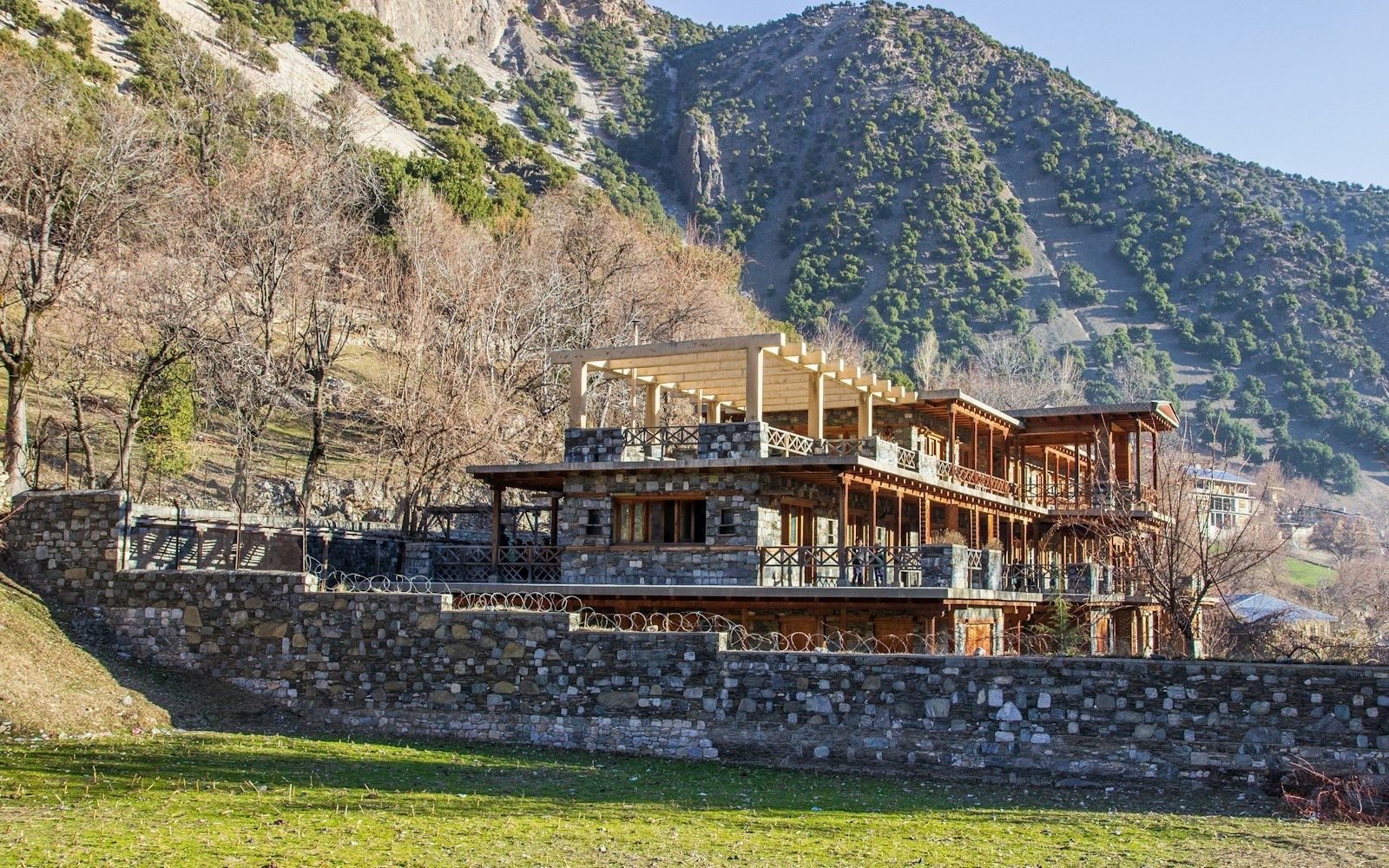
A stone and timber house with a dry-stone wall in Chitral.
Dress
Kalasha women wear a long black dress, the cew (also spelled chew), embroidered in bright colours and tied at the waist with a woven sash. Women are said to make and embroider their dresses themselves, often a new one for a festival. Bead necklaces are traditionally worn in layers, with more added for festivals. On their heads they wear the shushut, an everyday woollen headband. On festival days and special occasions many add the kupas, a larger headdress covered in cowrie shells, beads and small bells, worn on top of the shushut.
Houses and villages
Kalasha villages are built of wood and stone and climb the hillsides rather than spreading over the valley floor. Houses sit close together, almost stacked upon one another, so the flat roof of one house is often the terrace of the house above. A local carpenter told a reporter that the old villages were placed on raised ground on purpose, away from the floods of the valley floor.
Fields, food and pastures
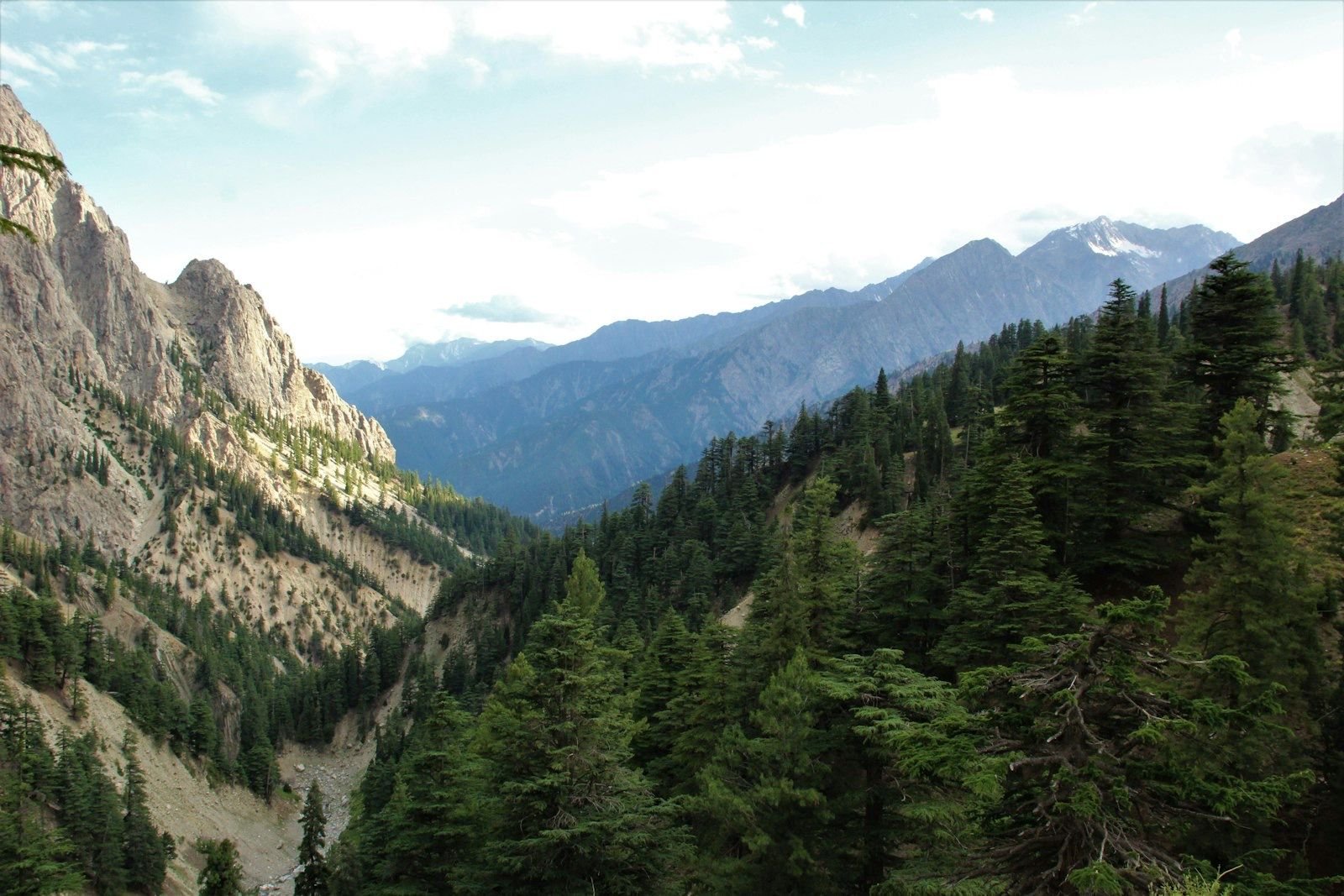
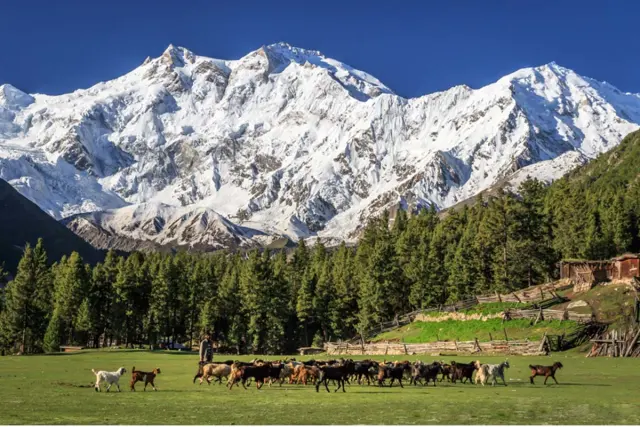
A pine forest on the slopes of a Hindu Kush valley in Chitral.
Each family farms small fields of wheat, maize and beans, with walnut, apricot, apple and grape trees around the village. Goats are at the centre of the economy and of the religion. At the start of summer, families take goats and sheep up to the high pastures, where men and boys traditionally tend them. Goat milk, cheese and butter are staples, especially in winter, and cheese made on the high pastures is carried down for the summer festival, Uchal.
The farming year sets the rhythm of every visit. Spring is sowing time and brings Chilam Joshi; summer is busy in the fields and on the pastures; autumn is the harvest of grapes and walnuts; winter is quieter and colder, and ends the year with Chaumos. Ask your host about the season's work: it is one of the best ways to start a conversation.
Family and marriage customs
Marriages may be arranged by families, but a couple may also choose each other and elope, a recognised custom that the families settle with the help of elders. This is a private part of community life, so we keep this section short and to what scholars have recorded.
Kalasha women often describe themselves as free. That phrase gave its title to an anthropological study of Kalasha women, Wynne Maggi's Our Women Are Free (2001), which looks at women's choice (chit), their work, their ritual life and the Bashali. Scholars have recorded marriage by elopement as a recognised and fairly frequent custom: a woman may leave a marriage by eloping with another man, and elders then help the two families reach a settlement. Arranged marriages also take place, and love marriages are said to have become more common in recent decades.
Death is also a time when the whole community comes together. When a respected elder dies, people gather for about three days in the Jestak han. They sing, play music, dance and recount the person's life, and the family feeds every guest who comes from the three valleys. It is a farewell and a celebration of a life, not a silent mourning. Funerals are a time of mourning for the whole community, so visitors should keep away unless the family invites them.
The Kalasha festivals
The Kalasha celebrate four great festivals: Chilam Joshi in spring, Uchal in summer, Pul in autumn (Birir only) and Chaumos in winter. The dates are set each year by the Kalasha community. Elders fix the days by their own calendar, which rests partly on Suri Jagek, the observation of the sun against the mountains, so the dates move a little from year to year and can differ between valleys. We confirm each year's dates before every departure.
| Festival | Usual timing | Valleys | Meaning |
|---|---|---|---|
| Chilam Joshi (Joshi) | Mid-May, about four to five days | All three; the closing ceremony is in Bumburet | Welcomes spring and the move of the herds towards the pastures |
| Uchal (Uchau) | Around 20 to 23 August, about two days | Bumburet and Rumbur | Thanksgiving for the harvest and the dairy, and for the herders' return |
| Pul (Phool, Poo'n) | Late September or October, on a date set by Birir elders | Birir only | Autumn harvest of grapes and walnuts |
| Chaumos (Chawmos) | About two weeks in December, ending near the winter solstice | All three, starting in one valley | The winter solstice and the Kalasha new year |
Chilam Joshi: the spring festival
Chilam Joshi is the spring festival. It usually falls in mid-May and lasts about four to five days, moving between the three valleys and ending with a closing ceremony in Bumburet. Women wear new dresses and their festival kupas, and the villages fill with song and dance. It welcomes the spring and the season when families take their goats and sheep up towards the pastures. It is also the busiest time for visitors, so book early.
Uchal: the summer festival
Uchal is a summer thanksgiving, usually around 20 to 23 August, held in Bumburet and Rumbur. It gives thanks for the harvest and the dairy season, and it welcomes back the herders from the high pastures; cheese made in the pastures is brought down for it. At about two days, it is shorter than Chilam Joshi, and our August departure of the Kalash Valley Tour is timed with it.
Pul: the autumn festival of Birir
Pul (also written Phool) belongs to Birir alone. It marks the autumn harvest, and before it the elders of Birir fix the day that ends the ban on picking grapes and walnuts. It usually falls in late September or October, on a date the Birir elders set each year, so it is the hardest festival to plan for. If you would like to see it, tell us early and we will follow the announcement for you.
Chaumos: the winter festival
Chaumos is the longest festival, lasting about two weeks in December and ending near the winter solstice. It marks the Kalasha new year and usually starts in one valley before moving to the others. Some parts are private: according to local accounts, non-Kalasha are asked to keep away from Kalasha homes during certain days. Chaumos is cold, with snow possible, so it suits travellers who are comfortable with winter conditions; see our guide to winter treks in Pakistan for what winter travel in the north is like.
Our Kalash Valley Tour is timed with the festivals, with departures for Chilam Joshi in May, Uchal in August and Chaumos in December. At every festival, please watch from the edges, do not block the dancers, and join in only if you are invited.
History and origins of the Kalasha
The Kalasha are the last people of the wider Hindu Kush who kept their pre-Islamic religion; genetic studies show they are a distinct, long-isolated population. Here is what history, linguistics and genetics tell us, in brief.
From Kafiristan to the Kalash valleys
The Kalasha once shared their old religion and culture with neighbouring peoples across the Hindu Kush, in the region then called Kafiristan, west of Chitral. In the winter of 1895 to 1896 that region was converted to Islam and renamed Nuristan. The Kalasha lived in Chitral, outside Kafiristan, so they were not part of that conversion, and they remain the last community keeping the old faith. Kalasha oral tradition speaks of ancestors who came from the west or south-west, from a homeland remembered as Tsiyam.
For centuries the valleys were part of the princely state of Chitral, ruled by the Mehtars from Chitral Fort, which still stands beside the Shahi Mosque on the Chitral River. The former state later joined Pakistan, and Chitral is now part of Khyber Pakhtunkhwa province. Over the twentieth century many Kalasha-speaking families became Muslim, which is why Muslims are now the majority in the three valleys.
The Alexander legend and the genetic studies
You will often hear that the Kalasha descend from the soldiers of Alexander the Great. It is a popular legend that genetic studies have not supported. Earlier Y-chromosome and mitochondrial DNA studies found no support for Greek descent, and a 2007 study in the European Journal of Human Genetics notes that earlier work had excluded any substantial Greek genetic input. Scholars of the Kalasha treat the story as legend.
A 2015 study in the American Journal of Human Genetics (Ayub and colleagues) used genome-wide data. It found the Kalasha to be a distinct population that has been isolated for a very long time, with no detectable gene flow from their neighbours. It estimated that they separated from other populations of the region about 11,800 years ago, and described them as present-day descendants of some of the earliest migrants into the Indian subcontinent from West Asia. Their language, Kalasha, is an Indo-Aryan language of the Dardic group, closest to Khowar.
Writing the Kalasha language
Kalasha was long a spoken language only. Early efforts to write it used the Arabic script, and around 2000 a Roman-based alphabet was adopted. Australian linguists Gregory and Elsa Cooper worked with the community on it from the 1980s. Teachers trained at the Kalasha Dur school in Bumburet are said to have taken the alphabet into the valleys' primary schools, and community committees of elders and women are reported to have helped publish primers and record folk tales.
Recognition by UNESCO and Pakistan
In 2018 UNESCO inscribed Suri Jagek ("observing the sun") on its List of Intangible Cultural Heritage in Need of Urgent Safeguarding. It is the Kalasha practice of observing the sun, moon and stars against the local mountains to set the dates of social events, festivals, feasts and religious ceremonies. In 2026 the "Kalasha Valley cultural landscape" of Bumburet, Birir and Rumbur was added to Pakistan's UNESCO World Heritage Tentative List; this is a first step, not World Heritage inscription. In Pakistan, the Khyber Pakhtunkhwa government approved the Kalash Valleys Development Authority (KVDA), a provincial body, in 2020 to protect the valleys' culture and guide building and development.
The Kalasha Dur Museum in Bumburet
The Kalasha Dur Museum in Brun, Bumburet, is the best place to start a visit: it introduces Kalasha culture before you walk through the villages. It stands at about 2,000 m in Brun, a stone and timber building with wooden balconies.
Greek volunteers built Kalasha Dur between 2001 and 2005 with Hellenic Aid support, and it formally opened in May 2006. It is now overseen by the Khyber Pakhtunkhwa Directorate of Archaeology and Museums.
A museum is the right place for close looking and questions. Time here means you can learn about Kalasha life without intruding on anyone's home or shrine, and arrive in the villages ready to listen.
How to visit the Kalash valleys with respect
Ask before you photograph anyone, keep away from the Bashali, shrines and graves, watch festivals from the edges and dress modestly. These are simple rules, and following them shows respect for your hosts.
Intrusive photography has been a real problem in the valleys. Posters in Bumburet ask visitors to get permission before taking photos, and some Kalasha women have started to veil because of intrusive photography. Please treat every person as you would want your own family treated at home.
- Photos: ask before you photograph anyone, especially women, and accept a "no" with a smile. Never photograph people from a distance with a long lens. Guides advise against paying people for photos.
- The Bashali: do not enter, approach or photograph the women's house. Men are not allowed in the area.
- Shrines, altars and the Jestak han: enter only if you are invited, and never touch shrine objects or carvings.
- Graveyards: do not touch the coffins or the effigies, do not take anything, and keep your camera down.
- Festivals: watch from the edges, do not block the dancers or step into the circle, and join a dance only if you are invited. Some parts of Chaumos are private.
- Dress: dress modestly, with shoulders and knees covered, as you would anywhere in Pakistan.
- Homes: do not walk into a house or onto a roof terrace uninvited. Remember that a roof may be the terrace of the family above.
- Buying crafts: if you would like a souvenir, such as embroidery or beadwork, buy it directly from the maker or her family and pay the price asked.
Our local guides will tell you quietly when you are near a place that should not be photographed. If you are ever unsure, ask your guide first.
How to get to the Kalash valleys
Most travellers reach the Kalash valleys by road from Islamabad or Peshawar, through Chakdara, Dir and the Lowari Tunnel to Chitral, then on to Ayun and the valleys. It is a long day on mountain roads, so we plan the day with a stop at Chakdara for a meal or tea.
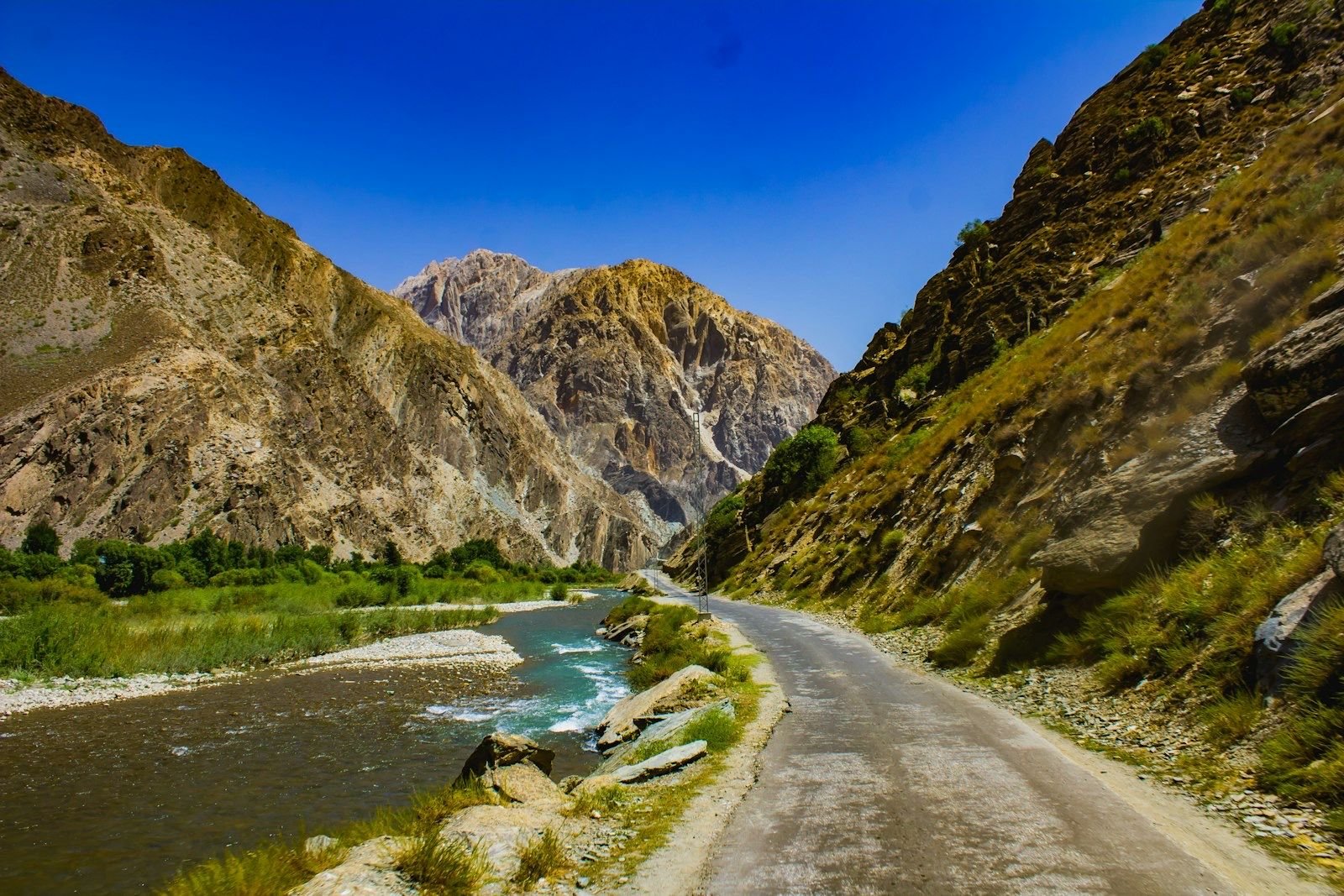
A mountain road along a river in Chitral.
From Islamabad the road follows the motorway to the Swat Motorway, then runs through Chakdara (about 700 m), Timergara and Dir (about 1,400 m) to the Lowari Tunnel. The tunnel carries the N-45 under the Lowari Pass (about 3,120 m). Its main bore is 8.5 km long, with a second tunnel of 1.9 km, and it was inaugurated on 20 July 2017. Before the tunnel, the pass road used to close for much of the winter. From the tunnel the road descends past Drosh to Chitral (about 1,500 m). On our tour we stop at Chakdara for a meal or tea on the way.
From Chitral you drive south to Ayun and turn west into the Kalash valleys, or continue south to Gahirat for Birir. These last kilometres are narrow and slow. Flights between Islamabad and Chitral are irregular and depend on the weather, so we never build a trip around them.
| Route | Distance by road |
|---|---|
| Islamabad to Chitral | About 402 km |
| Peshawar to Chitral | About 333 km |
| Chitral to Ayun | About 21 km |
| Chitral to Brun (Bumburet) | About 34 km |
| Ayun to Brun (Bumburet) | About 13 km |
| Brun (Bumburet) to Grom (Rumbur) | About 12 km |
| Chitral to Grom (Rumbur) | About 35 km |
| Chitral to Birir | About 35 km |
| Brun (Bumburet) to Birir, via Ayun | About 24 km |
| Chitral to Garam Chashma hot springs | About 45 km |
Distances come from a road-routing engine and are rounded. Driving times on these roads depend on traffic, roadworks and the weather, so we do not quote them here; ask us for the current plan. While you are in Chitral, it is worth seeing the Shahi Mosque, built between 1919 and 1924 beside Chitral Fort, and on a clear day the view of Tirich Mir (7,708 m), the highest peak of the Hindu Kush, from the town.
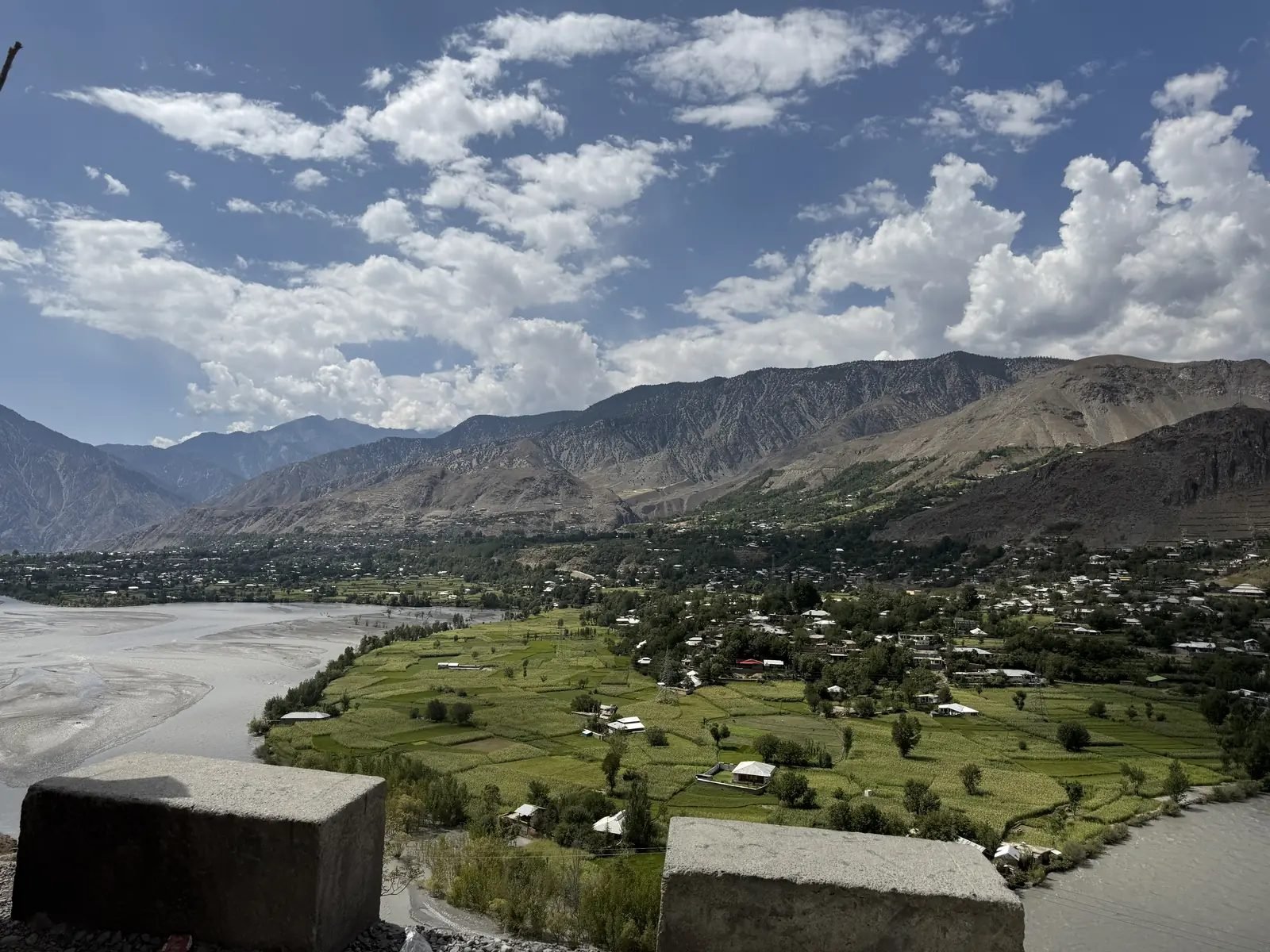
Chitral town, green fields and the Chitral River from above.
Best time to visit the Kalash valleys
The best months to visit are May to October, with mid-May (Chilam Joshi) and late August (Uchal) the favourites; December brings Chaumos but also cold weather and possible snow. Choose by festival first, then by weather.
The figures below are long-term averages (NOAA WMO normals for 1971 to 1990) for the weather station in Chitral town, at about 1,500 m. There is no weather station in the Kalash valleys. The villages are about 400 to 500 m higher than Chitral, so expect them to be somewhat cooler, especially at night.
| Month | Mean max °C | Mean min °C | Rain mm |
|---|---|---|---|
| Jan | 8.8 | −0.6 | 38.4 |
| Feb | 9.9 | 0.6 | 63.8 |
| Mar | 15.1 | 4.2 | 97.3 |
| Apr | 22.5 | 8.5 | 71.7 |
| May | 28.2 | 12.5 | 43.9 |
| Jun | 34.4 | 17.8 | 5.1 |
| Jul | 35.9 | 20.2 | 4.9 |
| Aug | 34.4 | 18.7 | 8.0 |
| Sep | 31.1 | 13.1 | 7.3 |
| Oct | 25.1 | 7.2 | 15.6 |
| Nov | 18.7 | 2.9 | 20.4 |
| Dec | 11.6 | 0.2 | 38.5 |
| Year | 23.0 | 8.8 | 414.9 |
- March and April: the wettest months in Chitral, with spring storms. Expect some rain.
- May: Chilam Joshi, green fields and warm days. The most popular month, so book early.
- June to September: very dry and hot in Chitral town (about 34 to 36 °C), somewhat cooler in the valleys. Uchal falls in late August.
- September and October: the grape and walnut harvest and Pul in Birir. Cool nights.
- November to February: cold, with Chaumos in December. Snow can close the Lowari Tunnel road for days at a time, so winter trips need spare days.
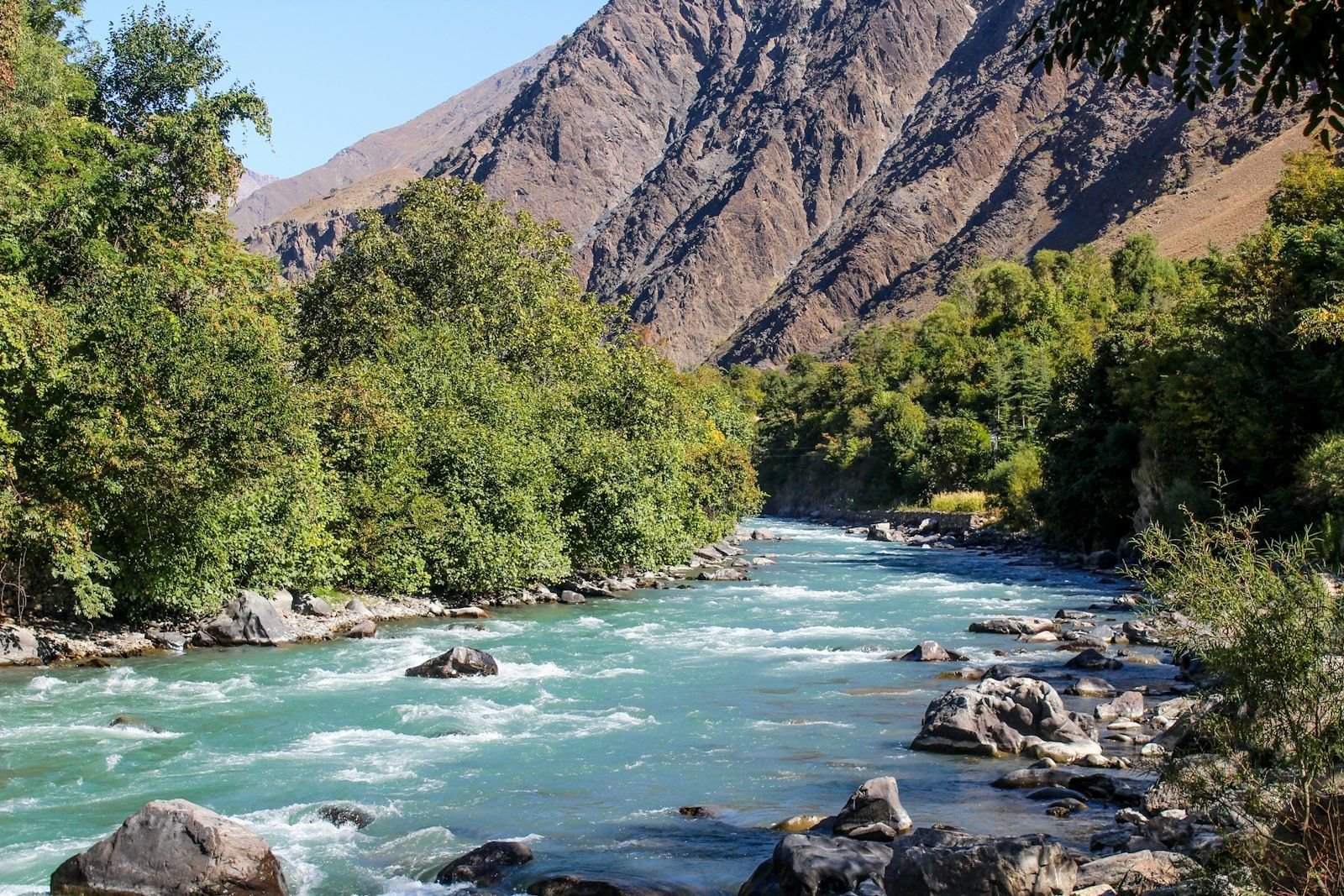
The Chitral River between green trees and dry mountains.
Where to stay in the Kalash valleys
Guests stay in family-run guesthouses and small hotels, mostly in Brun and Anish in Bumburet and in Grom in Rumbur; Birir has very limited lodging. Staying with a Kalasha or local family is part of the experience.
Bumburet has most of the lodging, from small hotels to rooms in family guesthouses run by Kalasha and other local families. Rumbur has a handful of family guesthouses in Grom. Birir has very few places to stay, so our tour visits it for a day from Bumburet. Chilam Joshi is the busiest time, so festival trips should be booked well ahead.
Lodging in the valleys is simple. Bring a warm layer even in summer, since the villages are higher than Chitral, and a head torch.
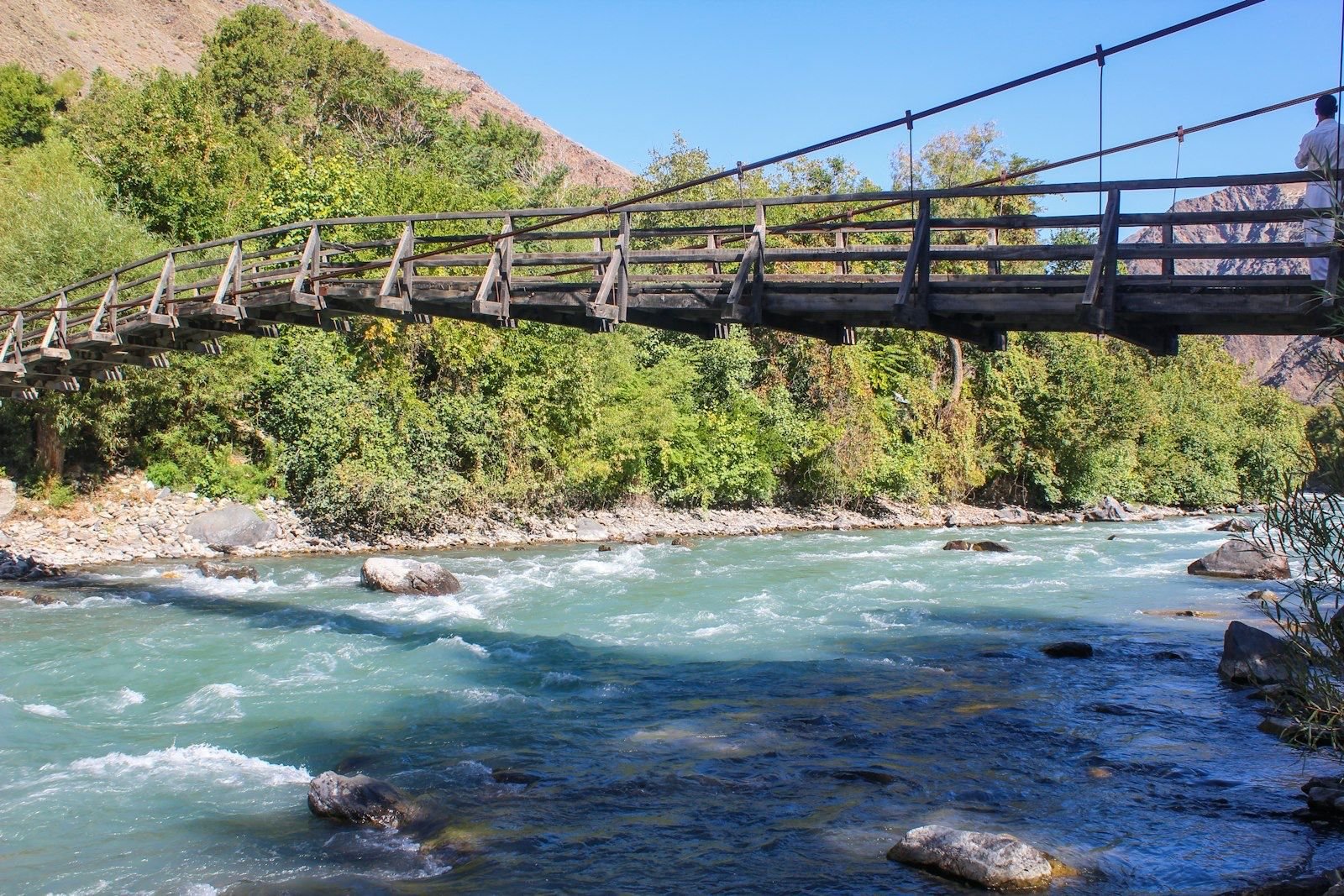
A wooden footbridge over a clear mountain river in Chitral.
Registration and permits for the Kalash valleys
Foreign guests need a valid Pakistan visa. We register your trip with the Khyber Pakhtunkhwa tourism authority and handle any local registration and community fees on your behalf. Rules can change, so we confirm the current requirements before every departure.
Apply for your visa online through the Pakistan Online Visa System. Our Pakistan visa guide explains how to apply. The Khyber Pakhtunkhwa tourism authority runs a tourist registration page for foreign tourists, which asks for the tour company, the guide, the driver, the vehicle, the itinerary and the passport and visa details of each guest. We complete it for you before the trip.
Keep your passport and a few copies of your visa with you throughout the trip. For broader planning, read our tourist guide to travelling in Pakistan.
Visit the Kalash valleys with us
Our 7-day Kalash Valley Tour from Islamabad or Peshawar is timed with the Kalasha festivals; for a longer journey, our Chitral to Hunza Tour adds two nights in the Kalash valleys to Shandur Pass, Hunza and Skardu. All our trips run in small groups of at most 12, with local, licensed guides.
| Trip | Days | From | What it includes |
|---|---|---|---|
| Kalash Valley Tour | 7 | USD 1,500 | Departures timed with Chilam Joshi (May), Uchal (August) and Chaumos (December); by road via the Lowari Tunnel; three nights in Bumburet, a visit to Rumbur, a day in Birir and a night in Chitral |
| Chitral to Hunza Tour | 15 | USD 2,000 | Two nights in the Kalash valleys, Shandur Pass, Hunza and Skardu |
The Kalash Valley Tour starts in Islamabad or Peshawar and follows the road through Chakdara and the Lowari Tunnel. You spend three nights in Bumburet, with time in Rumbur, a full day in Birir and a night in Chitral. It is our main Kalash trip, and we time departures so that guests can see a festival with an experienced guide at their side.
If you have more time, the Chitral to Hunza Tour links the Kalash valleys with the high road over Shandur Pass (about 3,700 m) to Hunza and Skardu. Read our Hunza Valley guide to see what waits on the other side, or pair Chitral with our Fairy Meadows and Hunza Tour (from USD 1,200). Climbers may know Chitral for its peaks too: our Koyo Zom Expedition climbs the highest peak of the Hindu Raj (6,872 m), on the boundary of Upper Chitral and Gilgit-Baltistan.
Would you like a private trip, a festival date or a different start? Contact us and tell us when you would like to travel. We are a local company with offices in Skardu and Islamabad, and we will plan the journey with you.
Frequently asked questions
Are the Kalash people Muslims?
The Kalasha follow their own ancient religion, with a creator god, Dezau, and their own festivals. Most people living in the three valleys today are Muslim, including some Kalasha-speaking families, and the two communities live side by side. A survey by the Kalash Valleys Development Authority counted about 4,100 followers of the Kalasha faith.
Where do the Kalash people live?
The Kalasha live in three side valleys on the west of the Chitral valley, in Lower Chitral District, Khyber Pakhtunkhwa, Pakistan: Bumburet, Rumbur and Birir. Their villages lie at about 1,750 to 2,050 m. Bumburet and Rumbur are reached from Ayun, and Birir from Gahirat, each about 34 to 35 km by road from Chitral town.
How many Kalasha are there?
A few thousand. The 2023 census counted 7,466 people in Pakistan with Kalasha as their mother tongue, a figure that includes Kalasha-speaking Muslims. Followers of the Kalasha religion are fewer: a survey by the Kalash Valleys Development Authority, as reported in the press, counted about 4,100. Most people living in the three valleys today are Muslim.
What language do the Kalash speak?
The Kalasha speak Kalasha (Kalasha-mun), an Indo-Aryan language of the Dardic group whose closest relative is Khowar. It was long a spoken language only. Since around 2000 it has had a Roman-based alphabet developed with the community. Ethnologue lists it as vigorous, while some researchers consider it threatened.
What is Kalash Valley famous for?
Its living Kalasha culture: the Kalasha religion and its four seasonal festivals (Chilam Joshi, Uchal, Pul and Chaumos), a farming and herding way of life in wooden villages that climb the hillsides, and Suri Jagek, a sun-watching calendar on UNESCO's urgent-safeguarding list. In 2026 the valleys were also added to Pakistan's World Heritage Tentative List.
Where do the Kalash people come from?
Kalasha oral tradition speaks of ancestors who came from the west, from what is now Nuristan. A popular legend links them to the soldiers of Alexander the Great, but genetic studies have not supported it. A 2015 study found that the Kalasha have been a distinct, isolated population for many thousands of years, with roots among some of the earliest people to reach South Asia.
How do the Kalasha marry?
Marriages may be arranged by families, but a couple may also choose each other and elope. Elopement is a recognised Kalasha custom, and elders help the two families settle it. Weddings and family life are private matters for the community, so visitors should not ask to attend unless a family invites them.
When are the Kalash festivals?
Chilam Joshi in mid-May, Uchal around 20 to 23 August, Pul in Birir in late September or October, and Chaumos in December, ending near the winter solstice. The exact dates are set each year by the Kalasha community; we confirm them before each departure of our Kalash Valley Tour.
Which Kalash valley should I visit?
Each valley has its own character. Bumburet has the Kalasha Dur Museum, most of the guesthouses and the closing ceremony of Chilam Joshi. Rumbur is quieter, with a few family guesthouses in Grom and the shrine of Sajigor. Birir has very limited lodging and is the only valley that holds Pul. If you can, see all three: our tour stays in Bumburet and visits Rumbur and Birir.
How far is the Kalash valley from Chitral and Islamabad?
Bumburet (Brun) is about 34 km by road from Chitral, and Rumbur and Birir about 35 km each. Chitral is about 402 km by road from Islamabad and about 333 km from Peshawar, through the Lowari Tunnel: a long day on mountain roads.
Can visitors take photos in the Kalash valleys?
Yes, of the landscape and the villages, but always ask before you photograph a person, especially women, and accept a refusal. Posters in Bumburet ask visitors for permission first. Never photograph the Bashali, do not photograph shrines, graves or private moments of a festival without permission, and do not pay people for photos.
Do I need a permit to visit the Kalash valleys?
Foreign guests need a valid Pakistan visa. We register your trip with the Khyber Pakhtunkhwa tourism authority and handle any local registration and community fees on your behalf. Apply for the visa online through the Pakistan Online Visa System; our Pakistan visa guide explains the steps. Rules can change, so we confirm the current practice before every departure.
About the author
Imtiyaz Ahmed Shigri founded Chogori Adventure in Skardu in 2015. Our guides are local, government-licensed and English-speaking, and most of them are trained in first aid. We are licensed by the Department of Tourist Services (licence no. 2494) and the Gilgit-Baltistan tourism department (licence DTS-GB-055), and we are a member of the Pakistan Association of Tour Operators, with offices in Skardu and Islamabad.
Rated 4.9 out of 5 from 47 reviews on Google (November 2026). Read our reviews on Google