Best Time for the Gondogoro La: Season and Weather
By Imtiyaz Ahmed Shigri, founder of Chogori Adventure, Skardu · Updated November 2026
The best time for the Gondogoro La (5,585 m) is from the end of June to the end of August. From mid-June to the end of September the crossing is still feasible: early in the season there is more snow, later more loose rock. Our trips run from mid-June to early October, and the last groups of the season reach the pass in October. The crossing always depends on the snow, the weather and the fixed ropes. If the crossing is not possible, the group walks back down the Baltoro Glacier instead. Below is what to expect month by month, with real station figures for Skardu and clearly marked estimates for the high camps.
In short: the Gondogoro La sits in the rain shadow of the Himalaya, so the summer monsoon that soaks Nepal from June to September reaches it only weakly. The weather station in Skardu (2,230 m) records on average only about 9–12 mm of rain a month from June to September. That is why the Karakoram trekking season is the summer, while the Nepal passes are crossed in spring and autumn. The pass is high, though, and the weather up there is far less settled than in Skardu, so snow and storms still decide each crossing.
Gondogoro La season at a glance
| Season | |
|---|---|
| Best time | End of June to end of August: the most settled weather, ropes in place |
| Still feasible | Mid-June to end of September |
| Our trips | Mid-June to early October; the last groups reach the pass in October |
| Fixed ropes | Fixed each season by a local rescue team from Hushe, usually from mid to late June |
| If the pass is not possible | The group walks back down the Baltoro Glacier to Askoli |
| Winter | November to May: deep snow and extreme cold; the pass is not crossed |
| Late September | Still feasible, but crossings are often not confirmed until shortly before, because they depend so much on snow and weather |

When is the best time for the Gondogoro La?
The best time is the end of June to the end of August, because three things come together then: the fixed ropes are in place, the weather is at its most settled, and the snow on the pass freezes hard at night. Outside that window one or more of these is missing, and the crossing becomes slower, colder or less certain.
Why the end of June to the end of August works best
By the end of June the local rescue team from Hushe has fixed the ropes on both sides of the pass. The deep winter snow has settled and the days are long: Skardu gets about 14.5 hours of daylight in late June and still about 13.5 hours in mid-August. Nights on the glacier are cold enough to freeze the snow, which is what makes a night crossing work. In July and August the Skardu station records its warmest weather, with average highs of about 31°C, and the high camps are at their least cold, with daytime temperatures of about 10–15°C.
Why mid-June and September are still feasible
In mid-June there is more snow on both sides of the pass, the ropes may only just have been fixed, and the nights are colder. The crossing takes longer, but no mountaineering experience is needed. In September the weather is often clear, but the nights get colder each week, the descent is mostly bare, loose rock, and the first autumn snow can fall on the pass. Both are workable months for a fit trekker with the right clothing.
Why late-September crossings are often not confirmed
The Gondogoro La depends very much on snow and weather. By late September a single storm can leave fresh snow on the pass that does not freeze into a firm surface, and the shorter, colder days leave less margin. So for groups that reach the pass in the last week of September, we often cannot confirm the crossing until shortly before. If crossing the pass matters most to you, choose a date in the best time.
Month by month
| Month | Weather | On the pass |
|---|---|---|
| Mid-June | Less settled; showers lower down and snow higher up are possible | Feasible: more snow on both sides, and the ropes are fixed from mid to late June. Colder and slower, but no mountaineering experience is needed |
| End of June | More settled | The start of the best time: snow, firm in the cold of the night |
| July | Usually clear and settled; the warmest days | Best time: snow on the top slopes, firm in the cold of the night |
| August | Settled and warm, with occasional storms | Best time: the snow melts on the descent towards Khuspang (4,680 m) and turns to loose rock, so the early start matters even more |
| September | Often clear, colder nights | Still feasible to the end of the month: mostly rock on the descent, colder at night |
| October | Clear but cold, with the first autumn snow | Our last groups: the crossing depends on the snow and the conditions on the day |
The table gives the short version. Here is what each part of the season means on the ground.
Mid-June: snow, cold and the first crossings
Our first groups of the year reach the pass in mid-June. The rescue team from Hushe fixes the ropes from mid to late June, so the very first crossings depend on when the work is finished. Expect snow from Ali Camp (4,950 m) all the way down to Khuspang, and nights around −10 to −15°C at the high camps. Showers in the lower valleys and snow higher up are possible. Snow bridges over the crevasses on the upper glacier are usually stronger early in the season, but the route is still roped and led by our guide.
End of June: the start of the best time
By the end of June the weather is more settled and the ropes are in place. The snow on the top slopes is deep but firm in the cold of the night, and most groups keep crampons on for the whole descent. The days are the longest of the year, which gives the group more daylight on the long day down to Khuspang.
July: the most reliable month
July is usually the clearest and most stable month, and it has the warmest days in Skardu (average high 31.6°C, low 16.4°C). On the pass, snow still covers the top slopes and freezes at night. The heat is felt more on the lower Baltoro and in the Hushe valley than on the pass itself. July is also the main climbing month on Laila Peak and on the 8,000 m peaks, so the camps are busier.
August: warm, with more melt and loose rock
August is still part of the best time, with settled, warm weather and occasional storms. Skardu records its highest monthly rain of the summer in August, about 12 mm, which is still very little. On the Gondogoro side, the snow on the descent melts and turns to steep, loose rock and scree. Stones that the night frost holds in place start to move once the sun reaches them, so the early start matters even more in August.
September: clear days and colder nights
September often brings clear skies and good views, and the camps are quieter. Skardu still averages 27°C by day, but nights at the high camps drop to about −10 to −15°C. The descent is mostly rock, the snow on the top is old and hard, and fresh snow is possible after any storm. The first half of the month is normally workable; the last week is less certain, as explained above.
October: the last groups
Our last departures start in late September and early October, so these groups reach the pass in October, as late as about mid-October. Days are clear but cold, with about 11.5 hours of daylight in early October, and the first autumn snow often falls on the high ground. Whether the group crosses depends on the snow and the conditions on the day. Treat an October crossing as a chance, not a plan: if a crossing matters to you, travel earlier.
November to May: why the pass is closed
From November to May the pass is not crossed. Deep snow covers the approach from Concordia and both sides of the pass, there are no fixed ropes, and nights at 5,000 m fall far below −20°C. Even in Skardu the average January low is −8.0°C. Most of the year's snow falls in winter and spring: the Skardu station records about 90 mm from January to March, compared with about 40 mm from June to September.
Gondogoro La weather: what the station figures say
There is no long-term weather station on the Gondogoro La, so no one can give true monthly averages for the pass. The nearest long-term record is the Pakistan Meteorological Department (PMD) station at Skardu, 2,230 m. Its averages for the trekking months are below. They describe the valley where every trip starts and ends, not the pass.
| Skardu (2,230 m) | Average high | Average low | Rain | Humidity (afternoon) |
|---|---|---|---|---|
| June | 28.7°C | 13.4°C | 9.0 mm | 22% |
| July | 31.6°C | 16.4°C | 9.8 mm | 27% |
| August | 31.2°C | 16.0°C | 12.2 mm | 31% |
| September | 27.2°C | 11.4°C | 9.3 mm | 30% |
| October | 20.4°C | 4.3°C | 7.3 mm | 31% |
| January (for comparison) | 3.2°C | −8.0°C | 27.5 mm | 64% |
Source: PMD Climate Data Processing Centre, Karachi, averages for 1961–2009. These are long-term averages: any single year can be wetter, hotter or colder.
How we estimate the high-camp temperatures
Air gets colder as you climb. On the Baltoro Glacier, scientists ran two automatic weather stations in the summer of 2004, at Urdukas (4,022 m) and near K2 Base Camp (the station stood at about 5,030 m, a little below the camp). Over 8–26 July the air near K2 Base Camp was on average about 7.5°C colder than at Urdukas, which is a fall of about 0.75°C for every 100 m of height. At night the fall was steeper, up to about 1°C per 100 m. We apply these rates to the Skardu averages to estimate each camp. The results are approximate: wind, cloud and the cold air that pools over the glacier can change them by several degrees on any night.
The same 2004 study is a useful reminder that the high glacier is wetter than Skardu. The Urdukas station recorded 85.4 mm of precipitation between 18 June and 1 August 2004, several times what Skardu receives in the same weeks in an average year. Up high, an afternoon shower is common, and it often falls as snow on the upper glacier.
Temperatures on the Gondogoro La side
In July and August, expect about 10–15°C by day at the high camps and about −5 to −10°C at night; in June and September, about 5–10°C by day and −10 to −15°C at night. The table below is the short version; the camp-by-camp table after it gives approximate figures for July.
| Period | Day (high camps) | Night (Ali Camp, Khuspang) |
|---|---|---|
| July and August | About 10–15°C | About −5 to −10°C |
| June, September | About 5–10°C | About −10 to −15°C |
| Place (July, approximate) | Day | Night |
|---|---|---|
| Hushe, 3,150 m | About 25°C | About 7–10°C |
| Saicho, 3,350 m | About 23°C | About 5–8°C |
| Concordia, 4,691 m | About 13°C | About −2 to −8°C |
| Khuspang, 4,680 m | About 13°C | About −2 to −8°C |
| Ali Camp, 4,950 m | About 11°C | About −4 to −10°C |
| Gondogoro La, 5,585 m | About 0 to 5°C (estimate) | About −10 to −16°C before dawn (estimate) |
These are estimates from the Skardu averages and the Baltoro temperature fall described above, not measurements. In June and September, take off about 3–4°C. Out of the wind and in full sun, a tent or a sheltered rock can feel much warmer than the air; in wind on the pass at night, it can feel 10°C colder.
Wind and the altitude make it feel colder, especially on the night climb to the top. Lower down in the Hushe valley, days are warm in summer. For the whole K2 route, see the month-by-month table in our K2 Base Camp Trek guide.
Snow conditions on the Gondogoro La
The top slopes of the Gondogoro La are snow-covered all summer. What changes through the season is the descent: it is mostly snow in June and July, and from August it turns to loose rock and scree. Fresh snow can fall in any month, and after a storm it needs a cold night to freeze before the crossing.
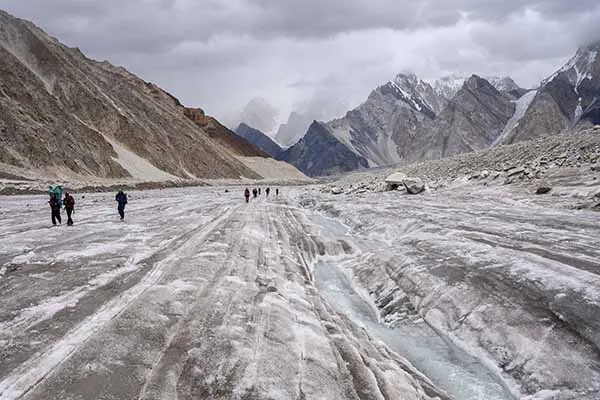
From Concordia the route turns up the Vigne Glacier to Ali Camp, at the foot of the pass. This part is a glacier walk with crevasses. From Ali Camp the climb to the top is a steep snow slope with fixed ropes. On the far side the slope drops steeply towards the Gondogoro Glacier and Khuspang, and fixed ropes are used there too.
- Night freeze: on a clear night the snow freezes into a firm crust that takes crampons well. By mid-morning the sun softens it, and the same slope becomes slushy and slower.
- Fresh snow: after a storm, new snow on the slope is soft and hides the old track. Our guide checks it on the night and decides whether the group can cross.
- Rockfall: from August, when the snow has melted on the descent, frozen stones start to move as the sun warms them. Being off the steep part early is the best defence.
- Crevasses: on the glacier between Concordia and Ali Camp, snow bridges are thicker early in the season and thinner by late summer. The line of the route changes from year to year.
How the season changes the crossing
- Snow early, rock later: in June and July the descent is mostly firm snow, and crampons stay on; from August the snow melts and the descent becomes steep, loose rock, with more risk of falling stones.
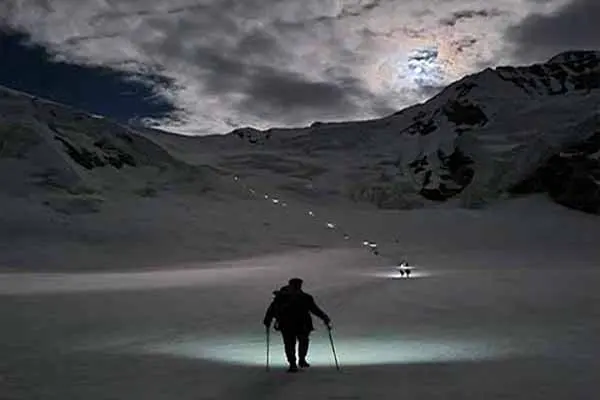
- Why we start at night: in every month we leave Ali Camp around midnight, so we cross while the snow is firm and the stones are still frozen.
- Fixed ropes: the local rescue team fixes the ropes on both sides of the pass each season and helps trekkers on the crossing. Their rope fee is included in our price.
- Late in the season: the snow and the weather decide more and more as autumn comes. If crossing the pass matters most to you, choose a date that reaches it between the end of June and the end of August.
- The guide decides: on the day, our guide checks the snow, the weather and the ropes. If conditions on the pass are too risky, we do not cross, and the group walks back down the Baltoro Glacier to Askoli.
- How hard the crossing is, and what gear you need: Gondogoro La difficulty.

Daylight and the midnight start
We leave Ali Camp around midnight in every month, so the group climbs while the snow is firm and the stones are frozen. Daylight matters for the long descent: at the latitude of the pass there are about 14.5 hours of daylight in late June and only about 12 hours by the end of September.
| Date (approximate) | Sunrise | Sunset | Daylight |
|---|---|---|---|
| Mid-June | about 4:40 | about 19:10 | about 14.5 hours |
| Mid-July | about 4:50 | about 19:10 | about 14.3 hours |
| Mid-August | about 5:15 | about 18:50 | about 13.5 hours |
| Mid-September | about 5:40 | about 18:05 | about 12.5 hours |
| End of September | about 5:50 | about 17:45 | about 12 hours |
| Early October | about 6:00 | about 17:30 | about 11.5 hours |
Times are Pakistan Standard Time, calculated for the Skardu area; in the deep valleys the sun reaches the camps later and leaves earlier. On a normal crossing, the group climbs by headlamp, reaches the top around dawn and is down the steep part before the sun softens the slope. Bring a headlamp with fresh batteries: the climb from Ali Camp is done in the dark in every month.
K2 weather in summer for trekkers
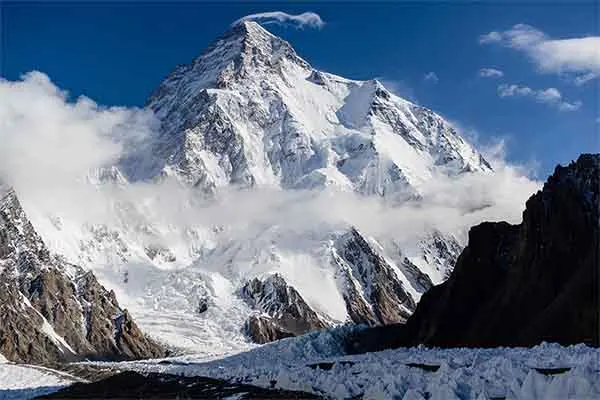
In July and August, K2 Base Camp (5,150 m) has days of about 5–10°C in the sun-warmed air and nights of about −5 to −12°C; Concordia (4,691 m) is a few degrees milder. These are approximate values from the Skardu averages and the Baltoro temperature fall, and they are about the trekking camps, not the summit of K2 (8,611 m), which is far colder and windier.
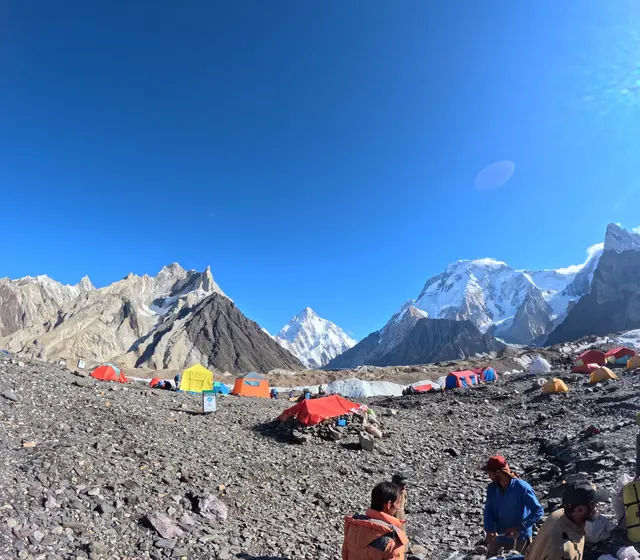
Summer on the Baltoro is a pattern of clear mornings and building afternoon cloud, with a storm every so often that can bring snow to Concordia and K2 Base Camp even in July. The glacier itself makes its own weather: cold air drains down it at night, and the sun reflected off snow and ice makes the middle of the day feel hot. Broad Peak Base Camp (4,850 m), where we sleep on the K2 day, sits between Concordia and K2 Base Camp in height and temperature. If you prefer not to cross a pass, the K2 Base Camp Trek walks back down the Baltoro the same way.
Hushe valley and Laila Peak weather
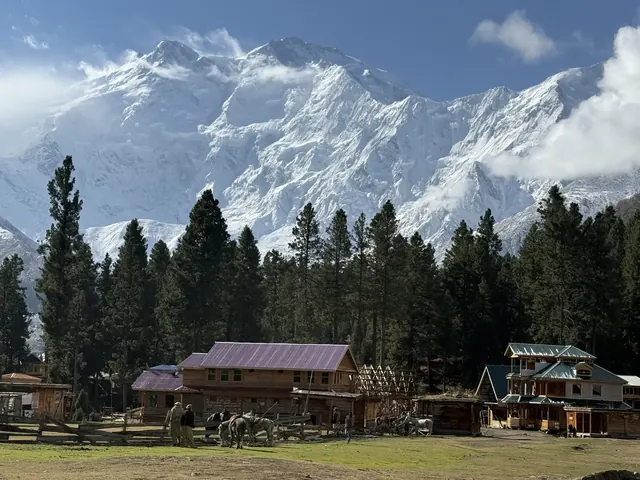
The Hushe valley, on the far side of the Gondogoro La, is warm and dry in summer: Hushe (3,150 m) has days of about 20–25°C and nights of about 5–10°C from June to August. Laila Peak (6,096 m) at the head of the valley is a different matter: on the summit, expect about 0°C by day and −15 to −20°C or colder before dawn in July. Both figures are estimates, not measurements.
The best time to climb Laila Peak is July and August, and our Laila Peak Expedition fixed departures run from 15 July to 5 August and from 5 to 26 August. The base camp at Dalchangpa, at about 4,200 m on the Gondogoro Glacier, has nights around freezing in summer. Climbers start the summit day in the night, as on the pass, so they move on the north-west face while the snow is frozen. If you want the views without the climb, the Laila Peak Base Camp Trek runs from mid-June to mid-September; after mid-September fresh snow is possible at Khuspang. For the villages and walks of the valley, see our Hushe valley guide.
Which season in Pakistan is best for hiking?
For high treks in the Karakoram, such as the Gondogoro La, K2 Base Camp and the Hushe valley, the best season is June to September. For lower valleys and cultural tours, spring (April and May) and autumn (October) are pleasant, with mild days and fewer crowds.
The reason is the same rain shadow. Pakistan's northern mountains get most of their snow in winter and spring, and only weak monsoon rain in summer. Lower valleys such as Skardu are hot in July, with average highs over 30°C, which makes spring and autumn the more comfortable time for walks below 3,000 m. Above 4,000 m, only the summer months are warm enough and free enough of snow for trekking. To compare routes, see our 10 trekking tours in northern Pakistan, and read Before you trek in Pakistan for permits and practical points.
Why the Karakoram season is the opposite of Nepal
In Nepal, high passes such as the Cho La and treks such as Annapurna Base Camp, Gokyo and Kanchenjunga are best in spring (March to May) and autumn (October to November). In the Karakoram, the Gondogoro La is best in high summer. The difference is the summer monsoon.
From June to September the monsoon brings heavy rain and cloud to the southern slopes of the Himalaya, so Nepal treks avoid those months. The Karakoram lies further north and west, behind the main Himalayan chain, and the monsoon arrives there weak or not at all; Skardu averages about 10 mm of rain a month in summer. In spring and autumn, when Nepal is at its best, the Karakoram passes are still deep in snow or getting cold again. So if you have already crossed a pass in Nepal in October, plan the Gondogoro La for July.
Choosing your departure date
On our 21-day K2 Gondogoro La Trek, the pass is on day 15, so it falls 14 days after the start date. To cross in the best time, choose a start date from about 12 June to 12 August.
| Start date (21-day trek) | Pass day | What to expect |
|---|---|---|
| 5 June | 19 June | Feasible: more snow; ropes may only just be fixed |
| 12 June | 26 June | Start of the best time |
| 5 July | 19 July | Best time: usually the most settled weather |
| 5 August | 19 August | Best time: warm, more loose rock on the descent |
| 27 August | 10 September | Feasible: colder nights, mostly rock |
| 12 September | 26 September | Late September: less certain; decided close to the day |
| 20 September, 27 September, 5 October | About 4, 11 and 19 October | Depends on the snow and the conditions on the day |
On the 15-day K2 Base Camp and Gondogoro La Pass Trek, which you join in Skardu, the pass is on day 12, so it falls 11 days after the start date: the 15 June start reaches the pass on 26 June. On the private Karakoram K2 Trek, the pass is on day 14, so for your own dates choose a start between about 13 June and 13 August.
Group trips follow the same days, so the pass day is fixed in the plan; if the weather on the planned night is bad, the guide decides on the day, and if the crossing is not possible the group takes the Baltoro route back. If you also want time on a summit, the Gondogoro Peak Climbing Expedition (5,650 m) follows the same trek to Khuspang and adds two climbing days, so it also needs a date in the best time.
If the pass is not possible: the Baltoro return
If the guide decides the crossing is not possible, the group walks back down the Baltoro Glacier the way it came, to Askoli (3,000 m), and drives to Skardu. This is the only workable alternative: there is no other pass or route out of Concordia for trekkers.
The return is the same route as the K2 Base Camp Trek: Concordia, Goro II (4,300 m), Urdukas (4,000 m), Paiju (3,400 m) and down the Braldu valley. You still see K2, Broad Peak and the Baltoro, and the Baltoro Glacier is about 63 km long, so it is a full walk out. You miss the views from the top of the pass and the Hushe valley. Read more about the route in our Baltoro trekking tips.
Packing for the Gondogoro La season
The pass needs climbing gear in every month: crampons, a harness, a helmet, a jumar, carabiners, a descender or figure-of-eight, shoe covers and warm mittens. A good hiking boot that takes crampons is very useful. We can arrange this gear in Skardu if you need it.
- For the nights: a sleeping bag rated to about −15°C, a warm down jacket and a hat for nights of −5 to −15°C at Ali Camp and Khuspang.
- For the climb: layers you can move in, mittens over thin gloves, and a headlamp; the climb starts around midnight.
- For the sun: glacier glasses, a sun hat and high-factor sun cream. At this height, sun on snow burns skin in minutes, even in cold air.
- For the valleys: light clothes for 25–30°C days in Skardu and the lower Hushe valley.
- Your bag: porters carry up to 16 kg per trekker on our K2 treks; extra weight costs $12 per kg.
For the full list and how hard each part is, see Gondogoro La difficulty. For the cost of the trek and what is included, see the K2 trek cost breakdown.
Mistakes to avoid when choosing your season
- Judging by Skardu forecasts: a 30°C day in Skardu says little about the pass, which is about 3,350 m higher and can be 25°C colder.
- Booking a late departure and counting on the pass: from late September the crossing depends more and more on fresh snow and cold. If the pass is the main goal, pick a summer date.
- Packing for summer only: nights at the high camps fall below freezing even in July. A summer sleeping bag is not enough.
- Using model weather apps for the high camps: free apps give smooth valley-based values that often miss the cold of the glacier and the speed of afternoon storms. There is no internet after Askoli.
- Skipping acclimatisation: the pass comes after 10 days on the trail, a week of them on the glacier, and the plan is built for that. The day-by-day guide linked below shows how the height builds up.
Plan your crossing
- K2 Gondogoro La Trek: 21 days from Islamabad, fixed departures; the pass is on day 15
- K2 Base Camp and Gondogoro La Pass Trek: 15 days, trek only from Skardu; the pass is on day 12
- Karakoram K2 Trek: 19 days, private, on your own dates; the pass is on day 14
- Day by day: Gondogoro La Trek daily distance and altitude. All K2 treks: the K2 hub.
Frequently asked questions
What is the best time to cross the Gondogoro La?
The best time to cross the Gondogoro La (5,585 m) is from the end of June to the end of August. The fixed ropes are in place, the weather is at its most settled, and the snow on the pass freezes hard at night, which makes the midnight crossing work. Mid-June and September are still feasible, with more snow early and more loose rock and colder nights later.
When can you cross the Gondogoro La?
The crossing is feasible from mid-June to the end of September, and best from the end of June to the end of August. Our trips run from mid-June to early October, and the last groups reach the pass in October. The crossing always depends on the snow, the weather and the fixed ropes, so the guide decides on the day.
When are the fixed ropes put up on the Gondogoro La?
A local rescue team from Hushe fixes the ropes on both sides of the pass at the start of each season, usually from mid to late June. The team also helps trekkers on the crossing. The very first crossings of the year depend on when this work is finished, which is one reason the best time starts at the end of June.
Can I cross the Gondogoro La in June?
Yes. From mid-June the crossing is feasible once the ropes are fixed, and from the end of June it is the best time. In June there is more snow on both sides, nights at the high camps are about −10 to −15°C, and the crossing is slower than in July. No mountaineering experience is needed, but you need the climbing gear for the pass.
Can I cross the Gondogoro La in September or October?
Yes, it is still feasible until the end of September, with colder nights and mostly rock on the descent. Late-September crossings are often not confirmed until shortly before, because they depend so much on snow and weather. In early October it depends on the snow and the conditions on the day; if the crossing is not possible, the group walks back down the Baltoro Glacier.
How cold is it on the Gondogoro La?
In July and August, expect about 10–15°C by day at the high camps and about −5 to −10°C at night at Ali Camp and Khuspang; in June and September, about 5–10°C by day and −10 to −15°C at night. On the pass itself, before dawn, our estimate is about −10 to −16°C, and wind makes it feel colder. All these are approximate values, not measurements.
Is there snow on the Gondogoro La in summer?
Yes. The top slopes of the Gondogoro La are covered in snow all summer. The descent towards Khuspang is mostly snow in June and July and turns to steep, loose rock from August. Fresh snow can fall in any month after a storm, which is why our guide checks the slope on the night of the crossing.
What happens if the weather is bad on the pass day?
Our guide decides on the day, after checking the snow, the weather and the ropes. If conditions on the pass are too risky, we do not cross: the group walks back down the Baltoro Glacier to Askoli and drives to Skardu. This is the only workable alternative, as there is no other route out of Concordia for trekkers.
What is the weather like at K2 Base Camp in summer?
In July and August, K2 Base Camp (5,150 m) has days of about 5–10°C and nights of about −5 to −12°C, with clear mornings and afternoon cloud. Storms can bring snow even in July. These figures are approximate and describe the trekking camp, not the summit of K2 (8,611 m), which is far colder.
What is the weather on Laila Peak?
Laila Peak (6,096 m) is best climbed in July and August. Hushe (3,150 m) in the valley below has summer days of about 20–25°C, the base camp at Dalchangpa (about 4,200 m) has nights around freezing, and the summit is about 0°C by day and −15 to −20°C or colder before dawn in July. These are estimates, not measurements.
Which season in Pakistan is best for hiking?
For high Karakoram treks such as the Gondogoro La and K2 Base Camp, June to September is best, and the end of June to the end of August is best for the pass. For lower valleys and cultural tours, April, May and October are more comfortable, because valley towns such as Skardu average over 30°C in July.
Does the monsoon affect the Gondogoro La?
Only a little. The Gondogoro La lies in the rain shadow of the Himalaya, so the summer monsoon arrives weak. Skardu records only about 9–12 mm of rain a month from June to September. Higher on the glacier there is more precipitation, often as afternoon snow on the upper glacier, and an occasional storm can close the pass for a day or more.
Why do you cross the Gondogoro La at night?
We leave Ali Camp (4,950 m) around midnight in every month so the group climbs while the snow is frozen and firm and the loose stones are held by the frost. By mid-morning the sun softens the snow and starts to release rocks on the descent. Climbing at night by headlamp means being down the steep part before that happens.
Which departure date is best for the Gondogoro La?
On our 21-day K2 Gondogoro La Trek the pass is on day 15, so choose a start date from about 12 June to 12 August to cross in the best time. On the 15-day trek-only version, joined in Skardu, the pass is on day 12; the 15 June start reaches it on 26 June. Later departures reach the pass in late September or October, when the snow decides more.
About the author
Imtiyaz Ahmed Shigri founded Chogori Adventure in Skardu in 2015. Our guides are local, government-licensed and English-speaking, and most of them are trained in first aid. We are licensed by the Department of Tourist Services (licence no. 2494) and the Gilgit-Baltistan tourism department (licence DTS-GB-055), and we are a member of the Pakistan Association of Tour Operators, with offices in Skardu and Islamabad.
Rated 4.9 out of 5 from 47 reviews on Google (November 2026). Read our reviews on Google