Introduction
The K2 Base Camp Trek is one of the world's most iconic and rewarding trekking adventures, taking you deep into the heart of Pakistan's spectacular Karakoram Range. This unforgettable journey follows the legendary Baltoro Glacier, passes beneath towering granite peaks, and leads to the foot of K2 (8,611 m)—the second-highest mountain on Earth. Along the way, trekkers visit the world-famous Concordia, often called the "Throne Room of the Mountain Gods," where four of the world's fourteen 8,000-meter peaks stand together in an awe-inspiring panorama.
Unlike many popular trekking destinations, the K2 Base Camp Trek is a true wilderness expedition. There are no villages, teahouses, or permanent facilities along the route. Instead, trekkers spend nearly two weeks camping in one of the most remote mountain environments on Earth, crossing glaciers, rugged moraines, and high-altitude terrain while surrounded by some of the planet's most spectacular scenery.
Although the trek does not involve technical climbing, it is considered one of the most challenging non-technical treks in the world. The combination of long trekking days, altitudes exceeding 5,150 meters (16,900 feet), unpredictable mountain weather, and the remote nature of the Karakoram requires good physical fitness, proper acclimatization, and careful preparation.
This complete guide covers everything you need to know before planning your K2 Base Camp adventure, including the trek's difficulty, best time to visit, weather conditions, Gondogoro La crossing, physical preparation, Pakistan's Mountaineering & Trekking Visa, trekking permits, travel logistics, and essential planning tips. Whether you're planning your first expedition to the Karakoram or comparing K2 Base Camp with other famous treks such as Everest Base Camp or Mount Kilimanjaro, this guide will help you prepare for one of the greatest trekking experiences in the world.
1. K Base Camp Trek Difficulty Level
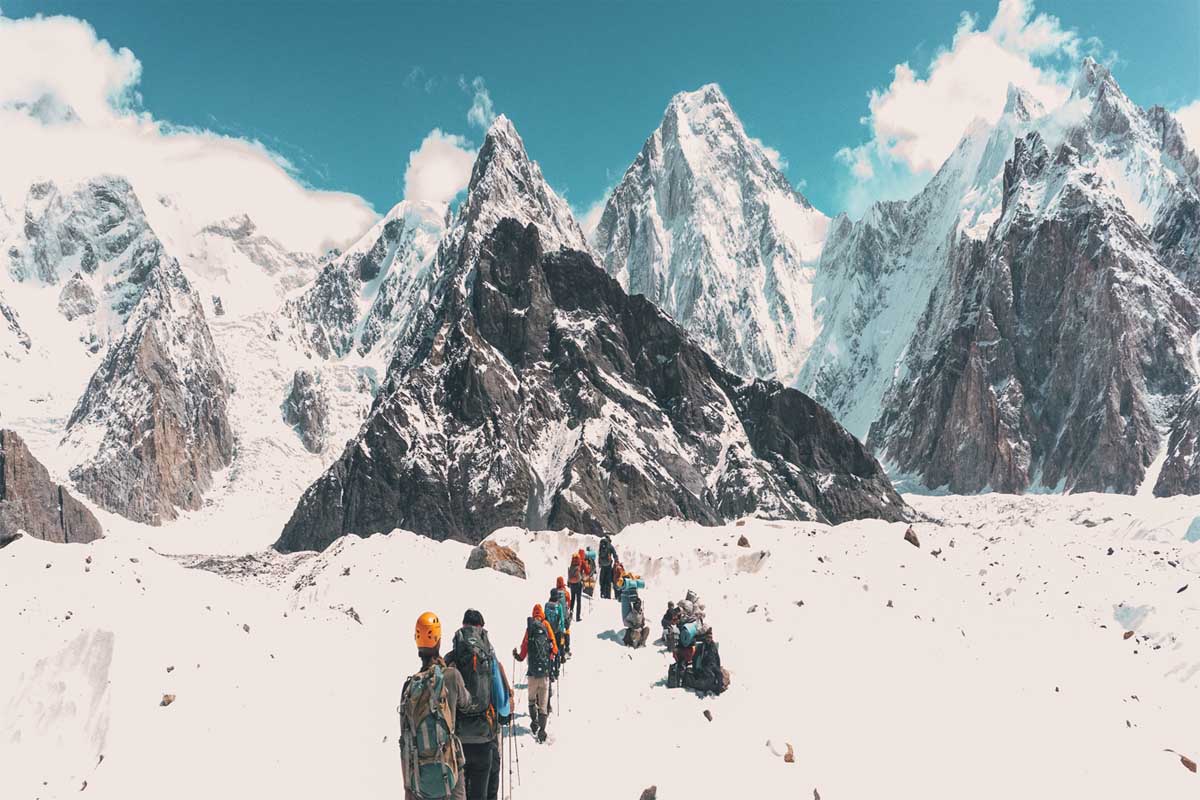
Trekking towards K2 Base Camp
Trekking Towards K2 base camp, Gasherbrum Spire in the backdrop
The K2 Base Camp trek is considered a challenging to very challenging trek, primarily due to its remoteness, altitude, and demanding terrain. Here are the key factors contributing to the difficulty:
- Altitude: The trek reaches an altitude of 5,150 meters (16,900 feet) at K2 Base Camp. Altitude sickness can be a risk, and trekkers must acclimatize properly to avoid complications such as headaches, dizziness, or nausea.
- Length and Duration: The trek typically spans 12-14 days, covering around 90 km (56 miles) one-way. This is a lengthy and physically demanding journey, with significant elevation gain and loss.
- Terrain: The route crosses rocky paths, glaciers, river crossings, and rough, uneven ground. The terrain can be tricky, requiring physical stamina and surefootedness.
- Limited Facilities: Trekking to K2 Base Camp is not a luxury experience. You will be camping along the way, often in basic conditions. You’ll need to be prepared for cold nights and unpredictable weather.
- Physical Fitness: A good level of fitness is crucial for the trek, especially since it involves long days of walking in rugged terrain at high altitudes. Trekkers should prepare with cardiovascular and strength training exercises, focusing on endurance.
You may like to read Daily distance and altitude on K2 Base Camp Trek.
2. Seasonality for Trekking K2 Base Camp
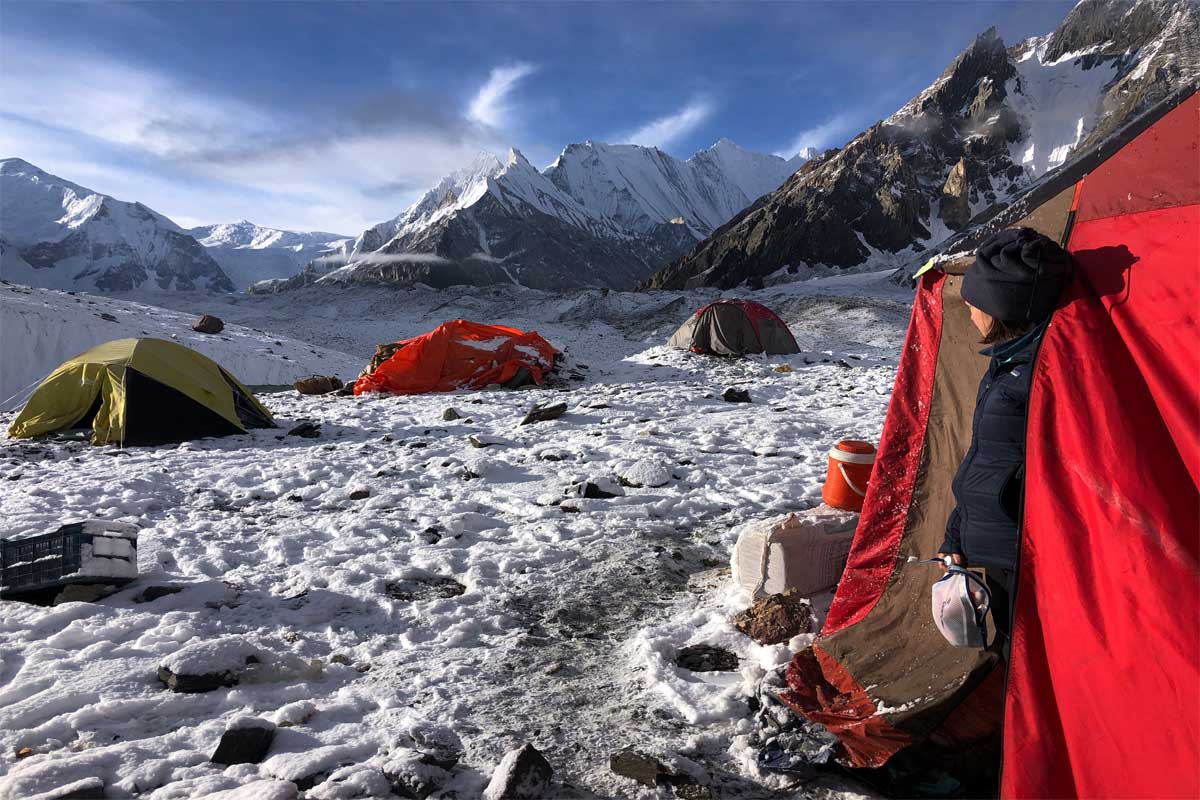
Concordia — K2 and the Karakoram giants
Snowfall at Concordia Camp in late August
The best time to trek to K2 Base Camp is during the summer months, specifically between late June to September. However, the seasonality of the trek can impact the conditions and the experience:
Peak Trekking Season (Late June to September)
- Weather Conditions: This is the ideal time for the trek, as temperatures are relatively warmer and precipitation is lower. The Karakoram Range experiences clear skies, allowing trekkers to enjoy spectacular views of K2 and other surrounding peaks.
- Crowds: Although this is the peak trekking season, it is still relatively quiet compared to more popular trekking destinations. However, it is advisable to book in advance as spaces in the limited campsites fill up.
- Safety and Accessibility: Trails are accessible, and the chances of avalanches or extreme weather are lower, making it the safest time for the trek.
Pre-season (Late May to Early June)
- Weather Conditions: Weather can be variable, with lingering snow and the possibility of storms. It’s a quieter time for trekking but also less predictable.
- Challenges: Some routes may still be blocked by snow or ice, and it may take longer for campsites and facilities to be fully set up.
Post-season (Late September to November)
- Weather Conditions: The weather starts cooling down, and it may get chilly, especially at higher altitudes. While there are fewer trekkers during this time, the weather can be unpredictable with an increased risk of snowstorms.
- Accessibility: It’s still possible to trek, but the conditions can be harsher, and some services may be reduced as the season winds down.
Best Time for Gondogoro La 5600m Crossing:

K2 Base Camp and Gondogoro La trekking route
View of K1 8611m from Gondogoro La Summit 5600m
The best time for Gondogoro La Trek (5,600m) is during the short and sensitive summer weather window, because this high mountain pass is far more weather-dependent than the classic K2 Base Camp trek. In general, Gondogoro La is only realistically doable from mid-June to mid-September, when the snow conditions are stable enough and the route is accessible for fixed ropes and safe crossing. However, even in this period, the pass remains fully contingent on weather, fresh snowfall, wind, and visibility, and can close temporarily even during peak season.
Among all months, July and August are considered the prime time for crossing, offering the best combination of stable weather, warmer nights, and a higher success rate. That’s why, if you are keen to cross Gondogoro La, planning your trek in July or August gives you the strongest chance of a safe and successful summit-day crossing.
Read more about Gondogoro la in the link Gondogoro La Difficulty
3. Weather Conditions
 On the way to Concordia
The weather on the K2 Base Camp trek can vary significantly due to the trek’s high altitude and remote location. Here’s an overview of the typical weather conditions:
Summer (June to September)
- Temperatures: At lower altitudes (2,000m-3,000m), daytime temperatures range from 10°C to 20°C (50°F to 68°F), while at higher altitudes, temperatures drop to around 0°C to -10°C (32°F to 14°F) during the night.
- Weather: During summer, the weather is generally dry, with clear skies and little rainfall. However, storms and heavy winds can occur, especially at higher altitudes.
- Snowfall: Snow is generally rare during the trekking season, though light snowfall can occur at higher elevations.
Winter (November to March)
- Temperatures: Winter temperatures drop significantly. Daytime temperatures at base camp can be as low as -20°C (-4°F), and nighttime temperatures can plummet even further.
- Weather: The Karakoram Range experiences heavy snowfall, blizzards, and extreme cold. Winter is an unsafe time for trekking due to the cold and risk of avalanches, as well as the complete lack of trekking facilities and services.
- Challenges: Apart from the freezing temperatures, the risk of frostbite, snowstorms, and treacherous conditions on the trail makes winter months unsuitable for the trek.
Spring (April to May)
- Temperatures: Spring sees milder temperatures than winter, but conditions can still be quite cold, especially at higher altitudes.
- Weather: Spring weather is variable, with some rain and possible snowstorms, but it is generally less severe than winter. This is a transition period, with some areas still covered in snow.
- Challenges: Spring trekking can be a bit unpredictable, and there might still be some difficulty navigating snow-covered paths.
How K2 Base Camp Trek Compares to Everest Base Camp and Kilimanjaro

K2, the Savage Mountain
K2/Chogori Base Camp 5120m
When comparing the K2 Base Camp Trek with Everest Base Camp (EBC) and Kilimanjaro, the biggest difference is the level of remoteness and overall difficulty. EBC is high and challenging, but it is supported by a well-developed trail network, frequent teahouses, and daily access to food, lodges, and emergency services. Kilimanjaro is physically demanding due to its rapid altitude gain, but it is a non-technical climb on a clear trekking route with a strong support system and a shorter duration. In contrast, the K2 Base Camp Trek is a true wilderness expedition where the difficulty is not just altitude, it’s the terrain, isolation, and long trekking days that make it significantly tougher for most trekkers.
In terms of difficulty, K2 Base Camp is widely considered harder than both EBC and Kilimanjaro, especially for trekkers who are not used to rough mountain terrain. The trail in Baltoro is long, remote, and often involves walking on glaciers, loose rocks, moraine, and uneven surfaces for many consecutive days. There are no villages, no teahouses, and no easy exit routes, meaning your body must handle continuous trekking with limited comfort and recovery. Even strong hikers find the Baltoro Glacier demanding because it requires constant balance, endurance, and mental toughness. While Kilimanjaro is a higher summit and EBC is famous for altitude, K2 Base Camp stands out as the most rugged and expedition-style trek, making it the toughest of the three in overall trekking difficulty.
4. Preparing for the Trek

Broad Peak Base Camp
Physical Preparation
- Cardio and Strength Training: Cardiovascular fitness and leg strength are key to handling the long, demanding days of the trek.
- Altitude Training: If possible, acclimate to higher altitudes before undertaking the trek to reduce the risk of altitude sickness.
- Packing: Pack lightweight, yet warm, clothing, a good pair of trekking boots, a sleeping bag suitable for freezing temperatures, and gear to protect against snow and wind.
Health and Safety
- Acclimatization: Ascend slowly and take regular rest days to allow your body to adjust to the high altitude.
- Hydration and Nutrition: Carry sufficient water and high-energy snacks. Hydration is crucial to avoid altitude sickness.
- Guides and Porters: It is highly recommended to trek with a guide, especially for such a remote and challenging route. They can assist with navigation and provide local knowledge, improving both your safety and experience.
You may also like to read : Is Pakistan Safe for Trekking?
5. How to Get to K2 Base Camp

On the trek to Concordia and K2 Base Camp
Planning a trek to K2 Base Camp is different from trekking in many other parts of the world. Because the route lies in a restricted area of Pakistan's Karakoram Range, foreign trekkers must obtain a special visa, government permits, and travel with a licensed local tour operator. This guide explains everything you need to know before embarking on one of the world's greatest trekking adventures.
1. Apply for a Pakistan Mountaineering & Trekking Visa
Foreign nationals trekking to K2 Base Camp must obtain a Pakistan Mountaineering & Trekking Visa, which is different from a standard tourist visa.
The application requires:
- An invitation letter from a licensed Pakistani tour operator.
- Supporting documents provided by your operator.
- A completed online visa application.
It is recommended to apply 4–6 weeks before your departure to allow sufficient time for processing.
You can apply online through the official Pakistan visa portal: Pakistan Trekking Visa Portal .
2. Obtain the K2 Trekking Permit
K2 Base Camp is located within the Central Karakoram National Park (CKNP) and lies inside a restricted trekking zone. Therefore, every foreign trekker must obtain a K2 Trekking Permit before entering the region.
Important information:
- The permit can only be obtained through a registered Pakistani tour operator.
- Individual applications are not accepted by the authorities.
- The government permit fee is USD 90 per person (2026 rate; subject to change).
- Permit approval generally takes several days, so it is advisable to confirm your booking well in advance.
3. Pay Government & National Park Fees
Besides the trekking permit, visitors are also required to pay the Central Karakoram National Park (CKNP) conservation fee.
The current conservation fee is USD 160 per person (2026 rate; subject to revision by the Government of Pakistan).
These fees help support:
- Environmental conservation
- National park management
- Trail maintenance
- Sustainable tourism in the Karakoram region
Most reputable trekking companies include these government charges in their package price, but it is always recommended to confirm what is included before booking.
4. Hire a Licensed Local Tour Operator
Foreign trekkers cannot trek to K2 Base Camp independently. Pakistani regulations require all international visitors to travel with a licensed Pakistani tour operator and a registered guide.
A professional operator will arrange:
- Pakistan Mountaineering & Trekking Visa invitation documents
- K2 Trekking Permit
- Government paperwork
- Airport transfers
- Domestic flights or road transportation
- Hotel accommodation in Islamabad and Skardu
- Jeep transport between Skardu and Askole
- Professional trekking guides
- Porters and camping staff
- Camping equipment and meals
- Emergency communication and logistical support
Choosing an experienced local company not only ensures compliance with government regulations but also provides a safer, smoother, and more enjoyable trekking experience.
5. Travel to Skardu
Nearly all K2 Base Camp expeditions begin in Islamabad, Pakistan's capital.
From Islamabad, trekkers usually take a one-hour flight to Skardu, the gateway to the Karakoram Mountains.
Because mountain weather can be unpredictable, flights are occasionally cancelled. In that case, travelers can reach Skardu by road via the Karakoram Highway, a journey that typically takes 18–22 hours.
Most itineraries include an extra buffer day to accommodate possible flight delays.
6. Drive to Askole & Begin the Trek
From Skardu, a scenic 6–8 hour jeep drive leads to Askole, the last permanent village before entering the wilderness of the Karakoram.
This is where the trek officially begins.
The classic K2 Base Camp route follows the famous Baltoro Glacier, passing through several iconic camps:
- Jhula
- Paiju
- Urdukas
- Goro II
- Concordia
- K2 Base Camp
The trek to and from Base Camp generally takes 14–16 days, while the complete expedition, including travel to and from Islamabad, usually lasts 18–21 days. K2 Base Camp Trek Only Package.
Before You Travel
Before leaving for Pakistan, make sure you have completed the following:
- ✔ Obtain a Pakistan Mountaineering & Trekking Visa.
- ✔ Book your trek with a licensed Pakistani tour operator.
- ✔ Secure your K2 Trekking Permit well in advance.
- ✔ Purchase comprehensive travel insurance that covers high-altitude trekking and emergency evacuation.
- ✔ Train for a physically demanding trek reaching elevations above 5,150 meters (16,900 feet).
- ✔ Pack appropriate trekking, camping, and cold-weather clothing and equipment.
Final Thoughts
The K2 Base Camp Trek is far more than an ordinary trekking holiday—it is a genuine expedition into one of the world's most remote and awe-inspiring mountain landscapes. Traversing rugged glaciers, crossing glacial rivers, and spending days in the wilderness, this trek is widely regarded as more demanding than many renowned routes such as Everest Base Camp or Mount Kilimanjaro. While no technical climbing is required, the combination of high altitude, long trekking days, challenging terrain, and the isolation of the Karakoram demands excellent physical fitness, mental resilience, and thorough preparation.
The trekking season is relatively short, making the timing of your expedition an important factor. Mid-June to mid-September generally offer the most stable weather and the best trekking conditions, although the overall season typically exted 15-20 days before and after the peak season . Proper planning, quality equipment, and the support of an experienced local team significantly enhance both the safety and enjoyment of the journey.
Although visiting K2 Base Camp requires additional preparation—including obtaining a Pakistan Mountaineering & Trekking Visa, securing the necessary trekking permits, paying the required government and Central Karakoram National Park fees, and traveling with a licensed Pakistani tour operator—these requirements help preserve the fragile environment and ensure safe, well-managed expeditions.
For those willing to embrace the challenge, the rewards are extraordinary. From the breathtaking scenery of the Baltoro Glacier and Concordia to standing beneath the majestic K2, every step offers an unforgettable experience in the heart of the Karakoram. With careful preparation and the right local support, the K2 Base Camp Trek is not only one of the world's greatest trekking adventures but also an experience that will remain with you for a lifetime.
Ready to experience the world's greatest trekking adventure? Chogori Adventure is a locally owned operator based in the Karakoram with over 30 years of experience leading K2 Base Camp expeditions. We offer guaranteed departures, experienced local guides, professional logistics, and personalized support from arrival in Pakistan until the end of your trek. Explore our upcoming departures and start planning your K2 adventure today. Follow this link for complete details about the Cost, Dates and Itineray. K2 BASE CAMP TREK.