Top 5 Trekking Peaks in Pakistan: From Shatong to Pastore

By Imtiyaz Ahmed Shigri, founder of Chogori Adventure, Skardu · Updated November 2026
The top five trekking peaks in Pakistan, from the least to the most demanding, are Shatong Peak (about 5,250 m) in Deosai, Minglik Sar (about 6,050 m) in the Shimshal valley, Gondogoro Peak (5,650 m) in the Hushe valley, Khosar Gang (6,046 m) above Shigar and Pastore Peak (6,209 m) near K2. All five are in Gilgit-Baltistan, are climbed in summer, and have no peak royalty. They range from a steep scree-and-snow summit to a serious glacier climb, so choosing the right one for your experience matters more than the height. This guide explains each peak, how hard it really is, the skills and gear you need, the best season and what it costs.
The five peaks at a glance
| Peak | Height | Area | Main difficulty | Best months | Our trip |
|---|---|---|---|---|---|
| 1. Shatong Peak | about 5,250 m | Deosai, near Skardu | Steep scree, snowy summit ridge; no glacier | July–September | coming soon |
| 2. Minglik Sar | about 6,050 m | Shimshal valley, Upper Hunza | Long approach over the Shimshal Pass; glacier with crevasses on summit day | July–August | coming soon |
| 3. Gondogoro Peak | 5,650 m | Hushe valley, above Khuspang | Glacier and snow slopes, steeper near the top; roped, no fixed ropes | July–August | Gondogoro Peak Climbing Expedition, 23 days |
| 4. Khosar Gang | 6,046 m | Shigar valley, near Skardu | Steep slopes, a 90 m snow wall on fixed ropes, long summit day | July–October | Khosar Gang Expedition, 12 days |
| 5. Pastore Peak | 6,209 m | Godwin-Austen Glacier, near K2 | Snow and ice the whole way on a crevassed glacier; 10–12 hour summit day without a high camp | July–August | Pastore Peak Expedition, 25 days |
The order is ours: it is based on how hard each climb usually feels to a fit trekker on a first expedition, not just on height. Gondogoro Peak is lower than Minglik Sar, but its summit day starts from a glacier camp at 4,680 m and is steeper near the top.
What is a trekking peak in Pakistan?
In Nepal, "trekking peak" is an official category with its own permit system. Pakistan has no such list. Here the term is used for mountains up to about 6,500 m that can be climbed without hard technical rock or ice, usually as part of a trek, with a small team of climbing guides and porters.
That does not mean they are walks. Every peak on this list except Shatong involves glacier travel, crampons and an ice axe, and most involve roped climbing on snow. The real difference from a "technical" peak such as Laila Peak is that the slopes are shorter and less steep, and the climbing can be learned on a basic course.
- No peak royalty: the five peaks in this guide have no peak royalty; you need the usual trekking permit and park fees, which we arrange.
- Climbing guides: on our trips, high-altitude porters who are also climbing guides go with you, one for every two climbers.
- Season: mainly July to September, when the snow is firm and the high passes are open.
1. Shatong Peak (about 5,250 m), Deosai
Shatong Peak (also written Shatung) rises from the Deosai Plains, the high plateau between Skardu and Astore that is protected as Deosai National Park. Expedition reports give the summit as 5,250 to 5,275 m; the "4,500 m" sometimes quoted is the height of the base camp. It is the least demanding of the five and a good first summit above 5,000 m in Baltistan.
The climb
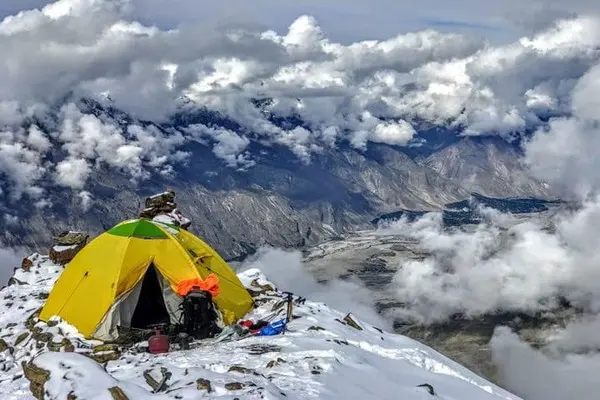
The approach is short: a drive from Skardu up to the plateau, then a walk across meadows full of wildflowers in July to a base camp at about 4,500 m. Above it the route climbs a long, steep slope of loose scree, which is the hardest part: it is tiring rather than technical. Near the top the route reaches a snowy ridge that leads to the summit, with wide views over the plateau and the surrounding peaks.
- Difficulty: strenuous but not technical; no glacier to cross. Depending on the snow on the summit ridge, crampons may be needed for the last section.
- Best for: fit trekkers who have been to about 4,000 m and want a first real summit.
- Season: July to September, when the Deosai road is open.
- Good to combine with: a few days in Skardu and the Deosai Plains, with Sheosar Lake and the chance to see marmots and brown bears.
We run Shatong Peak climbs from Skardu; the trip page will be added to our site soon. In the meantime, contact us for dates and prices.
2. Minglik Sar (about 6,050 m), Shimshal
Minglik Sar (also Mingli Sar or Mingling Sar) stands above the Shimshal Pamir at the southern edge of the Pamir mountains, in the far north of the Hunza district. It is about 6,050 m high and one of the few 6,000 m peaks in Pakistan that is regularly climbed by fit trekkers with basic snow skills. Its first recorded ascent is usually credited to the Pakistani mountaineer Nazir Sabir in 1988.
The approach
The journey is a large part of the adventure. From the Karakoram Highway at Passu a road leads east to Shimshal village (about 3,113 m), the highest settlement in the Hunza district. From there the trek follows the Shimshal river and climbs over the Shimshal Pass (about 4,700 m) to the wide summer pastures of the Shimshal Pamir, where the people of Shimshal graze their yaks, sheep and goats. Shimshal Lake lies at the foot of the mountain.
The climb
Base camp can be set high on the Pamir, close to the mountain, which shortens the summit day. The upper part of the route is on a glacier with crevasses, so the team walks roped together in crampons. The slopes are mostly moderate. In July 2021 a team of local musicians and climbers from Hunza even set a world record for the highest DJ set on its slopes, at 5,909 m.
- Difficulty: a long approach and a glacier climb; non-technical in good summer conditions, but much harder in deep snow. Before June the snow is deep and the climb is a serious mountaineering undertaking.
- Best for: trekkers with crampon and ice-axe experience who want a remote 6,000 m peak and a deep cultural experience in Shimshal.
- Season: July and August.
We run Minglik Sar climbs through Shimshal; this trip page will also be added soon.
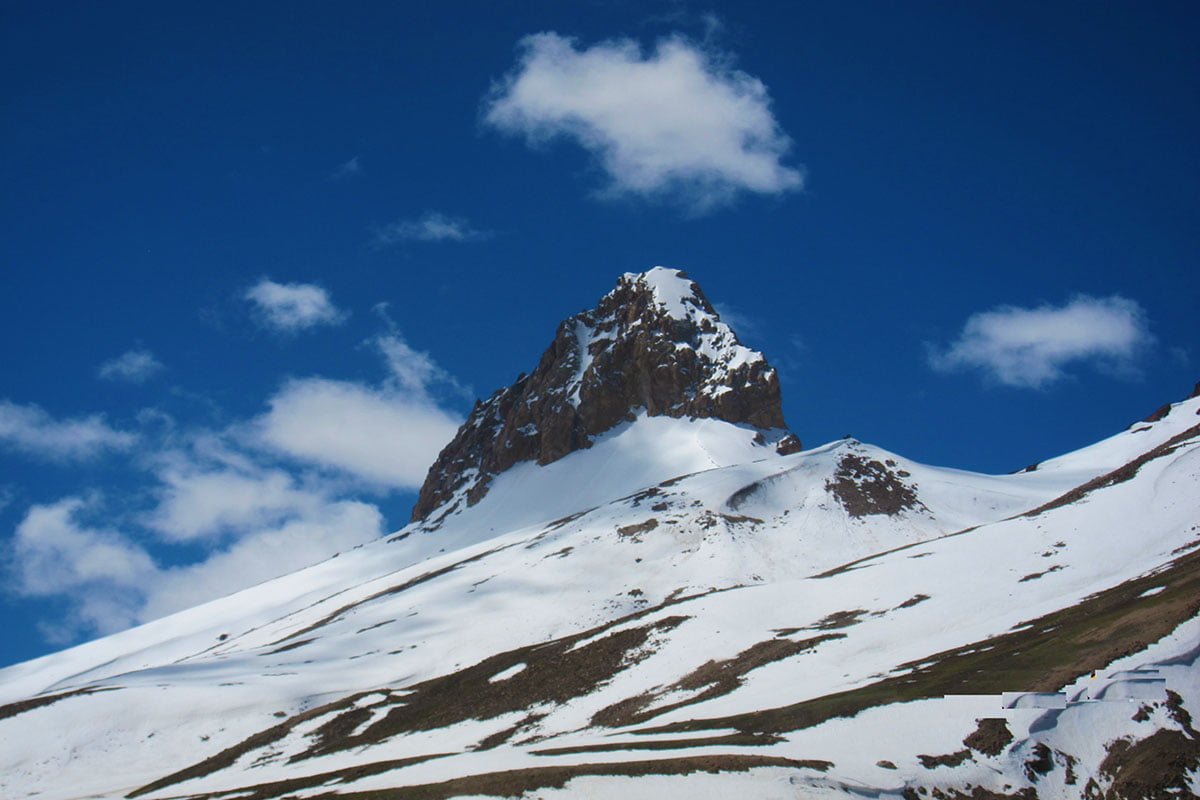
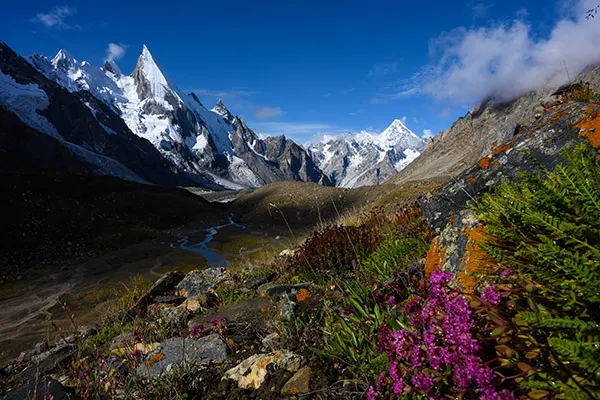
Minglik Sar, above the summer pastures of the Shimshal Pamir.
3. Gondogoro Peak (5,650 m), Hushe valley
Gondogoro Peak (also Gondoro or Ghondogoro Peak) is a summit above Khuspang in the upper Hushe valley, on the south side of the famous Gondogoro La pass. It is often climbed at the end of the K2 Base Camp trek, which means you arrive at the foot of the mountain already well acclimatised after two weeks above 4,000 m.
Gondogoro Peak is not the Gondogoro La
The two are often confused. The Gondogoro La (5,585 m) is the high pass between the Baltoro Glacier and the Hushe valley, crossed by trekkers on the K2 and Gondogoro La trek. Gondogoro Peak (5,650 m) is a separate summit above Khuspang (4,680 m), on the Hushe side of the pass. Our trip crosses the pass first, then climbs the peak.
The climb
Gondogoro Peak is non-technical, but it is a real climb: glacier walking and snow slopes, with steeper snow near the top. There are no fixed ropes; you climb roped together with our high-altitude porters, one for every two climbers. Summit day normally starts at midnight, and you are back at Khuspang the same day.
- Difficulty: moderate snow climb on a glacier; crampons, ice axe and harness needed.
- Best for: fit trekkers who have been to at least 4,000 m and want to add a real summit to the K2 trek.
- Our trip: the Gondogoro Peak Climbing Expedition, 23 days from Islamabad, from $4,000 per person as a private trip, with climbing gear and high-altitude porters included. The permit for the peak is charged at the trekking-fee rate, as it is below 6,500 m. A shorter climb from Hushe only is possible on request.
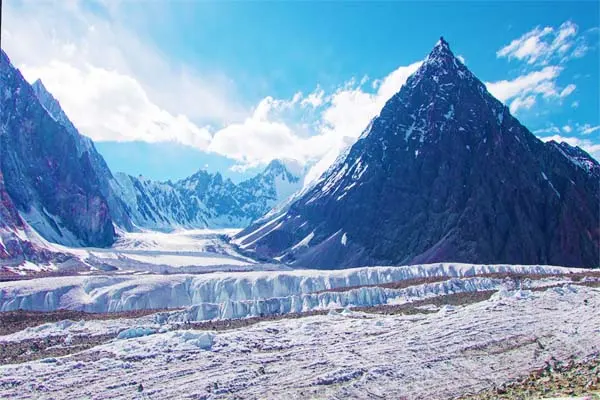
The Gondogoro La (5,585 m), the pass next to Gondogoro Peak.
4. Khosar Gang (6,046 m), Shigar
Khosar Gang, written Koser Gunge on many maps, is the highest mountain in the Shigar valley and the most popular first 6,000 m peak in Pakistan. Its official height is 6,400 m, but GPS measurements by climbers give about 6,046 m. The base camp is only a few hours' walk from the village of Sildi, about 45 km from Skardu, so you reach the mountain quickly. In Balti the name means "Ice Pumpkin".
A little history
Fanny Bullock Workman and William Hunter Workman made the first ascent in 1899. They estimated the height at 21,000 ft, then reported as a height record for a woman. Today more than 20 expeditions climb Khosar Gang each year, many of them Pakistani teams, and the success rate is above 90%.
The climb
- Base camp at about 3,800 m, on the summer pasture of our own community in Sildi.
- Camp 1 at about 4,800 m and Camp 2 at about 5,200 m, on snow.
- Summit day: 5 to 6 hours from Camp 2, with a steep snow wall of about 90 m climbed on fixed ropes, then snow slopes to the top.
It is a good first 6,000 m peak, but not an easy one: steep slopes, the fixed-rope section and a long summit day. You should have trekked to at least 4,000 m and be fit for long, steep days. Learn to use an ascender (jumar) on a fixed rope before you come.
Our trips: the Khosar Gang Expedition, 12 days from Islamabad, fixed departures July to October, $2,100 per person with climbing gear and ropes, and high-altitude porters included (one for every two climbers). Or combine it with the K2 trek on our K2 Base Camp and Khosar Gang Expedition, 27 days, $4,000 per person.
5. Pastore Peak (6,209 m), near K2
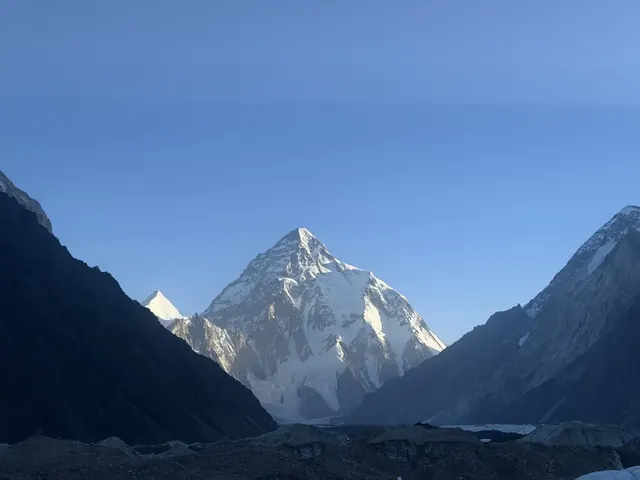
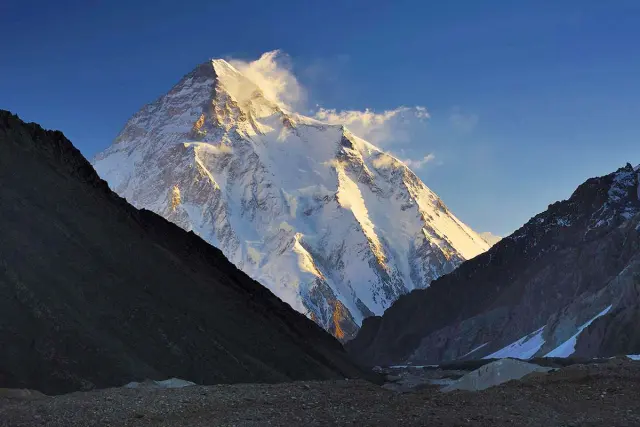
Pastore Peak stands on the west side of the Godwin-Austen Glacier, opposite Broad Peak and a few hours from K2 Base Camp. Surveys give 6,206 to 6,210 m. Because it is climbed from the K2 Base Camp trek and has no technical rock, many people call it a trekking peak; the Italian explorer Ardito Desio described it as a trekking route as early as 1956, and K2 expeditions often use it to acclimatise. But Pastore is the hardest peak on this list, and we treat it as a mountaineering expedition, not a first climb.
Why Pastore is harder than it looks
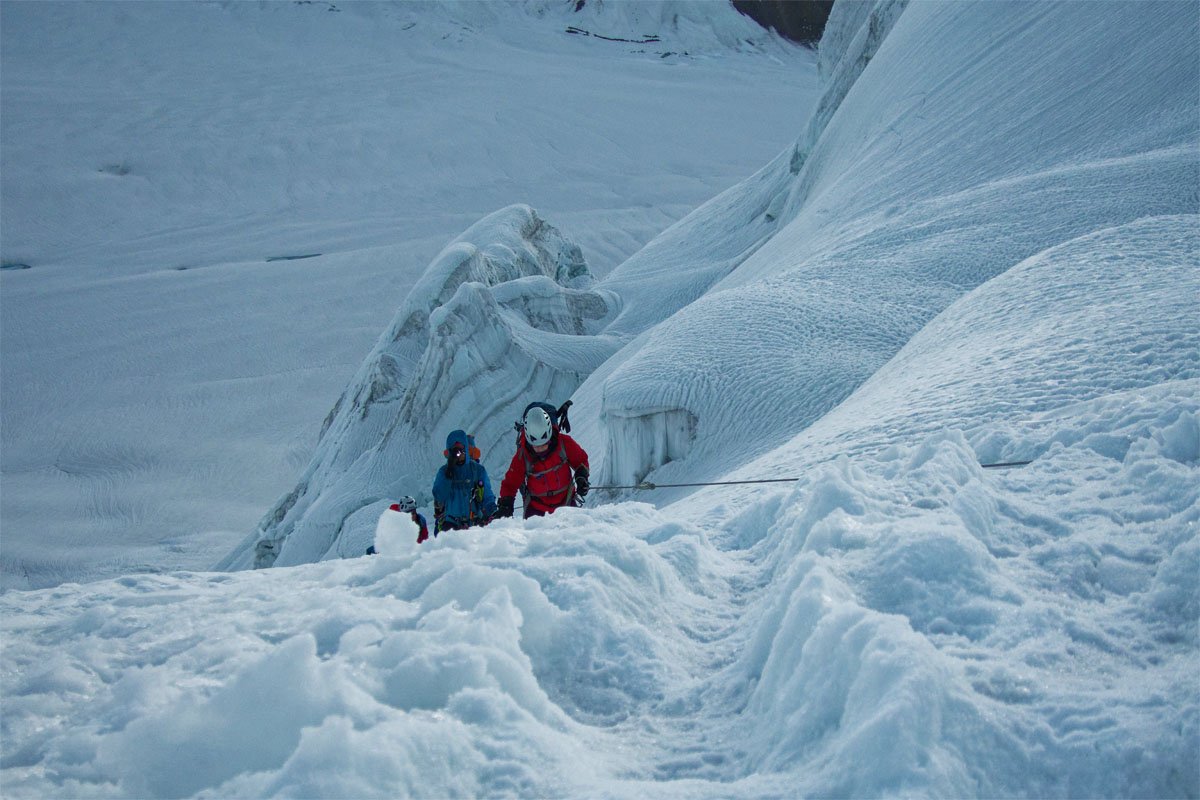
- Snow and ice the whole way. From base camp (about 4,800 m) the route climbs a crevassed glacier and snow slopes to the summit. Climbers rope up on the glacier from the start and use crampons and ice axes all day.
- Crevasses. The glacier is broken by crevasses that are often hidden under fresh snow. You must know how to travel roped and how to help with a crevasse rescue.
- A very long summit day. Without a high camp, the summit day from base camp takes 10 to 12 hours. Most teams set one high camp at about 5,200 m to shorten it, which means carrying tents and food up the glacier.
- Snow conditions decide. Deep or unstable snow can stop the climb, even in good weather. In winter it is a serious climb even for experienced mountaineers.
- Remoteness. You are about ten days' walk from the road head at Askoli. Help is far away, and the way out is over the Gondogoro La or back down the Baltoro.
- You climb as your own team. On our trip, base camp services are included, but nothing above base camp: you bring your own climbing gear, high-camp tent, ropes and mountain food, and climb without a climbing guide.
Who it is for: experienced mountaineers who have climbed above 6,000 m before and can climb as their own team on a glacier with crampons, ice axe and rope. If that is not you yet, climb Khosar Gang or Gondogoro Peak first.
Our trip: the Pastore Peak Expedition, 25 days from Islamabad: the K2 Base Camp trek, three days for the climb, and the return over the Gondogoro La. Fixed departures on 20 July and 5 August, private expeditions from June to October, from $4,000 per person for our base camp services. There is no peak royalty, as Pastore Peak is below 6,500 m.
What a summit push looks like
Every mountain is different, but the last days of a trekking-peak climb usually follow the same pattern:
- Arrival at base camp and a rest or acclimatisation day, with a check of your crampons, harness and boots.
- Skills practice near camp: walking in crampons, using the ice axe and moving on the rope with the climbing guides.
- Move to the high camp (where there is one), with an early night.
- Summit day: a start between midnight and 3 a.m., when the snow is frozen hard; the summit in the morning; and the descent before the sun softens the snow.
- Spare days in case of bad weather, so that one stormy day does not end the climb.
Our approach on the mountain
On all our climbs the weather, the snow conditions and your own condition decide the outcome. Our climbing guides set a turnaround time before summit day, and the decision to turn back is made on the mountain, by consensus between the climbers and our team. We plan spare days on every climb, carry a first-aid kit, and our guides are trained in first aid. Our aim is that you come home having climbed well, whether or not the summit was possible on the day.
Combining a trekking peak with other trips
Because all five peaks are reached from Skardu or the Karakoram Highway, they combine easily with sightseeing. After Shatong or Khosar Gang, spend a few days around Skardu: Shigar Fort, the Kachura lakes and Khaplu. After Minglik Sar, you are already in Upper Hunza, close to Passu, Attabad Lake and Karimabad. Gondogoro Peak and Pastore end in the Hushe valley, a short drive from Khaplu Palace.
How to choose your first trekking peak
| Your experience | Peak to start with |
|---|---|
| Treks to about 4,000 m, no snow skills yet | Shatong Peak |
| Treks above 4,000 m and a little crampon practice | Gondogoro Peak (with the K2 trek) or Minglik Sar |
| A basic mountaineering course, comfortable on snow | Khosar Gang, the classic first 6,000 m peak |
| Above 6,000 m before, able to climb as your own team on a glacier | Pastore Peak |
| Ready for steep ice and technical climbing | Laila Peak, then Spantik (7,027 m) |
If you have little time, Khosar Gang and Shatong are closest to Skardu. If you want the K2 Base Camp trek as well, Gondogoro Peak or the Khosar Gang combination makes the most of your acclimatisation. If you want remoteness and a strong cultural experience, choose Minglik Sar.
Skills you need
- Walking in crampons on flat and sloping snow and ice.
- Using an ice axe, including self-arrest if you slip on a snow slope.
- Roped glacier travel: tying in, keeping the rope tight, and what to do if someone falls into a crevasse.
- Fixed ropes: climbing with an ascender (jumar) and abseiling, for Khosar Gang.
- Altitude awareness: recognising the signs of altitude sickness in yourself and others.
A basic mountaineering or winter skills course before your trip is the best preparation. On the mountain our climbing guides will check your technique before summit day.
Gear checklist
| Item | Notes |
|---|---|
| Mountaineering boots | Stiff, insulated boots that take crampons; double boots for Pastore |
| Crampons and ice axe | Included on our Khosar Gang and Gondogoro Peak trips; bring your own for Pastore |
| Harness, helmet, carabiners, ascender | Included on Khosar Gang and Gondogoro Peak |
| Down jacket and warm layers | Summit nights can be well below freezing, even in July |
| Glacier glasses and sun cream | The sun on snow at 5,000–6,000 m is very strong |
| Headlamp | Summit days usually start at night |
| Sleeping bag | Rated to about −15 °C for high camps |
Fitness and acclimatisation
Fitness is the most important factor. Summit days start in the night and last 6 to 12 hours at altitude, after days of trekking with a pack. Train for at least three months: long hill walks with a loaded pack, stair climbing, and steady cardio such as running or cycling. Build up to days with 1,000 m of ascent.
Acclimatisation is built into our trips: rest days in Skardu, a slow approach, and spare days on the mountain. On the Gondogoro Peak and Pastore trips you climb after two weeks on the K2 trek, which is the best possible acclimatisation. On Khosar Gang and Shatong the approach is short, so it is worth arriving with recent altitude experience.
Best season
July to September is the main climbing season for all five peaks, with July and August usually the most reliable. Earlier in the year the snow is deep and soft, which makes Minglik Sar and Pastore much harder, and the Deosai road and the Shimshal Pass are not yet open. Khosar Gang runs until October. Winter ascents are serious mountaineering on any of these peaks.
Permits, royalty and costs
None of the five peaks in this guide has a peak royalty. You need a trekking permit, and national park fees apply in Deosai and the Central Karakoram National Park; we arrange both as part of our trips. You also need the Mountaineering & Trekking visa (trekking category, as all five peaks are below 6,500 m; see our Pakistan visa guide), which you apply for online at visa.nadra.gov.pk.
| Trip | Days | Price per person | Included |
|---|---|---|---|
| Khosar Gang Expedition | 12 | $2,100 (fixed departure) | Climbing gear, ropes, high-altitude porters |
| K2 Base Camp and Khosar Gang Expedition | 27 | $4,000 | K2 trek, climbing gear, high-altitude porters |
| Gondogoro Peak Climbing Expedition | 23 | from $4,000 (private) | K2 trek, climbing gear, high-altitude porters |
| Pastore Peak Expedition | 25 | from $4,000 | Base camp services only |
| Shatong Peak and Minglik Sar | — | on request | Trip pages coming soon |
All prices are in US dollars (USD), or the equivalent in Pakistani rupees (PKR) on the day you pay. For all our climbs between 6,000 and 7,000 m, see our 6,000 m peaks in Pakistan.
After your first trekking peak
A trekking peak is often the first step on a longer path. Many climbers go on to Laila Peak (6,096 m), a steep, technical snow and ice peak in the Hushe valley: see our Laila Peak Expedition. The next step is usually Spantik (7,027 m), the most straightforward 7,000 m peak in the Karakoram: see our Spantik Expedition. After that, some climbers aim for an 8,000 m peak; our guide to 8,000 m peaks by difficulty compares the options.
Climbing responsibly
All five peaks rise above villages and summer pastures that local people depend on. On our trips we employ local staff from Shigar, Hushe and the other valleys, and we bring all our waste back from base camp. Please do the same: carry out everything you carry in, use the toilets at camps, and ask before photographing people.
Frequently asked questions
What are the best trekking peaks in Pakistan?
From the least to the most demanding, our top five are Shatong Peak (about 5,250 m) in Deosai, Minglik Sar (about 6,050 m) in Shimshal, Gondogoro Peak (5,650 m) in the Hushe valley, Khosar Gang (6,046 m) above Shigar and Pastore Peak (6,209 m) near K2.
Which trekking peak in Pakistan is the least demanding?
Of the five, Shatong Peak in Deosai is the least demanding: a steep walk on scree to a snowy summit ridge, close to Skardu and with no glacier to cross. It is a good first summit above 5,000 m.
Do I need climbing experience for a trekking peak?
For Shatong you need good fitness and experience of trekking at altitude. For Minglik Sar, Gondogoro Peak and Khosar Gang you should be able to walk in crampons and use an ice axe; a basic mountaineering course helps. Pastore Peak is for experienced mountaineers only.
Is there a royalty for trekking peaks in Pakistan?
No. These five peaks have no peak royalty. You still need the usual trekking permit and national park fees where they apply, which we arrange as part of our trips.
What is the best time to climb trekking peaks in Pakistan?
July to September for most peaks, when the snow is firm and the passes are open. Khosar Gang runs from July to October. Earlier in the year the snow is deep and climbs are much harder.
Which trekking peak is best for a first 6,000 m summit?
Khosar Gang (6,046 m) is the most popular first 6,000 m peak in Pakistan: it is close to Skardu, has a short approach and a high success rate. Minglik Sar (about 6,050 m) is a quieter alternative in a remote valley.
Is Pastore Peak a trekking peak?
Many people call it one, because it is climbed from K2 Base Camp and has no technical rock. In practice it is a serious snow and ice climb on a crevassed glacier, with a summit day of 10 to 12 hours without a high camp. We run it for experienced mountaineers only.
How long does it take to climb Khosar Gang?
Our Khosar Gang Expedition takes 12 days from Islamabad back to Islamabad, with days 4 to 9 on the mountain, including spare days for the weather.
Is Gondogoro Peak the same as the Gondogoro La?
No. The Gondogoro La (5,585 m) is the pass between the Baltoro Glacier and the Hushe valley; Gondogoro Peak (5,650 m) is a summit above Khuspang on the Hushe side of the pass.
What gear do I need for a trekking peak?
Mountaineering boots that take crampons, crampons, an ice axe, a harness, a helmet and warm layers including a down jacket, plus glacier glasses. On our Khosar Gang and Gondogoro Peak trips the climbing gear is included; on Pastore you bring your own.
How fit do I need to be?
Very fit. Summit days start at night and last 6 to 12 hours at altitude, after days of trekking. Train for several months with long hill walks carrying a pack, and build up to 1,000 m of ascent in a day.
Can I climb a trekking peak with the K2 Base Camp trek?
Yes. Our Gondogoro Peak Climbing Expedition adds Gondogoro Peak to the K2 Base Camp and Gondogoro La trek, and our K2 Base Camp and Khosar Gang Expedition adds Khosar Gang after the trek.
What comes after a trekking peak?
Technical 6,000 m peaks such as Laila Peak (6,096 m), then Spantik (7,027 m), the usual first 7,000 m peak in the Karakoram. After that, some climbers move on to an 8,000 m peak.
How many days do I need for a trekking peak?
From Islamabad, allow about 12 days for Khosar Gang, which is close to Skardu, and about 23 to 25 days for Gondogoro Peak or Pastore Peak, which are climbed after the K2 Base Camp trek. Shatong is the shortest climb, from Skardu; Minglik Sar needs extra days for the approach through Shimshal.
Can beginners climb Khosar Gang?
Yes, if "beginner" means a fit trekker who has been to about 4,000 m and has learned basic snow skills. You do not need previous summits, but you must be able to walk in crampons and climb a short fixed rope with an ascender.
Which trekking peak has the best views?
Gondogoro Peak and Pastore Peak, because they stand in the heart of the Karakoram, close to K2, Broad Peak and the Gasherbrums. Khosar Gang looks out over the Shigar valley and the high peaks of the Karakoram, and Minglik Sar over the Pamir and the Shimshal glaciers.
Will I reach the summit?
We do not sell a summit. The weather, the snow and your own condition decide the outcome, and the decision to turn back is made on the mountain.
About the author
Imtiyaz Ahmed Shigri founded Chogori Adventure in Skardu in 2015. Our guides are local, government-licensed and English-speaking, and most of them are trained in first aid. We are licensed by the Department of Tourist Services (licence no. 2494) and the Gilgit-Baltistan tourism department (licence DTS-GB-055), and we are a member of the Pakistan Association of Tour Operators, with offices in Skardu and Islamabad.
Rated 4.9 out of 5 from 47 reviews on Google (November 2026). Read our reviews on Google