Founded 2015 Licensed: DTS no. 2494 and DTS-GB-055 Member of PATO 4.9/5 from 47 Google reviews
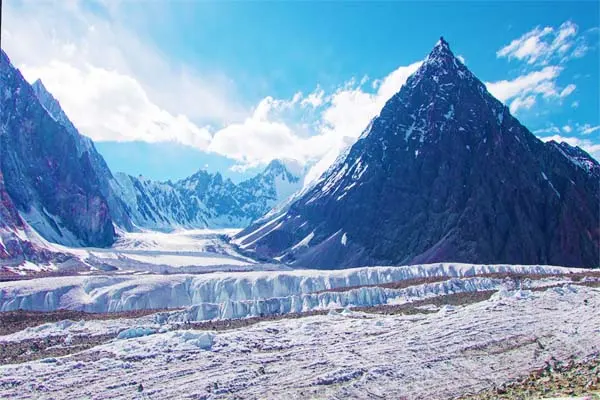
Laila Peak (6,096 m) is the spear-shaped peak above the Gondogoro Glacier in the Hushe Valley of the Karakoram, Pakistan. Our 22-day expedition takes you from Islamabad to base camp at Dalchangpa (4,200 m), from where climbers attempt the north-west face: about 1,500 m of snow and ice, up to 55° near the top. It is a technical climb, not a trekking peak. Fixed departures run in July and August, and the price is $2,400 per person for our base camp services.
We take care of everything up to and at base camp: flights to Skardu, hotels in Skardu and Islamabad, the jeep to Hushe, porters, the trek, a cook and kitchen team, tents and all meals on the trek and at base camp, and the permits. Above base camp you climb as your own team: you bring your own climbing gear, high-camp tents, ropes and mountain food. A high-altitude porter or climbing guide can be arranged on request, at extra cost.
From Dalchangpa the route crosses onto the Gondogoro Glacier to the foot of the north-west face. Most teams set one or two camps on the glacier and below the face, then make a long summit day: about 1,500 m of steady snow and ice, 45° in the lower part and up to 55° below the summit, climbed with crampons, ice axes and a rope. Teams start in the night, so that they climb while the snow is firm and are off the face before the sun softens it. The plan has 10 days (days 8 to 17) for acclimatisation, the climb and bad weather.
You should have climbed at least one 5,000 m peak and be in very good physical condition. Because you climb above base camp as your own team, you need to be at home on steep snow and ice with crampons, an ice axe and a rope. Laila Peak is not a first peak. If you want an easier peak first, see our Gondogoro Peak Climbing Expedition (5,650 m) in the same valley.
The main risks are rockfall and falling ice on parts of the face, avalanches after fresh snow, and the altitude. Early starts, patience with the weather and turning back in time reduce them. We do not sell a summit. The weather, the snow conditions and your own condition decide the outcome, and the decision to turn around is made on the mountain, by consensus within your climbing team.
Laila Peak stands on the west side of the Gondogoro Glacier, above Hushe, the last village of the Hushe Valley in Ghanche district, Gilgit-Baltistan. Its height is usually given as 6,096 m; older figures of about 6,200 m and 6,614 m are not confirmed. A British team (Andy Cave, Tom Curtis, Sean Smith and Simon Yates) made the first known ascent of the north-west face in 1987, and an Italian team made the first official ascent on 2 July 1996. The first winter ascent was made by Alex Txikon and José Fernández on 18 February 2013. Laila is also known as a ski mountain: the first complete ski descent of the north-west face was made in May 2018.
On a fixed departure the price is $2,400 per person, from Islamabad back to Islamabad, for our base camp services. Laila Peak has no peak royalty, as it is below 6,500 m. The approach from Hushe follows the Hushe Valley trek, which the visa portal's trek list marks as restricted. No liaison officer is needed for Laila Peak. For a private expedition, the price per person depends on the size of your group:
| Solo price | 2 to 4 people | 5 to 10 people |
|---|---|---|
| $4,500 | $3,000 | $2,400 |
Not climbing? Our Laila Peak Base Camp Trek walks to the same base camp, and our K2 and Gondogoro La Trek crosses the Gondogoro La from Hushe. Want to go higher? See our Khosar Gang and Spantik expeditions, or read about the Hushe Valley.
| Tour | Price (USD) |
|---|---|
| Spantik Expedition—28 Days | $6,050 |
| Khosar Gang Expedition—12 Days | $2,100 |
| Trango Tower Expedition—35 Days | $2,400 |
| K2 Climbing Expedition—50 Days | $12,000 |
| Broad Peak Climbing Expedition—50 Days | $10,000 |
We employ local staff from the Hushe Valley and bring all our waste back from base camp.
Pick a fixed departure above, or ask us for a private trip.
Fill in the booking form with your name, email and group size.
The deposit holds your place on the trip.
Once the deposit arrives, we confirm and start booking your hotels and arrangements.
By bank transfer two weeks before you arrive, or bring cash to Islamabad.
Our staff meet you at Islamabad International Airport and take you to the hotel. Please send your flight details 3 to 4 days before you arrive.
Morning flight to Skardu, with views of Nanga Parbat and the Karakoram when the weather is clear. If the flight is cancelled, we drive on the Karakoram Highway (about 20 hours, with a night on the way).
Rest in Skardu while we complete the permit formalities. An easy walk to Kharpocho Fort above the town helps you acclimatise.
A 5 to 7-hour jeep drive along the Shyok River to Hushe, the last village of the Hushe Valley, below Masherbrum.
An easy first day on foot, through the summer pastures of Hushe to the camp at Saicho.
A steeper day up the Gondogoro Valley to Dalchangpa, a grassy shelf beside the Gondogoro Glacier with Laila Peak above it. We set up base camp.
A rest day at base camp, with a short walk higher to help acclimatisation, and gear checks before the climb.
Ten days for acclimatisation, the climb and bad weather. Climbers cross the Gondogoro Glacier, set one or two camps below the north-west face, and make the summit attempt from there, starting in the night. Above base camp you climb as your own team (a high-altitude porter or climbing guide on request, at extra cost). Our cook and kitchen team stay at base camp. The decision to turn around is made on the mountain, by consensus within your climbing team.
We pack up base camp and walk back down the Gondogoro Valley to Saicho.
The walk back to Hushe, where the trek ends.
The jeep takes us back to Skardu, with time for a shower and the bazaar.
Flight to Islamabad (or the road journey if the flight is cancelled).
Our staff take you to Islamabad International Airport for your flight home.
Here is what your $2,400 per person covers, from Islamabad back to Islamabad, and what it does not.
Authentic journeys, local expertise.
Expert-led journeys crafted with wisdom and a personal touch.
What's included is listed on each trip.
Free guides from our local team, so you arrive ready.
Laila Peak is 6,096 m (20,000 ft). It stands above the Gondogoro Glacier in the Hushe Valley, Ghanche district, Gilgit-Baltistan, in the Karakoram of Pakistan. Older figures of about 6,200 m and 6,614 m are not confirmed.
There are several peaks called Laila in Pakistan. This is the Laila Peak of the Hushe Valley, above the Gondogoro Glacier, reached from the village of Hushe.
It is a technical climb: about 1,500 m of steady snow and ice on the north-west face, 45° in the lower part and up to 55° below the summit. You need crampons, an ice axe and a rope, a very early start and a long summit day. It is not a trekking peak.
The north-west face, reached from base camp at Dalchangpa (4,200 m) across the Gondogoro Glacier. Most teams set one or two camps on the glacier and below the face before the summit day.
Our base camp services, from Islamabad back to Islamabad: flights to Skardu, hotels in Skardu and Islamabad, all meals in Skardu, on the trek and at base camp, jeeps, porters, the cook and kitchen team, tents and the permits. Nothing above base camp is included.
Everything on the mountain: your climbing gear, high-camp tents, ropes, gas and stoves, and mountain food. A high-altitude porter or climbing guide can be arranged on request, at extra cost. Oxygen is not used.
At least one 5,000 m peak and very good fitness. You climb above base camp as your own team, so you need to be at home on steep snow and ice with crampons, an ice axe and a rope.
22 days from Islamabad back to Islamabad, with 10 days (days 8 to 17) for acclimatisation, the climb and bad weather.
July and August. Our fixed departures run from 15 July to 5 August and from 5 to 26 August, and both are confirmed.
Laila Peak has no peak royalty, as it is below 6,500 m. The approach from Hushe follows the Hushe Valley trek, which the visa portal's trek list marks as restricted. No liaison officer is needed for Laila Peak. We arrange the permits and fees that apply. You apply for the Mountaineering & Trekking visa (trekking category, as the peak is below 6,500 m; see our Pakistan visa guide) online at visa.nadra.gov.pk, with our letter of invitation, free for our guests (the visa portal calls it a sponsor letter).
Our porters carry up to 25 kg of personal luggage per climber to base camp.
No. Meals in Islamabad are not included. All meals in Skardu, on the trek and at base camp are included.
No. Oxygen is not used on Laila Peak, and it is not part of our services.
Rockfall and falling ice on parts of the face, avalanches after fresh snow, and the altitude. Early starts, patience with the weather and turning back in time reduce them. Your insurance must cover mountaineering to 6,096 m and helicopter rescue.
A British team made the first known ascent of the north-west face in 1987, and an Italian team made the first official ascent on 2 July 1996. The first winter ascent was on 18 February 2013, and the first complete ski descent of the north-west face in May 2018.
No. We do not sell a summit. The weather, the snow conditions and your own condition decide the outcome, and the decision to turn around is made on the mountain, by consensus within your climbing team.
Yes. Gondogoro Peak (5,650 m) is a shorter climb above the same glacier. See our Gondogoro Peak Climbing Expedition.
If you, or your whole group, decide to return early from the expedition, for any reason, the extra costs this causes are not included in the price and are not covered by us: for example extra hotel nights, extra jeeps or other transport, changed flights, or a guide or porter to take you back. This applies to groups and to individual travellers. Our services are provided as listed in the trip plan for this expedition.
We would like to use cookies for visitor statistics (Google Analytics) and for the video on our home page. They load only if you accept.
You can change your choice at any time under “Cookie settings” at the bottom of every page.